Bee Balm Seeds vs Zinnia Seeds: Which One Should You Buy?
Bee balm seeds vs zinnia seeds, compared on four seed packets: bloom color and height, growing zones and sun, germination and seed count, and who each side suits.

On this page
Top picks at a glance
As an Amazon Associate I earn from qualifying purchases.
- 1
 Polar Bear Zinnia9.5/10View on Amazon
- 2
 Panorama Bee Balm9.5/10View on Amazon
- 3
 Wild Bee Balm9.4/10View on Amazon
- 4
 Peppermint Stick Zinnia9.3/10View on Amazon
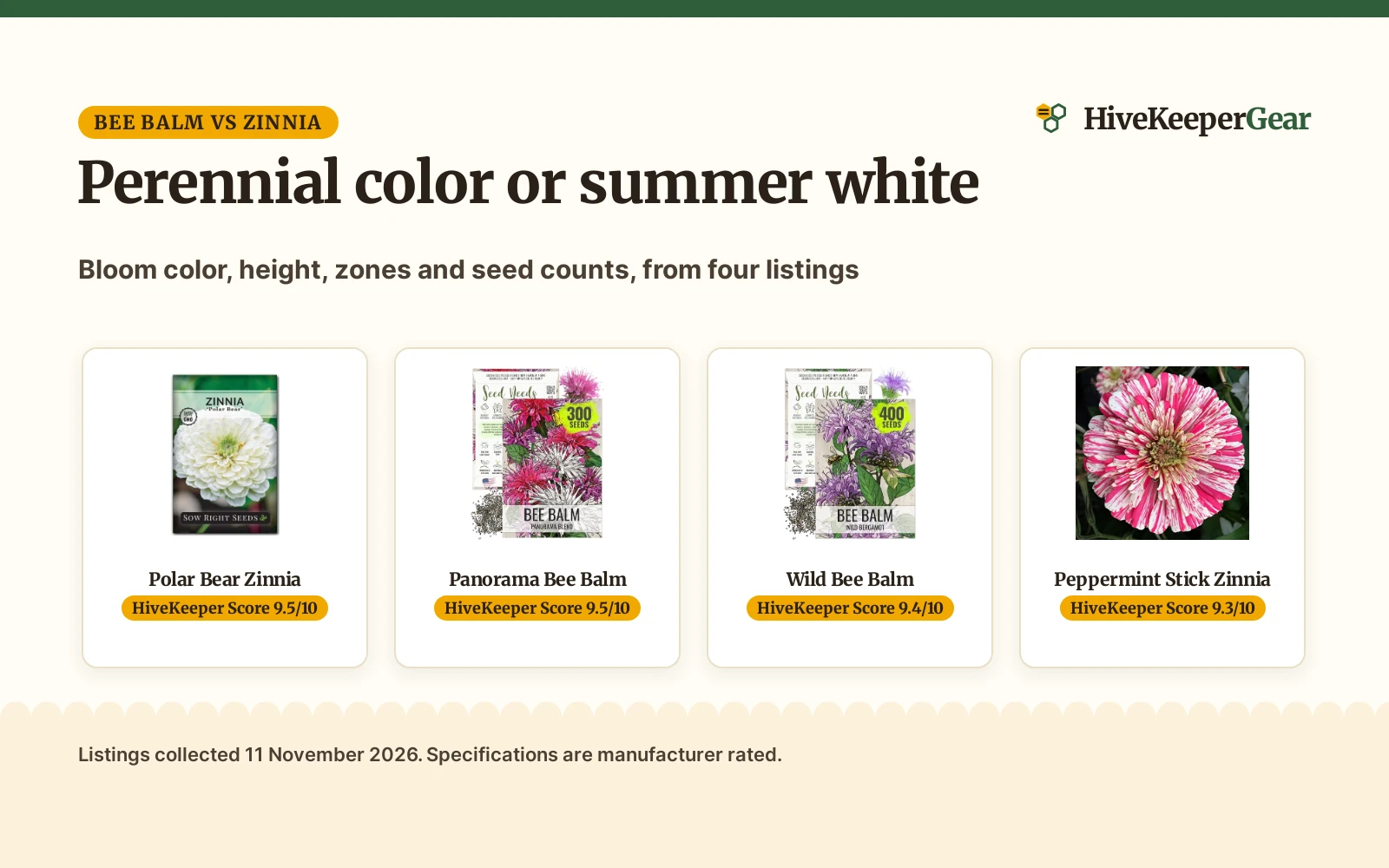
Bee balm seeds vs zinnia seeds is a choice between a perennial that comes back each season and a flower for bold color in borders and arrangements. Bee balm brings tall flowers for hummingbirds, butterflies and bees, while zinnia brings white and red and white blooms, with the Polar Bear packet blooming all summer long. This comparison uses seed packets from both sides.
HiveKeeperGear earns a commission when you buy through links on this page, at no extra cost to you. As an Amazon Associate I earn from qualifying purchases. Affiliate disclosure.
Quick verdict: choose bee balm if you want a perennial that returns each season, draws hummingbirds as well as bees and butterflies, and grows tall in sun or part shade. Choose zinnia if you want bold summer blooms and the clearest sowing instructions here, from the Polar Bear packet. Both sides draw bees and butterflies; the difference is perennial habit against bloom color and sowing detail.
Four examples
| # | Product | HiveKeeper Score | Buy |
|---|---|---|---|
| 1 | Polar Bear Zinnia | 9.5/10 | Buy on Amazon |
| 2 | Panorama Bee Balm | 9.5/10 | Buy on Amazon |
| 3 | Wild Bee Balm | 9.4/10 | Buy on Amazon |
| 4 | Peppermint Stick Zinnia | 9.3/10 | Buy on Amazon |
Polar Bear Zinnia
A white double zinnia with a minimum of 1 g per packet, about 150 seeds, and full sowing detail from germination to maturity.
Pros
- Full sowing detail: 7 to 10 days, 1/4 in deep, 18 in apart
- 4 in blooms on 3 to 4 ft plants, mature in 70 to 80 days
- Blooms all summer long in USDA zones 2 to 11
- Non-GMO heirloom seed under the Safe Seed Pledge
Cons
- No packet dimensions stated
- No warranty term is stated
- No safety feature is stated
- White flowers only
Panorama Bee Balm
A perennial bee balm mix in pink, white and scarlet, growing up to 30 in tall in USDA zones 3 to 9.
Pros
- Pink, white and scarlet blooms with a minty fragrance
- Perennial in USDA zones 3 to 9; started indoors or sown outdoors
- Mildew resistant, in well-drained, moist soil
- Draws hummingbirds, butterflies and bees; serves as a cut flower
Cons
- No seed count stated
- No germination time stated
- No warranty term is stated
- No safety feature is stated
Wild Bee Balm
A native North American perennial bee balm with lavender to pink tubular flowers, growing 2 to 4 ft tall.
Pros
- Lavender to pink tubular flowers, blooming mid-summer to early fall
- Drought-tolerant in full sun to partial shade and well-drained soil
- Native North American perennial in the mint family
- Draws bees, butterflies and hummingbirds
Cons
- No seed count stated
- No germination time stated
- No warranty term is stated
Peppermint Stick Zinnia
A red and white peppermint stick zinnia with 200 seeds and 2+ grams per packet, in a listing that states almost nothing else.
Pros
- 200 seeds and 2+ grams per packet, the largest stated count here
- Non-GMO heirloom seed, USA harvested
- Red and white flowers for bees and butterflies
- Packet size and weight stated: 3.5 x 2.25 x 0.1 in, 0.01 pounds
Cons
- Listing is nearly empty: one short bullet line, no growing detail
- No germination time stated
- No height, zones or sun stated
- No warranty term is stated
As an Amazon Associate I earn from qualifying purchases.
Other hives and gear to compare
 Seed Needs Spotted Bee Balm Seeds to Plant HorsemintCheck price on Amazon
 LOSEEDSOO Wild Bergamot Seeds for PlantingCheck price on Amazon
 Outsidepride Scarlet Bee Balm SeedsCheck price on Amazon
 CarpetC 500+ Bee Balm Seeds for PlantingCheck price on Amazon
 700 Spotted Bee Balm Heirloom Flower Seeds for PlantingCheck price on Amazon
 Sow Right SeedsCheck price on Amazon
Bee balm seeds vs zinnia seeds: side by side
| Spec | Polar Bear Zinnia | Panorama Bee Balm | Wild Bee Balm | Peppermint Stick Zinnia |
|---|---|---|---|---|
| Bloom color | White | Pink, white and scarlet | Lavender to pink | Red and white |
| Plant height | 3 to 4 ft | Up to 30 in | 2 to 4 ft | Not stated |
| Bloom time | All summer long | Long-lasting blooms | Mid-summer to early fall | Not stated |
| USDA zones | 2 to 11 | 3 to 9 | Not stated | Not stated |
| Sun | Full sunlight | Full sun to part shade | Full sun to partial shade | Not stated |
| Germination | 7 to 10 days | Not stated | Not stated | Not stated |
| Seed count | About 150 seeds | Not stated | Not stated | 200 seeds |
| Pollinators | Butterflies and bees | Hummingbirds, butterflies and bees | Bees, butterflies and hummingbirds | Bees and butterflies |
Sizes, materials and capacities are the manufacturer’s ratings as each listing states them, collected 11 November 2026.
Bloom color and height
Color is where the sides part ways: pink, white and scarlet on the Panorama bee balm, lavender to pink on the Wild bee balm, snowy white on the Polar Bear zinnia, and red and white on the Peppermint Stick zinnia. Height runs tall where it is stated: the Wild bee balm grows 2 to 4 ft, the Polar Bear zinnia grows 3 to 4 ft with 4 in blooms, and the Panorama bee balm grows up to 30 in. The Peppermint Stick listing states no height.
Growing conditions
Zones and sun are patchy: USDA zones 2 to 11 for the Polar Bear zinnia and zones 3 to 9 for the Panorama bee balm, with no zones stated on the other two packets. Sun is full sunlight for the Polar Bear zinnia, full sun to part shade for the Panorama bee balm, and full sun to partial shade for the Wild bee balm. Soil is stated on the bee balm side only: well-drained, moist soil for the Panorama mix, and well-drained soil with drought tolerance for the Wild bee balm.
Sowing and seed counts
Only the Polar Bear packet gives sowing numbers: germination in 7 to 10 days at 70 to 75 degrees Fahrenheit, planting 1/4 in deep with 18 in spacing, and maturity in 70 to 80 days. The Panorama bee balm can be started indoors or sown directly outdoors, but no bee balm listing states a germination time, depth or spacing. Seed counts are stated for zinnia only: about 150 seeds for the Polar Bear packet, and 200 seeds at 2+ grams for the Peppermint Stick packet. Neither bee balm listing states a seed count.
Pollinators and bloom time
Both sides draw bees and butterflies, and the bee balm listings add hummingbirds. Bloom time is stated on three packets: the Polar Bear zinnia blooms all summer long, the Wild bee balm blooms from mid-summer to early fall, and the Panorama bee balm offers long-lasting blooms. The Peppermint Stick listing states no bloom time.
Listing gaps to check
The Peppermint Stick listing is the thinnest here: one short bullet line, no germination time, height, zones, sun, soil or bloom time, and little beyond the seed count and packet size to go on. The Wild bee balm listing disagrees on packet size: the bullets say 3.5 by 5 in, the spec table says 5.5 x 8.0 x 0.5 in. Neither bee balm listing states a seed count, and no listing states a warranty term or a safety feature.
Which should you choose?
Choose bee balm seeds if you want a perennial bed that returns each season, flowers for hummingbirds, bees and butterflies, and height for the back of a border. The best bee balm seeds for gardens roundup compares more packets.
Choose zinnia seeds if you want bold blooms in white or red and white for arrangements, and the clearest sowing numbers here, from the Polar Bear packet. The best zinnia seeds for pollinators roundup compares more packets.
Whichever you choose, sow as the packet directs. For a mix, read the best pollinator seed mix for beekeepers.
In the Bee Yard
- Each Seed Needs packet shows an illustration on the front and sowing information on the reverse.
- Save extra seed for the following season if properly stored.
- The Sow Right packet carries instructions, and the maker says it will make it right if the seeds do not germinate.
- The Polar Bear packet states a minimum of 1 g, about 150 seeds.
Inside the HiveKeeper Score
| Product | HiveKeeper Score | Perf. /35 | Build /25 | Value /25 | Safety /10 | Warranty /5 |
|---|---|---|---|---|---|---|
| Polar Bear Zinnia | 9.5 | 32 | 21 | 21 | 0 | 0 |
| Panorama Bee Balm | 9.5 | 30 | 21 | 21 | 0 | 0 |
| Wild Bee Balm | 9.4 | 29 | 20 | 20 | 0 | 0 |
| Peppermint Stick Zinnia | 9.3 | 23 | 18 | 18 | 0 | 0 |
HiveKeeper Scores sit between 9.2 and 9.8, and a hive item’s weighted total lands on that range in proportion, so a higher total always gives a higher score.
The HiveKeeper Score weighs performance, build, value, safety and warranty, as explained on the How We Pick page. The Polar Bear packet scores highest for the fullest sowing detail, and the Peppermint Stick packet scores lowest for stating almost nothing beyond the seed count. Neither side earns safety or warranty points.
FAQs for beekeepers
Do bee balm seeds or zinnia seeds draw more pollinators?
Both sides draw bees and butterflies, and the bee balm listings also name hummingbirds. No count of visits is stated, so neither side can be called better on pollinators from this data.
Which side is perennial?
Bee balm: both bee balm listings call the plant a perennial. Neither zinnia listing states perennial or annual.
How long do zinnia seeds take to germinate?
The Polar Bear listing states 7 to 10 days at 70 to 75 degrees Fahrenheit. No other listing states a germination time.
How many seeds come in a packet?
The Polar Bear packet states a minimum of 1 g, about 150 seeds, and the Peppermint Stick packet states 200 seeds and 2+ grams. Neither bee balm listing states a seed count.
Can I sow bee balm or zinnia seeds directly outdoors?
The Panorama bee balm listing says it can be started indoors or sown directly outdoors, and the Polar Bear zinnia listing gives sowing depth and spacing for outdoor planting. The other two state no sowing method.
More hive guides
Related: best zinnia seeds for pollinators, best bee balm seeds for gardens, bee balm seeds vs coneflower seeds, zinnia seeds vs pollinator seed mix, and best pollinator seed mix for apiaries.
More picks: lemon balm seeds for pollinators, chicory seeds for pollinators, borage seeds vs bee balm seeds. Beginners start here: beekeeping supplies for beginners.