Bee Vacuum vs Swarm Catching Box: Which One Should You Buy?
Learn when to choose a bee vacuum or a swarm catching box for collecting honey bees, comparing gentle capture, equipment setup, and hive transfer.

On this page
Top picks at a glance
As an Amazon Associate I earn from qualifying purchases.
- 1
 VIVO Large Beekeeping Jacket with Zip-Off Veil Hood9.6/10View on Amazon
- 2
 Benefitbee 6-Frame Langstroth Beehive Queen Mating Nuc BoxView on Amazon
- 3
 Neorexon Swarm TrapView on Amazon
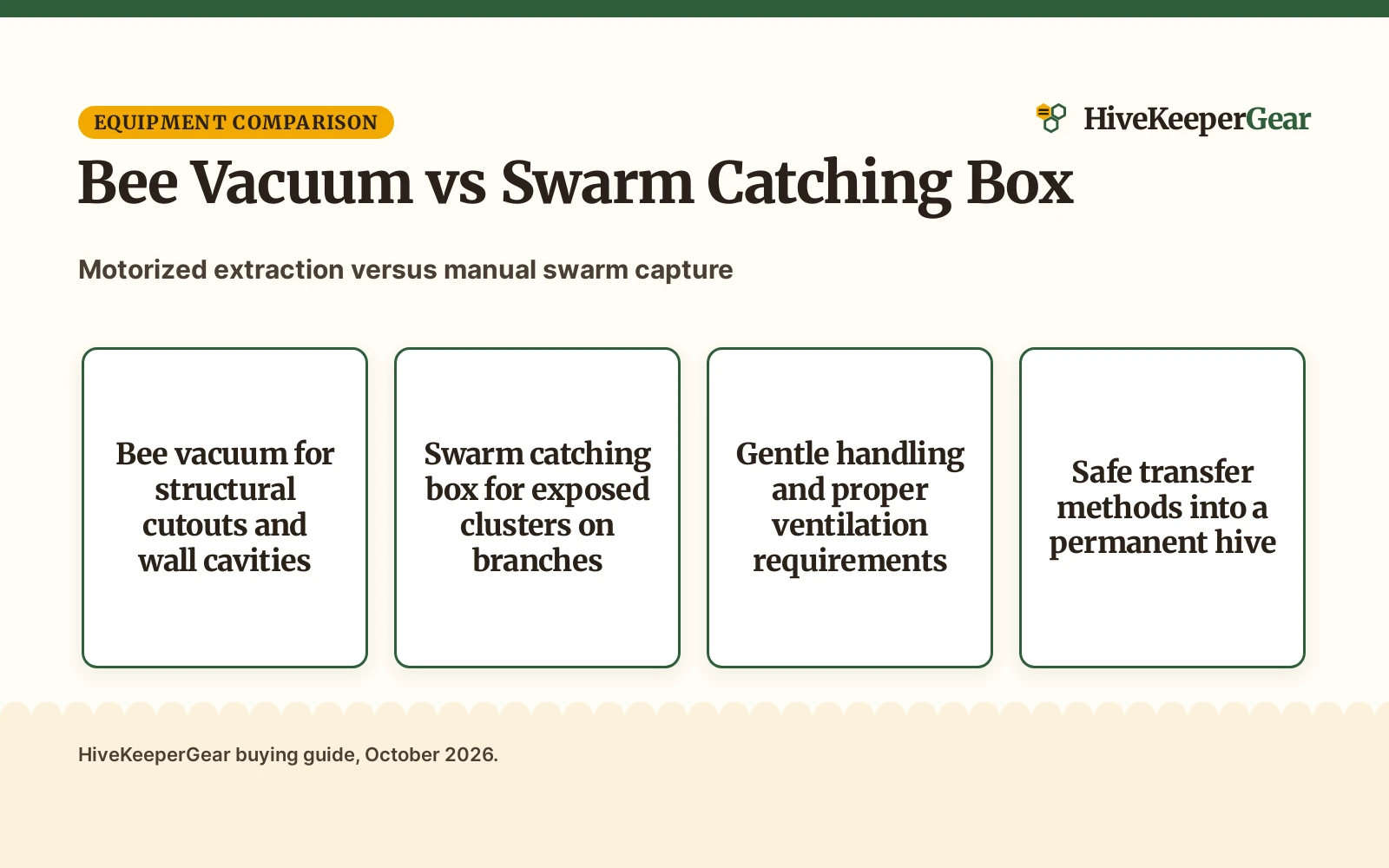
Spring buildup brings rapid expansion to apiary colonies, and on warm afternoons following a nectar flow, beekeepers often find scout bees swirling around low branches as a fresh swarm clusters in the yard. Choosing between a bee vacuum vs swarm catching box depends on where the bees gather and how accessible the cluster remains. For open clusters hanging from tree limbs, fence rails, or garden posts, a swarm catching box provides a gentle, quiet, and direct collection method that requires no power cables or suction hoses. For structural cutouts where bees settle behind exterior siding, inside soffits, or within wall cavities, a bee vacuum becomes essential because suction draws bees out of tight voids where brushes and collection boxes cannot reach.
Other hives and gear to compare
 Benefitbee 6-Frame Langstroth Beehive Queen Mating Nuc BoxCheck price on Amazon
 Neorexon Swarm TrapCheck price on Amazon
HiveKeeperGear earns a commission when you buy through links on this site, at no extra cost to you. As an Amazon Associate I earn from qualifying purchases. Affiliate disclosure.
Before you choose: understand swarm behavior and capture
Swarming represents the natural reproduction of a honey bee colony. When a strong colony outgrows its hive space during late spring, the resident queen departs with worker bees to establish a new home. Before locating a permanent cavity, the cluster settles temporarily on an exposed branch, porch railing, or fence line. Bees in a swarm cluster gorge on honey stores before departing, making them remarkably gentle and focused on protecting their queen while scout bees seek suitable nest sites.
Capturing swarms allows beekeepers to expand their apiary without purchasing packaged bees. The physical location of the cluster determines the proper tool. When bees rest in the open, capturing them involves guiding the cluster into an enclosed container using gravity or a soft bee brush. When bees enter an established building or crawlspace, removal turns into a structural cutout requiring specialized extraction tools. Understanding these scenarios helps beekeepers select the appropriate equipment before heading into the field.
Bee vacuum vs swarm catching box: comparison summary
Comparing these capture tools highlights differences in airflow, manual handling, equipment bulk, and hive transfer. While both tools aim to collect bees safely, each serves a distinct operational purpose during swarm season.
| Feature | Bee Vacuum | Swarm Catching Box | When to Choose |
|---|---|---|---|
| Primary application | Structural cutouts, wall voids, and confined spaces | Exposed swarm clusters on accessible branches and posts | Cutouts versus open clusters |
| Capture mechanism | Regulated airflow suction into a collection chamber | Gravity shake or gentle sweeping into ventilated container | Motorized suction versus manual collection |
| Power requirement | Electrical wall power, inverter, or battery pack | Fully manual operation requiring no electrical source | Powered sites versus remote field locations |
| Equipment components | Vacuum motor, flexible hose, collection box, and mesh insert | Ventilated box, secure lid, and bee brush | Mechanical assembly versus simple container |
| Hive installation | Transferring catch chamber or pouring through funnel | Placing frames directly into hive body or shaking cluster | Chamber release versus direct frame placement |
Motorized extraction: how a bee vacuum works
A bee vacuum uses regulated air displacement to draw honey bees through a flexible hose into an aerated collection chamber. Unlike standard household utility vacuums, which generate harsh suction and violent turbulence that injure flying insects, a specialized bee vacuum incorporates airflow regulators and bypass dampers. These dampers reduce airspeed within the hose so bees glide gently into the collection box without striking hard interior surfaces.
Inside the vacuum container, a padded baffle or suspended mesh catch box cushions the incoming bees. Screened ventilation walls allow air to exhaust freely while containing the bees safely. Many commercial models allow the inner collection box to be detached directly from the vacuum motor housing. This design enables the beekeeper to transport the captured colony directly to the bee yard without handling bees loose. For apiaries operating away from electrical outlets, beekeepers choose between corded and portable options, as detailed in our guide on cordless vs corded bee vacuums.
Manual capture: how a swarm catching box works
A swarm catching box is a lightweight, enclosed container designed to transport a cluster of honey bees from a field location to an apiary. These boxes are constructed from corrugated plastic, breathable wood, or heavy cardboard, featuring screened ventilation panels that maintain airflow during transport. Some catching boxes accommodate standard wooden frames from a Langstroth beehive kit, allowing beekeepers to furnish the interior with drawn comb from beehive frames to attract and anchor the swarm immediately.
Operation relies on simple physical collection. When a cluster hangs beneath an accessible tree branch, the beekeeper positions the open catching box directly underneath the mass. With a sharp, sudden shake of the branch, the cluster drops cleanly into the box. Alternatively, if the cluster spreads across a fence post, tree trunk, or brick surface, the beekeeper uses a soft bee brush to sweep bees gently downward through the box opening. Once the queen enters the box, worker bees release orientation pheromones and march inside.
When to choose a swarm catching box
A swarm catching box represents the practical choice for most hobbyists and backyard beekeepers. When swarm calls involve clusters resting on low apple trees, garden hedges, deck railings, or fence lines, manual collection proves faster, quieter, and far less disruptive than motorized extraction.
Consider a swarm catching box if you meet these situations:
- You collect swarms in apiaries, orchards, suburban yards, and public parks where bees hang in open clusters.
- You want lightweight gear carried through open fields, woods, or up ladders without managing heavy cords or machinery.
- You prefer equipment that holds standard hive frames, enabling bees to walk directly onto familiar wax foundation during transport.
- You operate on remote properties where electrical outlets are unavailable and portable generators or heavy batteries are impractical.
Beekeepers managing small yards often find that a simple nucleus box satisfies seasonal capture requirements. Learn more about nucleus box sizing and ventilation in our guide on what a nuc box is.
When to choose a bee vacuum
A bee vacuum becomes indispensable when collection work transitions from open clusters to structural cutouts. Honey bees frequently choose hollow building walls, garage ceilings, attic vents, and chimney gaps for their permanent homes. Once bees enter these enclosed voids, shaking a branch or brushing comb is impossible without destroying building materials or losing bees into dark recesses.
Select a bee vacuum under these circumstances:
- You perform structural removals from residential houses, barns, sheds, and commercial outbuildings.
- Bees are located behind siding, drywall, or tight floor joists where access openings remain narrow.
- You need to clear scattered bees off interior framing after comb removal to leave the building cavity clean.
- You work on removal jobs where rapid, thorough clearing of flying and crawling bees is required.
For operators frequently called to extract established colonies from buildings, a purpose-built bee vacuum saves extensive labor while keeping bee mortality low through gentle, regulated suction.
Transferring captured bees into your hive equipment
Capturing a swarm represents only the initial phase; the colony must be successfully established in permanent hive equipment. The transfer procedure varies based on the capture tool used.
When using a swarm catching box containing frames, the transfer remains effortless. After bringing the box to your apiary, remove the hive lid from an assembled wooden hive body. Lift each frame from the catching box, inspect the cluster to confirm comb attachment, and place the frames directly into the center of the brood chamber. Fill remaining spaces with spare wooden frames, install the inner cover, and fit an entrance reducer to help the colony defend its new home.
When utilizing a bee vacuum, the captured bees reside inside a mesh collection cage or vacuum chamber. Place the hive body on its bottom board with several frames set aside to create an open space in the center. Position the vacuum collection box above the open hive. Release the sliding bottom gate, allowing bees to slide downward onto the bottom board. Once the mass settles, slowly slide the remaining frames back into position, taking care not to crush bees along the frame rests. Position the cover securely and leave the hive undisturbed so the bees can orient to their location.
Protective clothing remains essential throughout the transfer process. Always wear a well-fitted suit from our reviewed beekeeping suits, reliable hand protection from our beekeeping gloves guide, and keep a cool-smoking tool handy from our bee smokers collection.
FAQs for beekeepers
Can a bee vacuum hurt the queen or worker bees?
A bee vacuum designed for beekeeping uses gentle, regulated airflow and cushioned interior baffles to protect bees from injury. Harm occurs only when operators use unregulated workshop vacuums or fail to adjust the bypass damper properly during capture.
Do I need electrical power in the field to run a bee vacuum?
Corded vacuums require an electrical wall outlet, an extension cord, or a portable generator. Cordless models operate on rechargeable battery packs, making them usable in remote apiaries and suburban yards where power cables cannot reach.
Can a swarm catching box hold standard hive frames?
Many wooden and plastic swarm catching boxes are sized to accommodate standard Langstroth frames. Using frames with drawn wax comb encourages the swarm to cluster calmly and simplifies transferring the colony into a permanent hive body.
Which tool is better for a beginner beekeeper?
A swarm catching box is better for beginners because it is lightweight, affordable, requires no assembly or power source, and excels at collecting open clusters from accessible branches.
How soon should captured bees be moved into a permanent hive?
Captured bees should be transferred into their permanent hive as soon as practical, preferably during the same day or early the following morning. Keeping bees enclosed in capture containers too long causes overheating and stress.
More hive guides
Browse every guide by category: beehives, protective gear, hive tools and honey harvesting.
More picks: compare cordless vs corded bee vacuums, read our swarm trap setup guide, learn what a nuc box is, or choose the best bee brush.