Electric Wire Embedder vs Transformer Embedder: Which One Should You Buy?
Compare electric wire embedders and transformer embedders to choose the right heating tool for embedding support wire smoothly into beeswax foundation frames.

On this page
Top picks at a glance
As an Amazon Associate I earn from qualifying purchases.
- 1
 Electric Wax Wire Embedder, Adjustable 3-24VView on Amazon
- 2
 TOPINCN Electric Beehive Frame Wire EmbedderView on Amazon
- 3
 Manual Wire Embedder and Frame Tensioner KitView on Amazon
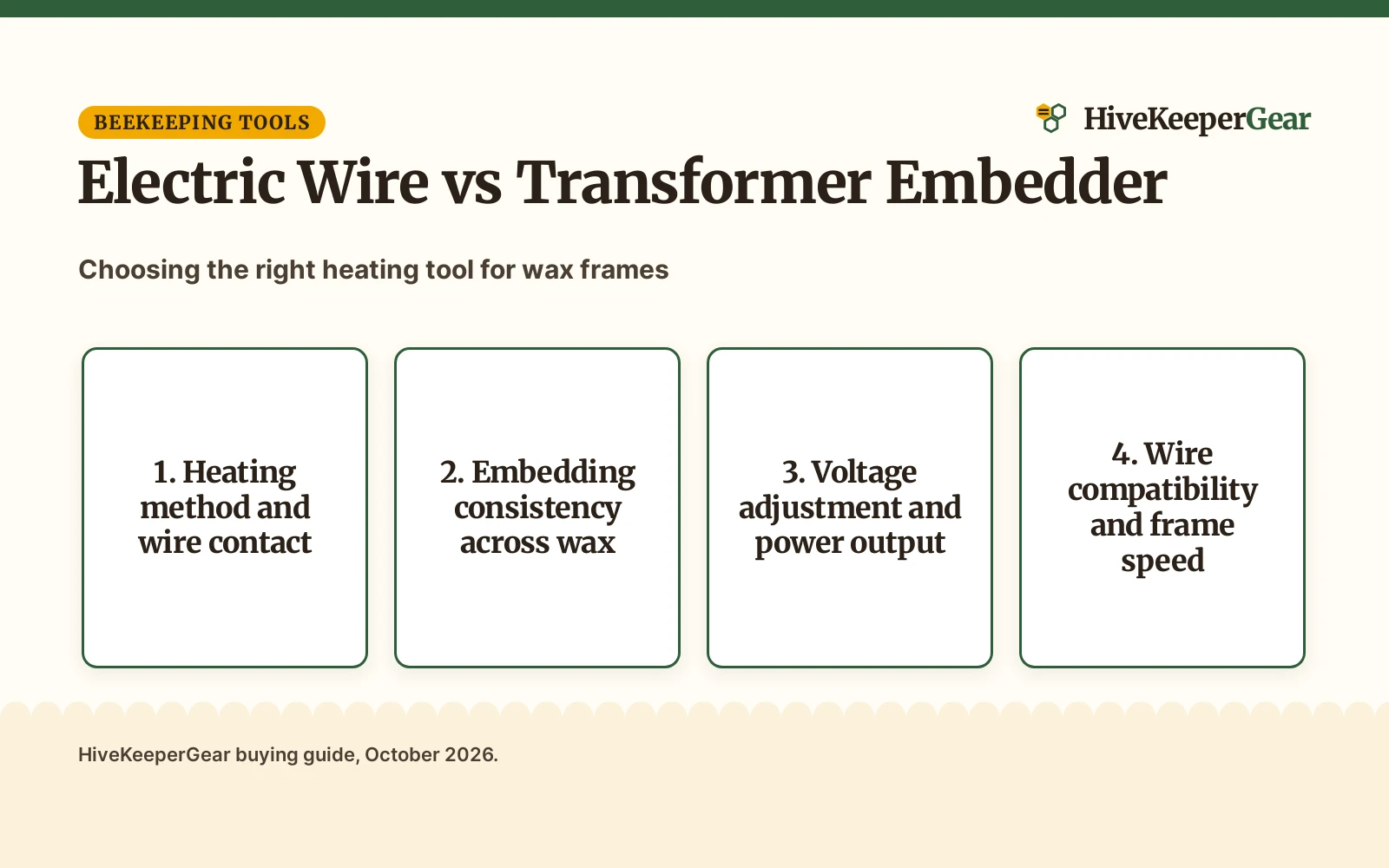
During late winter workshop prep ahead of spring buildup, assembling wooden frames with fresh beeswax foundation is a central apiary task. When comparing an electric wire embedder vs transformer embedder, the right choice depends on frame volume and desired consistency: a transformer embedder is the better choice for most beekeepers because it sends low-voltage electric current through the entire support wire to embed wax foundation evenly in a continuous pass, whereas a handheld electric wire embedder uses a localized heating element to trace or press wire sections manually. The transformer design delivers superior embedding consistency across the entire sheet when pulsed briefly, whereas a handheld electric wire embedder heats wire sections locally, requiring careful manual tracing to avoid uneven depth or localized melt-through.
Other hives and gear to compare
 Electric Wax Wire Embedder, Adjustable 3-24VCheck price on Amazon
 TOPINCN Electric Beehive Frame Wire EmbedderCheck price on Amazon
 Manual Wire Embedder and Frame Tensioner KitCheck price on Amazon
HiveKeeperGear earns a commission when you buy through links on this site, at no extra cost to you. As an Amazon Associate I earn from qualifying purchases. Affiliate disclosure.
Before you buy: check frame wiring requirements
Before selecting an embedder, confirm what style of foundation your apiary uses. Wire embedders are designed solely for wooden frames fitted with tensioned horizontal wire and sheets of pure beeswax foundation, as compared in our guide to plastic vs wax foundation. If you run plastic foundation or pre-assembled plastic frames, support wire is not needed and neither tool applies. For beekeepers working with wooden frames, tensioning stainless steel or galvanized wire properly across the end bars is necessary before applying any heat source.
Electric wire embedder vs transformer embedder: key differences
| Feature | Electric Wire Embedder | Transformer Embedder | Key Difference |
|---|---|---|---|
| Heating method | Localized heating tip or pin | Electrical resistance through wire | Direct contact vs full wire heating |
| Power delivery | Internal heating element cord | Step-down power supply with leads | Wand tool vs benchtop transformer |
| Attachment style | Manual handheld press or wand | Insulated crocodile clips | Manual tracing vs stationary clips |
| Embedding speed | Gradual, section by section | Instantaneous full-strand pulse | Slow tracing vs rapid pulse speed |
| Depth consistency | Varies with hand pressure | Uniform depth across entire frame | Risk of wavy depth vs uniform seat |
| Wax burn-through risk | High if wand pauses on wire | High if electric pulse lasts too long | Localized melt vs full-wire slicing |
1. Heating mechanism and contact method
The primary difference between these tools lies in how thermal energy reaches the frame wire. A handheld electric wire embedder functions like a specialized soldering tool or heated iron. An internal heating element warms a metallic tip, pin, or grooved wheel. The Aitoserlea listing states a pin type electric heating wire embedder featuring a temperature range of 0-180°C, while the Generic BT15 embedder listing notes a 10-second heat-up for its ceramic heating element. To embed foundation, the beekeeper manually presses the heated head against the wire, melting the beeswax directly underneath the contact point.
A transformer embedder uses electrical resistance rather than a heated wand. The unit plugs into mains electricity, accepting input voltages of AC 100-240V as listed for the Aramox and Aitoserlea models, and converts power into low-voltage electrical current. Using insulated crocodile clips, as described on the 2022 Good light and LXCLCYM listings, the operator attaches leads to opposite ends of the tensioned frame wire. When current flows through the circuit, the electrical resistance of the wire itself generates heat along the entire strand simultaneously. The wire sinks uniformly into the beeswax foundation across the full width of the frame without manual sliding.
2. Embedding consistency across wax foundation
Achieving a uniform embedding depth is critical for comb building. Plain beeswax sheets, as evaluated in our comparison of wired vs unwired wax foundation, require the support wire to sit centered within the wax thickness. If wire sits exposed on the surface, bees may chew around it or construct irregular comb. If wire presses completely through the foundation sheet, the wax drops out of the frame under the weight of honey.
Handheld electric embedders depend entirely on operator technique and manual pressure. Guiding a heated point along horizontal wires often produces uneven depth, particularly if hand speed varies across the span. In contrast, a transformer embedder delivers identical heat along every millimeter of wire at the same moment. Backed by a wooden support board, the entire wax sheet bonds smoothly around the wire in a controlled pulse, providing superior embedding consistency.
3. Voltage adjustment and power control
Precise electrical control prevents ruined foundation. Pure beeswax softens readily, meaning excessive temperature will melt wide gaps through the sheet. The Generic BT15 listing highlights adjustable voltage spanning 3-24V, dividing settings into low voltage (3-12V), medium (12-18V), and high (18-24V) ranges for different wax types to prevent overheating and frame warping, as the listing describes. Starting on low voltage allows the operator to find the right thermal threshold without burning the foundation.
Power configurations differ across available listings. One TOPINCN embedder listing specifies a fixed 12V 60W power rating, whereas the Aramox listing features 100-240V compatibility with a 12V 5A rating and an integrated voltage display. The Aitoserlea listing indicates a working voltage of DC 3-24V with 2.5A current and 60W power. For long-term reliability, the Generic BT15 embedder listing incorporates overheat protection alongside a ceramic heating element rated for 5,000+ uses.
4. Wire compatibility and frame materials
Because transformer embedders rely on an electrical circuit, wire composition matters. The 2022 Good light and LXCLCYM listings state compatibility with stainless steel wire and galvanized wire. Both metals offer suitable electrical resistance to heat quickly under low voltage. Wooden frame construction is equally critical: traditional pine and hardwood frames, explored in our review of wooden hive frames and detailed across types of bee hive frames, act as natural electrical insulators. The wooden end bars ensure the current stays concentrated within the tensioned wire rather than grounding into bench fixtures.
Handheld electric embedders apply external heat directly and do not require current to pass through the wire itself. However, they remain limited to wooden frames holding real wax foundation. Frames salvaged and scraped clean during winter maintenance, as outlined in our guide on cleaning bee frames for reuse, can be re-tensioned and embedded using either tool style.
5. Assembly speed and frame volume
Workshop efficiency separates both tool styles. Tracing individual wire lines with a handheld wand takes considerable time per frame. For a backyard beekeeper assembling occasional replacement frames for beehive frames, manual tracing is manageable. However, when assembling boxes of frames ahead of the spring honey flow, a transformer embedder reduces embedding time to a momentary contact per frame.
Tool dimensions and bench weight reflect this operational difference. Handheld tools remain light and portable: one TOPINCN plastic embedder listing publishes an item weight of 0.704 ounces, while a separate TOPINCN listing for a 12V 60W embedder specifies dimensions of 4.7 by 2.1 by 1.4 inches. Separate Generic BT15 listings report weights of 7.8 and 8.1 ounces, and the Aitoserlea listing records dimensions of 130 by 60 by 35 millimeters with a weight of 0.25 kilograms. Benchtop transformer units carry more substance to remain stable during repetitive work: the 2022 Good light and LXCLCYM listings weigh 12.3 ounces, with the LXCLCYM unit listing a manufacturer warranty of 3 years, while the Aramox model weighs 12.7 ounces.
A step-by-step embedding workflow
Support board setup: Place a wooden foundation form board flat on your workbench. The board is sized to fit inside the frame perimeter to support the beeswax sheet firmly against the wires from beneath.
Foundation alignment: Lay a sheet of pure beeswax foundation flat upon the support board, sliding the upper edge securely into the wedge top bar groove of the wooden frame.
Frame placement: Lower the pre-wired wooden frame over the foundation sheet so the taut horizontal wires rest directly across the upper face of the wax.
Voltage calibration: When operating an adjustable transformer unit, set the dial to a low voltage setting (within the 3-24V range listed for the 2022 Good light, LXCLCYM, and Aramox models) before initiating contact.
Current application: Attach the insulated crocodile clips to opposite wire terminals. Apply electrical current briefly until the wire warms and settles into the center of the wax sheet. Disconnect current promptly before the wire cuts through.
Cooling and verification: Allow the beeswax to cool and solidify around the wire before lifting the frame. Inspect both sides of the sheet to verify that the wire is fully embedded without exposed loops or wax perforations.
Nice to have later
- A dedicated frame wire crimper to add small zig-zag crimps that improve wire tension and grip inside wax foundation.
- A wooden foundation form board sized to support wax sheets during assembly without bowing under pressure.
- Spools of stainless steel or galvanized frame wire alongside brass eyelets to prevent wire from cutting into wooden end bars.
- A reliable digital multimeter to check circuit continuity across tensioned frame wires before applying power.
- A sturdy J hook hive tool, as compared in our guide to hive tools, for cleaning frame top bar wedges and scraping propolis.
Keeping spare wire spools and clean form boards organized ensures efficient winter assembly sessions, letting you build sturdy comb foundation long before colonies need expansion space.
What is not on this list
Pre-assembled plastic foundation sheets and molded plastic frames do not require wire embedding tools, as plastic inserts come manufactured with molded cell patterns and wax coatings. We do not provide instructions for fabricating unverified homemade power supplies or modifying household line voltage. For apiary health inspections, disease prevention, or colony management, consult local extension resources and regional beekeeping associations.
FAQs for beekeepers
Can a transformer embedder cut through wax foundation?
Yes. If electrical current is applied too long or at excessive voltage, the wire overheats and slices completely through the beeswax sheet. Utilizing an adjustable unit with low starting voltage (such as the 3-24V adjustable range cited on the 2022 Good light, LXCLCYM, and Aramox listings) and applying power in brief pulses prevents wire burn-through.
Do electric wire embedders work on plastic frames?
No. Electric wire embedders and transformer embedders are built exclusively for wooden frames strung with metal support wire and pure beeswax foundation. Plastic foundation inserts are rigid and do not accept embedded wire.
What wire types work with transformer embedders?
Conductive metal wires such as stainless steel wire and galvanized wire, both cited on the 2022 Good light and LXCLCYM listings, are required for transformer embedders to conduct electrical current and generate resistance heat.
How long does an electric wire embedder take to heat up?
Heat-up times vary by design. The Generic BT15 listing specifies a 10-second heat-up for its ceramic heating element, while other handheld listings do not publish heat-up times. In contrast, transformer units heat the frame wire itself almost immediately through electrical resistance once the crocodile clips complete the circuit.
Which embedder is better for a beginner beekeeper?
Beginners assembling only a few frames can manage with a compact handheld embedder. However, a transformer embedder with insulated crocodile clips and adjustable voltage provides superior embedding consistency and reduces damaged foundation sheets, making it the better long-term workshop tool.
More hive guides
Browse every guide by category: beehives, protective gear, hive tools and honey harvesting.