Plastic vs Wax Foundation: Which One Should You Buy?
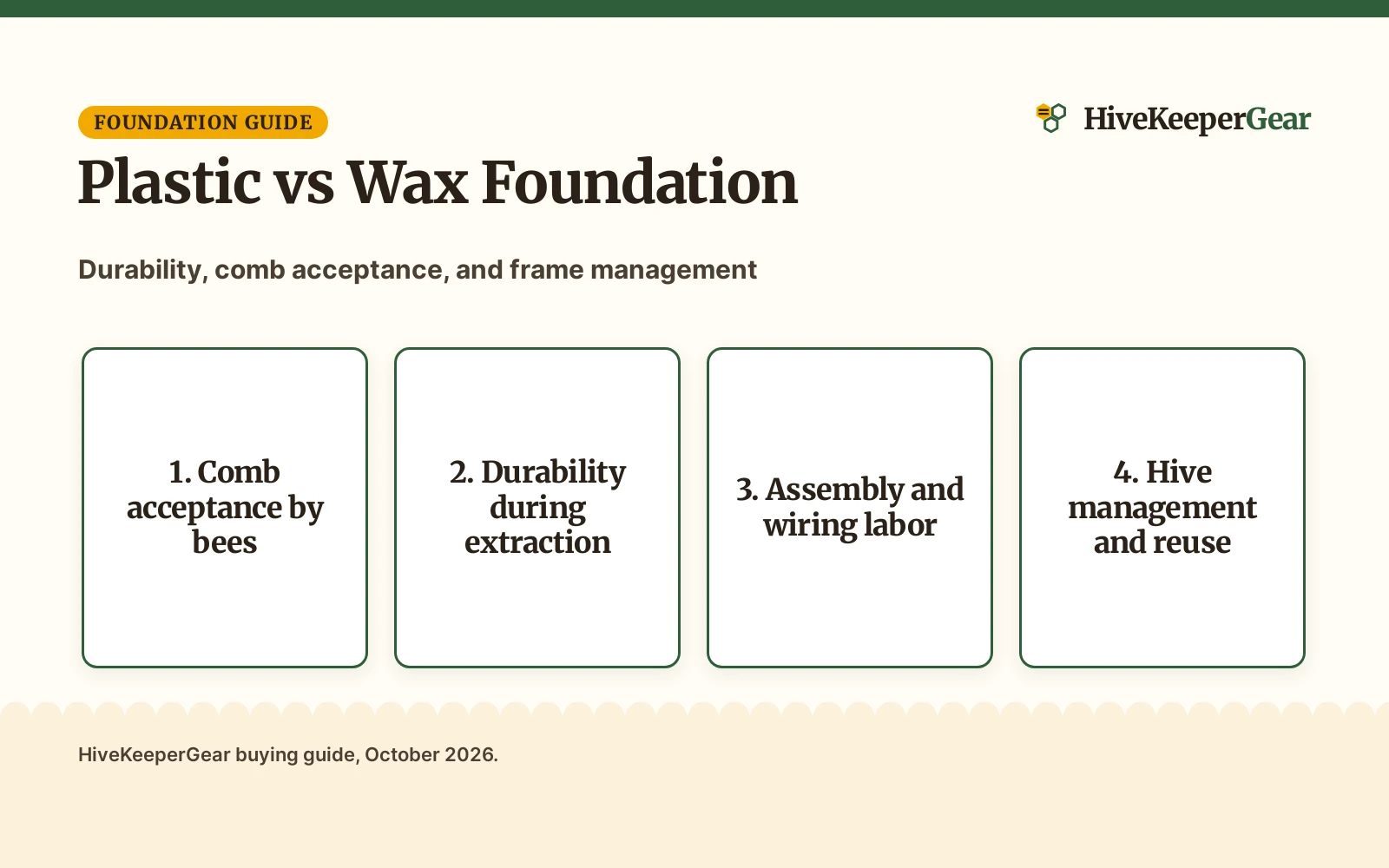
Compare plastic vs wax foundation for hive frames, looking at comb acceptance by bees, durability during extraction, assembly labor, and long-term apiary management.

On this page
Top picks at a glance
As an Amazon Associate I earn from qualifying purchases.
- 1
 VIVO Plastic Beehive Stand for 10 Frame Langstroth Hives with9.5/10View on Amazon
- 2
 ATTITUDE Oceanly Plastic-Free Light Coverage Foundation StickView on Amazon
- 3
 Apimaye Ergo Insulated Bee Hive Set with Plastic PRO FramesView on Amazon
- 4
 Hoover Hives Deep Wooden Frames with Black PlasticView on Amazon
- 5
 witbee 20-Pack Deep Brood Plastic Bee Hive Frames withView on Amazon
During early spring inspections when bees begin whitening the top edges of comb with fresh wax, choosing between plastic vs wax foundation determines how quickly a colony expands and how your frames hold up at harvest time. For most modern backyard beekeepers, beeswax-coated plastic foundation is the practical choice because it resists comb blowouts in centrifugal extractors and snaps into grooved frames without tedious wiring. Pure beeswax foundation remains the traditional preference for beekeepers focused on rapid comb acceptance, all-natural wax production, or keeping synthetic materials out of the hive. Understanding how each foundation material performs during spring buildup, the main nectar flow, and summer extraction will help you select the right option for your hive frames.
Other hives and gear to compare
 ATTITUDE Oceanly Plastic-Free Light Coverage Foundation StickCheck price on Amazon
 Apimaye Ergo Insulated Bee Hive Set with Plastic PRO FramesCheck price on Amazon
 Hoover Hives Deep Wooden Frames with Black PlasticCheck price on Amazon
 witbee 20-Pack Deep Brood Plastic Bee Hive Frames withCheck price on Amazon
HiveKeeperGear earns a commission when you buy through links on this site, at no extra cost to you. As an Amazon Associate I earn from qualifying purchases. Affiliate disclosure.
Before you buy: frame styles and hive fit
Before purchasing foundation sheets, verify the frame style and box depth of your hive boxes. Langstroth frames come in specific cuts: grooved top bar, wedge top bar, and split or grooved bottom bar configurations. Plastic foundation sheets are designed for grooved frames, where the rigid sheet slips into a grooved top bar and seats into the bottom bar without needing wooden wedges or support pins. Wax foundation sheets, by contrast, typically install into wedge top bar frames where a wooden cleat nails down over the wax edge, supported by slotted bottom bars and reinforced with support pins or taut frame wire.
Foundation dimensions must match your frame size precisely to avoid comb sagging or excessive burr comb. For example, BeeCastle lists 5-5/8-inch medium plastic foundation sheets measuring 16.65 by 5.51 inches with a 0.19-inch thickness, weighing 3.34 pounds for a pack of 10 sheets to fit standard medium frames. Using the correct sheet size ensures the foundation fills the wooden frame completely. For full details on wooden frame construction and sizing, see our guides on types of bee hive frames and beehive frames.
Plastic vs wax foundation: side-by-side comparison
The choice between plastic and wax foundation involves balancing durability and convenience against natural acceptance and comb flexibility. Plastic foundation provides a rigid midrib that holds straight through years of inspections and high-speed extraction. Wax foundation provides pure beeswax cell walls that worker bees draw out with minimal hesitation. The comparison table below highlights how both materials perform across primary apiary management tasks.
| Factor | Plastic foundation | Wax foundation | Key consideration |
|---|---|---|---|
| Comb acceptance | Requires beeswax coating for bees to draw comb evenly | Accepted naturally and drawn out quickly by bees | Bees accept wax foundation more readily during a lighter nectar flow |
| Extraction durability | Rigid core prevents comb blowouts in extractors | Can tear or collapse under high extractor speed | Plastic withstands higher centrifugal force |
| Frame assembly | Snaps into grooved frames without wire or pins | Requires wedge cleat assembly, wiring, or support pins | Plastic saves assembly labor before nectar flows |
| Wax moth resilience | Plastic core survives larval chewing undamaged | Larvae consume foundation and destroy comb structure | Plastic core can be scraped clean and recoated |
| Foundation replacement | Scrape old comb to plastic base and add beeswax | Requires complete removal and new wax sheet | Plastic core can be reused across multiple seasons |
Many beekeepers find that using both materials in different parts of the hive offers a balanced approach. Plastic foundation excels in honey supers where extraction forces are severe, while wax foundation can be used in brood chambers or specialized comb honey supers.
1. Comb acceptance and drawing speed
Honeybees construct comb by secreting wax flakes from abdominal glands, chewing the wax, and forming hexagonal cell walls over embossed foundation bases. Pure beeswax foundation carries the natural scent and pliable texture of hive wax. Worker bees accept wax foundation almost immediately, drawing straight, uniform worker comb across the entire sheet even during modest nectar flows.
Plastic foundation requires a thin layer of natural beeswax over its embossed polymer surface before bees will build upon it. When plastic foundation has a light or uneven wax coating, bees may hesitate, leave bare patches, or draw irregular bridge comb between frames. During a heavy spring nectar flow or when beekeepers supply sugar syrup using internal beehive feeders, worker bees readily draw out properly coated plastic sheets into beautiful, straight combs.
2. Durability during honey extraction
Durability during honey harvesting represents the primary advantage of plastic foundation. Uncapping honey frames with an electric or cold uncapping blade requires steady handling. An uncapping knife can accidentally slice through delicate wax foundation if angled improperly, whereas a rigid plastic foundation sheet provides a firm guide that protects the central midrib from blade damage. See our picks for uncapping tools for options that work smoothly across both foundation types.
Inside a centrifugal honey extractor, frames spin rapidly to sling liquid honey out of uncapped cells. Pure beeswax foundation, even when reinforced with embedded wires or cross wiring, can bow, tear, or blow out under heavy rotational force, particularly when extracting cool or dense honey. Plastic foundation possesses a tough plastic core that withstands high spinning speeds without warping or collapsing. This rigidity allows beekeepers to run honey extractors efficiently and return intact drawn comb directly to the colonies.
3. Assembly, wiring, and frame labor
Setting up frames before the spring season demands time and preparation. Installing unwired wax foundation requires considerable hand labor, as beekeepers often insert brass eyelets into wooden end bars, thread frame wire across the frame, tension the wire, and embed it into the wax sheet. Even pre-wired wax sheets require careful seating into wedge top bars to stay aligned. If wire is loose or unsupported, a wax sheet may sag or drop out of the frame in hot weather. Our guide on wired wax foundation for bee frames covers these assembly methods in detail.
Plastic foundation eliminates wiring, eyelets, and embedding tools entirely. A sheet of plastic foundation flexes just enough to snap into the top and bottom frame grooves in moments. The rigid sheet stays flat without sagging or stretching, even in hot hive conditions. For beekeepers assembling numerous frames before a nectar flow, choosing plastic foundation for bee frames reduces assembly time substantially.
4. Wax moth resilience and storage
During the cooler months when honey supers and spare frames are stored in an apiary shed, wax moth larvae pose a serious threat to drawn comb. Wax moth larvae tunnel through beeswax comb, consuming cocoons and pollen while leaving dense webbing behind. When wax moths infest frames with wax foundation, their feeding destroys the wax sheet completely, leaving empty wooden frames and loose wires that must be rebuilt from scratch.
Plastic foundation demonstrates exceptional resilience against wax moth damage. While larvae can chew away the drawn wax cells on the surface, they cannot penetrate or destroy the hard plastic base. When cleaning infested equipment with a sturdy hive tool, beekeepers can scrape away silk webs and debris down to the bare plastic midrib. The plastic sheet can then be washed, recoated with warm beeswax, and returned to service without buying replacement foundation. Follow our steps on cleaning bee frames for reuse to salvage comb safely.
5. Hive management and comb replacement
Over multiple seasons of brood rearing, comb gradually darkens as bees accumulate propolis and larval cocoons inside each cell. Routine hive hygiene calls for rotating old brood frames out of service periodically to maintain hive vigor and clean wax. The foundation material dictates how easily a beekeeper can renew dark comb.
With pure wax foundation, replacing old comb requires cutting the entire comb and embedded wires out of the wooden frame, cleaning propolis out of the frame grooves, and installing a new wired sheet. With plastic foundation, comb renewal is straightforward: a hive tool can scrape the old comb off the rigid plastic sheet down to the embossed midrib without harming the underlying foundation. Applying fresh melted beeswax with a foam roller restores the foundation so bees can draw clean comb during the next nectar flow.
A first-season timeline
Late winter: Inventory your wooden frames and decide between plastic and wax foundation before ordering spring supplies. Assemble wooden frame components, ensuring top and bottom bars match your chosen foundation style, and store completed frames in a dry space.
Early spring: Install your bees into the brood box. If using plastic foundation, confirm the sheets have an adequate beeswax coating, and feed sugar syrup as needed during early buildup until worker bees have drawn comb across the central frames.
Late spring and summer: Add upper hive boxes as the colony fills the lower brood chamber. Inspect outer frames to monitor comb drawing progress, watching for straight cell construction along the foundation face.
Late summer harvest: Remove surplus honey supers for extraction. Enjoy the blowout protection of plastic foundation in your extractor, or use extra care when spinning delicate wax foundation frames.
Fall and winter prep: Remove empty supers after extraction, scrape excess propolis from frame rests, and store drawn comb in a well-ventilated, mouse-proof storage area protected from wax moths.
Nice to have later
- A block of clean, pure beeswax for rolling an extra wax layer onto plastic foundation sheets before hive installation.
- A small high-density foam roller and a melting pot for applying smooth, thin layers of liquid beeswax.
- A spur wire embedder or electric embedding transformer if you choose to embed wire into plain wax foundation sheets.
- Frame support pins or wooden wedge cleats for fastening wax sheets firmly into frame top bars.
- A plastic frame spacer tool to ensure even frame distribution inside honey supers for thicker, easier-to-uncap comb.
What is not on this list
This comparison focuses on standard Langstroth plastic and wax foundation sheets. We do not cover foundationless beekeeping frames or ultrathin surplus wax sheets designed exclusively for cut-comb honey, as those approaches require specialized top bars and distinct colony handling. We also do not provide colony health, disease diagnosis, or chemical pest treatment guidance. For hive health questions, reach out to your local beekeeping association or state apiary inspector.
FAQs for beekeepers
Do bees accept plastic foundation as readily as wax foundation?
Bees typically draw pure wax foundation faster because of its natural beeswax scent and familiar texture. Bees accept plastic foundation readily when it carries a thorough coating of natural beeswax and the colony has an active nectar flow or supplemental feeding.
Can you reuse plastic foundation after wax moth damage?
Yes. The rigid plastic midrib survives wax moth larval feeding undamaged, allowing beekeepers to scrape away webs and debris with a hive tool, clean the surface, apply fresh melted beeswax, and return the frame to the hive.
Why does plastic foundation blow out less in a honey extractor?
Plastic foundation features a solid polymer sheet that supports drawn comb under heavy centrifugal force. Pure wax foundation lacks a rigid center and can tear or collapse when extractors rotate at high harvesting speeds.
What size plastic foundation fits a medium hive frame?
Medium hive frames use medium foundation sheets, commonly designated as 5-5/8-inch foundation. For example, BeeCastle lists medium foundation sheets measuring 16.65 by 5.51 inches with a 0.19-inch thickness to fit medium frames.
Do plastic foundation sheets require cross wiring or eyelets?
No. Plastic foundation is rigid and snaps directly into grooved frame bars without wire, eyelets, or crimping tools, saving significant assembly labor.
More hive guides
Browse every guide by category: hive frames, beehives, hive tools and honey harvesting.