Frame Feeder vs Top Feeder: Which One Should You Buy?
A direct comparison of frame feeders and top feeders, covering capacity, colony warmth, syrup refilling, drowning prevention, and hive management.

On this page
Top picks at a glance
As an Amazon Associate I earn from qualifying purchases.
- 1
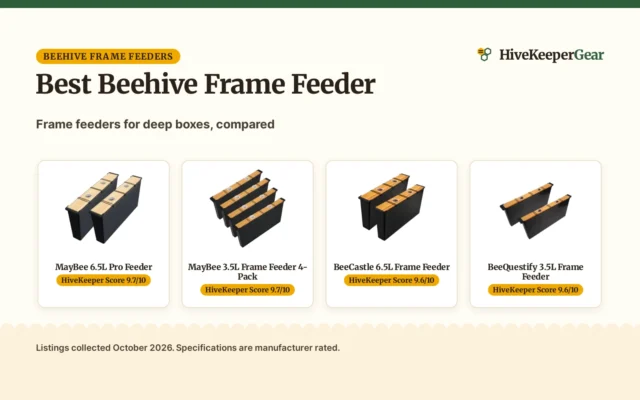
 MayBee 6.5L Bee Pro Feeder9.7/10View on Amazon
- 2
 AOIT Rapid Round Hive Top Feeder for 8 or 10 Frame Beehives9.7/10View on Amazon
- 3
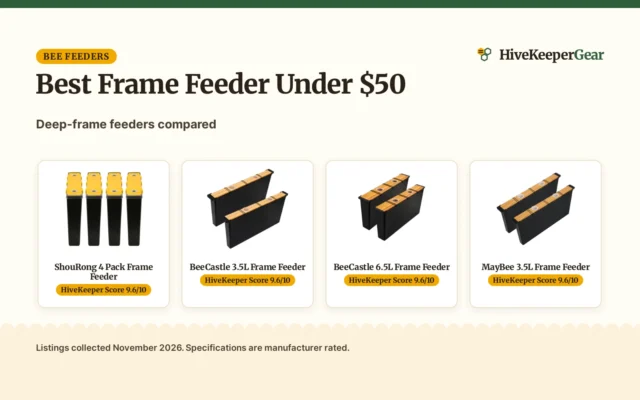
 MayBee 3.5L Frame Feeder9.7/10View on Amazon
- 4
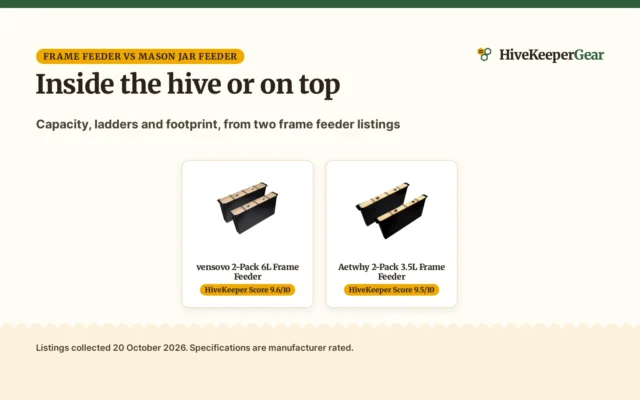
 vensovo 2 Pack 6L Bee FeederView on Amazon
- 5
 10 Frame Hive Top Feeder Water Pollen Slurry SeparationView on Amazon
- 6
 2 Pack 3.5L Bee FeederView on Amazon
- 7
 MayBee 2 Pack 3.5L Bee Feeder Beeswax Coated Beehive FrameView on Amazon
When preparing a colony for autumn stores or helping spring bees draw new comb, choosing between a frame feeder vs top feeder comes down to colony strength, weather, and how often you plan to refill syrup. If you need bulk feeding without opening the brood nest during warm weather, choose a top feeder; if you are feeding a small cluster during cool spring weather where bees must stay adjacent to warm syrup, choose a frame feeder. We compared how each feeder fits standard Langstroth equipment, syrup capacities, refilling procedures, and drowning prevention.
Other hives and gear to compare
 MayBee 2 Pack 6.5L Bee Pro Feeder Beekeeping Supplies BeehiveCheck price on Amazon
 vensovo 2 Pack 6L Bee FeederCheck price on Amazon
 10 Frame Hive Top Feeder Water Pollen Slurry SeparationCheck price on Amazon
 2 Pack 3.5L Bee FeederCheck price on Amazon
 MayBee 4 Pack 3.5L Beehive Feeder Beeswax Coated BeehiveCheck price on Amazon
 MayBee 2 Pack 3.5L Bee Feeder Beeswax Coated Beehive FrameCheck price on Amazon
HiveKeeperGear earns a commission when you buy through links on this site, at no extra cost to you. As an Amazon Associate I earn from qualifying purchases. Affiliate disclosure.
Before you choose: understand your feeding goals
Supplemental feeding gives honeybees the carbohydrate fuel needed to draw wax foundation, rear brood, or survive periods of dearth. Before purchasing equipment, evaluate colony size and regional climate. A small package or nucleus colony behaves differently than an established colony. Installing the right feeder helps bees take down syrup efficiently while minimizing stress on the cluster. You should also consider your apiary schedule, as some feeders require frequent top-offs while others hold enough syrup for extended periods.
The frame feeder vs top feeder comparison
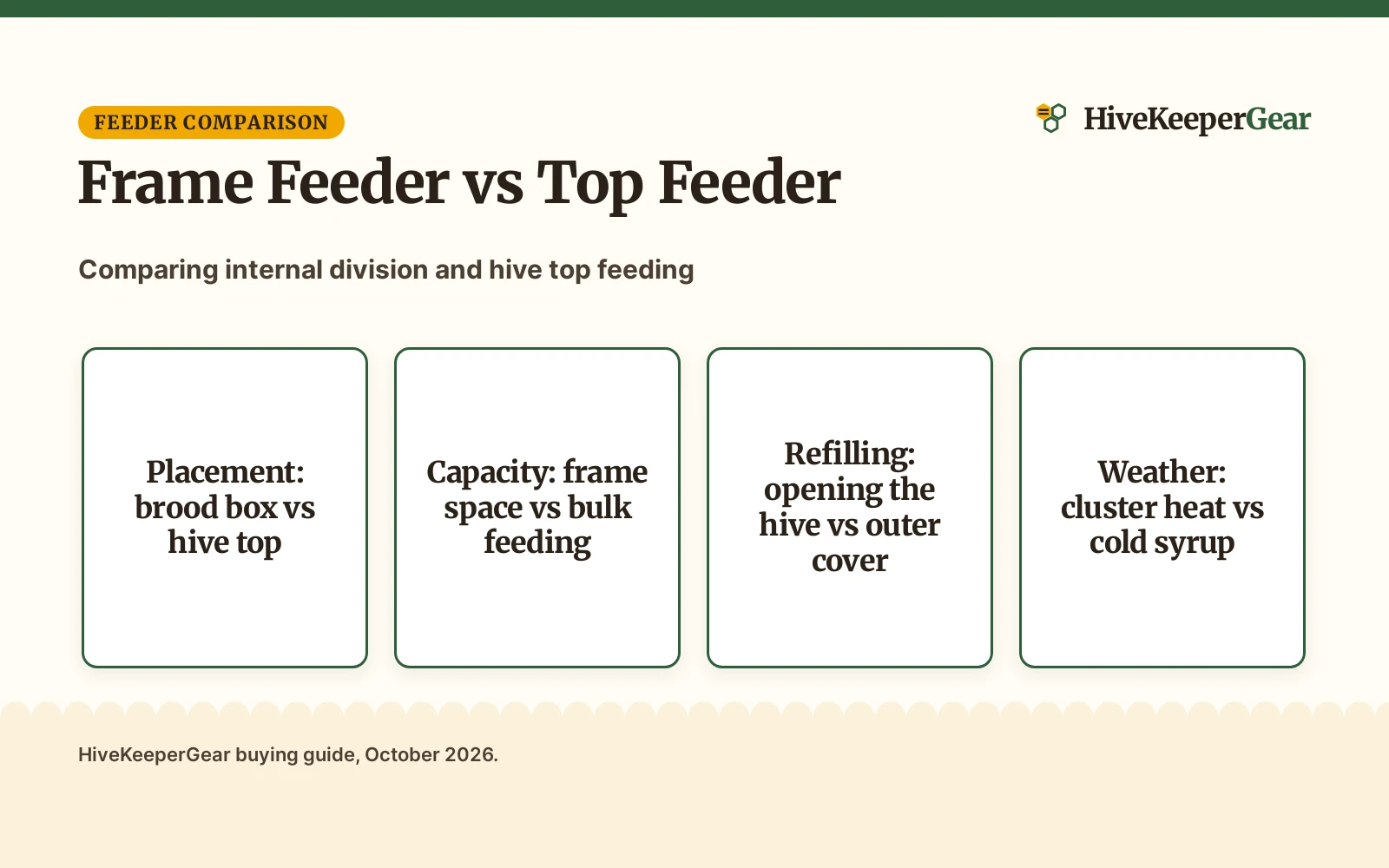
Both styles keep sugar syrup protected inside the hive structure, guarding against robbing from neighboring apiaries. However, physical placement, capacity, and refilling routines differ. Review the key features below to see how internal frame feeders compare with hive top feeders.
| Feature | Frame Feeder | Top Feeder | Related Guide |
|---|---|---|---|
| Hive placement | Inside brood box on frame rests | Above uppermost box under outer cover | Hive frames |
| Syrup capacity | 3.5 to 6.5 liters depending on width | Bulk overhead reservoir | Beehive feeders |
| Refill routine | Must open hive and inner cover | Lift outer cover only without disturbing bees | Bee feeder types |
| Cool-weather feeding | Adjacent to warm cluster heat | Farther from cluster, syrup cools faster | Winter bee feeds |
| Comb space impact | Replaces standard brood frames | Preserves all internal comb space | Langstroth kits |
| Ideal colony stage | Package installs and small clusters | Strong colonies and autumn preparation | Beginner feeders |
1. Placement and hive space
A frame feeder hangs directly on the frame rests inside a standard deep hive box. To insert a frame feeder, you must remove existing comb frames from the hive box, placing the feeder along the outer flank of the cluster. Manufacturer specifications indicate the amount of internal space required: Aetwhy notes its feeder occupies the position of 1 to 2 frames in a deep hive box, HiveSweet states its feeder occupies approximately 2 bee frames, and vensovo states its feeder occupies about 2 to 3 frames. Giving up frame space inside the brood box leaves fewer drawn combs for the queen to lay eggs or workers to store honey.
A top feeder sits directly on top of the uppermost hive box, beneath the telescoping outer cover. It does not displace any frames from the brood nest, allowing the colony to maintain all drawn combs. While this preserves interior brood space, the feeder rim adds vertical height to the hive stack and requires separate off-season storage.
2. Syrup capacity and refilling routine
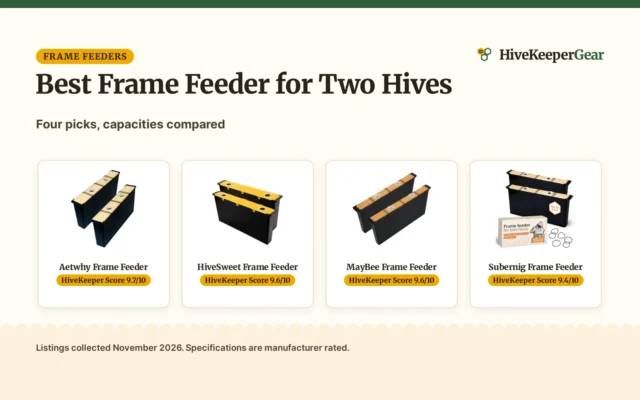
Syrup volume determines how frequently you must replenish feed. Frame feeders come in compact and high-capacity designs. Subernig lists a 3.5-liter frame feeder measuring 19 by 1.9 by 8.6 inches, and Aetwhy lists a 3.5-liter model measuring 18.9 by 1.46 by 8.74 inches. For beekeepers wanting fewer refill trips, wider models hold larger volumes: vensovo publishes a 6-liter capacity measuring 19 by 3 by 9 inches, MayBee lists a feeder holding 6.5 liters (1.7 gallons) measuring 19 by 3.14 by 8.46 inches, and Aetwhy lists a 6.5-liter feeder measuring 19.09 by 2.32 by 9.17 inches.
Refilling a frame feeder requires opening the hive. You must remove the outer cover and inner cover, puff gentle smoke, and pour syrup directly into the reservoir. This disturbs the cluster and can release sweet aromas into the air. A top feeder simplifies refilling: you lift the outer cover and pour syrup directly into open trays. Bees remain isolated behind protective screens or access chimneys, so you do not need a smoker for a quick refill.
3. Temperature and cold-weather feeding
Honeybees cluster tightly to regulate temperature when ambient conditions cool in early spring or autumn. Because syrup must be warm enough for bees to imbibe, feeder location relative to the cluster is critical. A frame feeder sits directly beside the brood cluster inside the hive box. Warmth produced by the bees keeps the liquid warm, allowing workers to feed without breaking cluster.
Top feeders struggle in cold weather because heat dissipates through the upper hive area. The syrup reservoir sits directly on top of the uppermost hive box beneath the outer cover, separated from the warmth of the cluster below. During prolonged cold spells, honeybees will not break cluster to travel into an unheated upper chamber, leaving cold syrup untouched. Top feeders perform best during mild autumn weather or late spring flows when nights stay warm.
4. Drowning prevention and bee access
Liquid feeding presents a drowning hazard if bees lose footing in deep syrup. Frame feeders incorporate textured climbing ladders and floats. For instance, MayBee states its feeder features internal grooves to help bees enter and prevent drowning, while Aetwhy provides two internal inclined ladders with grooves down to the bottom. KAIMONOYOU includes 6 safety islands and 12 rubber bands with floating boards to ensure bees have resting platforms across the liquid surface.
Top feeders utilize protected access passages, such as central chimneys or corner access wells lined with plastic ribbing or fine wire mesh screens. Bees crawl up from the frames below through a narrow entry slit, step onto the textured chimney surface, and sip syrup through small apertures. Because baffles separate bees from the bulk reservoir, workers cannot fall into open liquid, allowing large numbers of bees to feed safely.
5. Robbing defense and colony disturbance
Supplemental feeding during a nectar dearth carries the risk of triggering robbing behavior from neighboring colonies or wasps. Both frame feeders and top feeders provide solid robbing protection compared to exterior entrance feeders because all syrup remains enclosed within the hive shell. Guard bees at the bottom entrance can defend the colony without robbers easily locating an exposed food source.
Frame feeders keep syrup deep inside the brood chamber, where resident bees defend it vigorously. However, opening the hive when refilling can spill syrup droplets or release scent flares. Top feeders allow beekeepers to replenish syrup in moments without breaking brood box propolis seals or exposing frames. Provided the outer cover fits tightly, top feeders minimize apiary excitement and keep colonies calm.
A seasonal feeding timeline
Adapting your feeder choice to the beekeeping calendar ensures colonies receive nutrition when they need it most:
Early spring buildup: When installing a new package of bees or supporting an overwintered colony in cool weather, use a frame feeder. Place it directly alongside the brood frames so the cluster can drink warm syrup without venturing into cold hive space.
Late spring and summer flow: When natural nectar becomes abundant and bees begin storing surplus honey in supers, remove all syrup feeders. To prevent bees from storing sugar syrup in combs intended for honey harvest, remove all feeders before placing honey supers on the hive.
Early autumn preparation: Once honey supers are removed in late summer, switch to a top feeder. Strong colonies take down large volumes of syrup quickly through a top feeder, filling empty combs with winter stores before temperatures drop.
Late autumn and winter: As cold weather arrives and bees form a tight winter cluster, cease liquid feeding. Bees cannot process high-moisture syrup in cold weather, and cold syrup chills the cluster. Switch to emergency dry sugar or solid fondant placed over the cluster if stores run low.
Helpful feeding accessories
- A dedicated syrup pitcher or funnel with a clean spout to pour syrup smoothly into frame feeder slots without splashing top bars.
- Wooden ladders or rough pine slats to place inside smooth plastic frame feeders that lack molded internal traction grooves.
- A standard hive entrance reducer installed at the bottom board to help guard bees defend the hive during feeding periods.
- An extra hive body or deep super shell to enclose alternative feeding methods when necessary.
- A tight-fitting hive outer cover with sound corners to prevent scent leaks and exclude wandering scout bees.
Feeder styles not compared here
While internal frame feeders and hive top feeders are the primary styles for backyard apiaries, beekeepers may encounter other designs in the bee yard. Entrance feeders slide into the front bottom entrance with an inverted jar. While they allow easy monitoring of syrup levels, their exterior position attracts robbers and is vulnerable to freezing. Overhead pail or bucket feeders sit inverted over the inner cover hole, using atmospheric pressure and fine mesh to dispense liquid. For an overview of every design, consult our comprehensive guide to bee feeder types.
FAQs for beekeepers
Which feeder is better for a new colony of bees?
A frame feeder is typically better for a newly installed package or small nucleus colony. Placing syrup directly beside the small brood cluster allows bees to feed during chilly spring weather without having to travel into cold upper boxes.
Can bees drown inside a frame feeder?
Bees can drown if the feeder interior lacks sufficient traction or floating support. Manufacturers address this with grooved surfaces and floats; for example, MayBee incorporates grooved internal walls, Aetwhy includes two grooved inclined ladders, and KAIMONOYOU includes 6 safety islands with floating boards to keep bees safe.
How much syrup does a frame feeder hold?
Capacity depends on the width of the feeder. Compact models from Subernig and Aetwhy hold 3.5 liters, whereas wider deep models from vensovo hold 6 liters, and MayBee and KAIMONOYOU list a 6.5-liter capacity.
Do I have to remove frames to use a frame feeder?
Yes. Frame feeders hang directly on the frame rests inside the brood chamber, replacing drawn frames. Listings indicate that narrower 3.5-liter models from Aetwhy occupy the position of 1 to 2 frames, while larger units from vensovo occupy about 2 to 3 frames.
Why choose a top feeder over a frame feeder?
A top feeder holds large syrup reservoirs and allows fast refilling simply by lifting the outer cover, without smoking the bees or disturbing the brood chamber. It also preserves every frame inside the hive box for comb building and brood rearing.
More hive guides
See every bee feeder guide and all hive tools guides.
More picks: Explore our guides to the entrance feeder vs top feeder, entrance feeder vs frame feeder, and bucket feeder for bees. New to beekeeping? Check out our list of beekeeping supplies for beginners.