Plastic vs Wood Bee Frames: Which One Should You Buy?
A side-by-side guide comparing plastic and wood bee frames for durability, bee acceptance, assembly time, maintenance, and hive management.

On this page
Top picks at a glance
As an Amazon Associate I earn from qualifying purchases.
- 1
 Mann Lake 9 1/8-Inch Deep Plastic Frames with Beeswax Coating9.7/10View on Amazon
- 2
 Acorn Bee medium plastic frame 10 packView on Amazon
- 3
 witbee 20-Pack Deep Brood Plastic Bee Hive Frames withView on Amazon
- 4
 Apimaye Ergo Insulated Bee Hive Set with Plastic PRO FramesView on Amazon
- 5
 Ambrose Bee Supply Plastic Queen ExcluderView on Amazon
- 6
 Hoover Hives Deep Wooden Frames with Black PlasticView on Amazon
- 7
 Flexzion Queen Bee Catcher ClipsView on Amazon
When opening a hive box during spring expansion, deciding between plastic vs wood bee frames shapes how you manage foundation, comb growth, and seasonal maintenance across the apiary. For beekeepers seeking immediate convenience with zero assembly and rigid durability against hive pests, pre-waxed plastic frames are the practical choice, while wood frames remain the traditional standard for keepers who prefer natural beeswax foundation, plastic-free comb, and field repairability. We compared published manufacturer specifications, foundation materials, stated frame dimensions, and maintenance demands to help you determine which frame style matches your beekeeping setup.
Other hives and gear to compare
 Acorn Bee medium plastic frame 10 packCheck price on Amazon
 witbee 20-Pack Deep Brood Plastic Bee Hive Frames withCheck price on Amazon
 Apimaye Ergo Insulated Bee Hive Set with Plastic PRO FramesCheck price on Amazon
 Ambrose Bee Supply Plastic Queen ExcluderCheck price on Amazon
 Hoover Hives Deep Wooden Frames with Black PlasticCheck price on Amazon
 Flexzion Queen Bee Catcher ClipsCheck price on Amazon
HiveKeeperGear earns a commission when you buy through links on this site, at no extra cost to you. As an Amazon Associate I earn from qualifying purchases. Affiliate disclosure.
Before you choose: understand your hive goals
Beehive frames provide the structural border supporting honeycomb inside modern Langstroth hives, allowing beekeepers to inspect individual combs without damaging hive architecture. Wooden frames represent the historical standard, relying on milled wood bars assembled with fasteners and optional support wire. Plastic frames offer a modern manufactured alternative with single-piece molded construction combining outer bars and textured foundation into one unit. Both designs maintain proper bee space within the hive body, but they differ in assembly labor, durability, handling, and colony acceptance.
Plastic vs wood bee frames: key differences compared
Choosing between plastic and wood frames involves practical trade-offs between initial setup labor, structural resilience, and comb acceptance. The table below outlines how both frame materials compare across essential apiary criteria.
| Comparison factor | Plastic frames | Wood frames | Relevant guide |
|---|---|---|---|
| Assembly and setup | Ready for the hive with one-piece molded construction | Assembled from wooden components, or purchased pre-assembled | Beehive frames |
| Foundation support | Rigid plastic midrib coated with beeswax | Supports pure beeswax, wired wax, or plastic inserts | Plastic foundation |
| Pest defense | Rigid plastic midrib resists larvae burrowing | Comb susceptible to tunneling; larvae chew wood to pupate | Wood hive frames |
| Bee acceptance | Requires generous beeswax coating | Rapid acceptance on pure beeswax foundation | Wax foundation frames |
| Wax renewal | Scraped clean down to plastic base | Wax cut out and replaced in wood frame | Wired wax foundation |
| Durability | Resilient polymer resists joint failure | Natural wood allows individual part repair | Types of bee hive frames |
Specifications vary across manufacturers. Mann Lake lists deep Rite-Cell plastic frames measuring 19 inches wide by 9 1/8 inches high (10-pack weight 7.5 pounds) and medium frames measuring 19 inches wide by 6 1/4 inches high (10-pack weight 6.3 pounds). By comparison, Swampland Bees lists a 20 pack of deep 9-1/8 inch wooden frames wired with 0.55mm 304 stainless steel wire and pure beeswax foundation, measuring 19 by 1.4 by 9.13 inches at 14.8 pounds. Acorn Bee lists a 10 pack of medium plastic frames measuring 20 by 8.5 by 8.25 inches at 6.19 pounds. Both Mann Lake and Acorn Bee state 100% beeswax coatings on their plastic foundations.
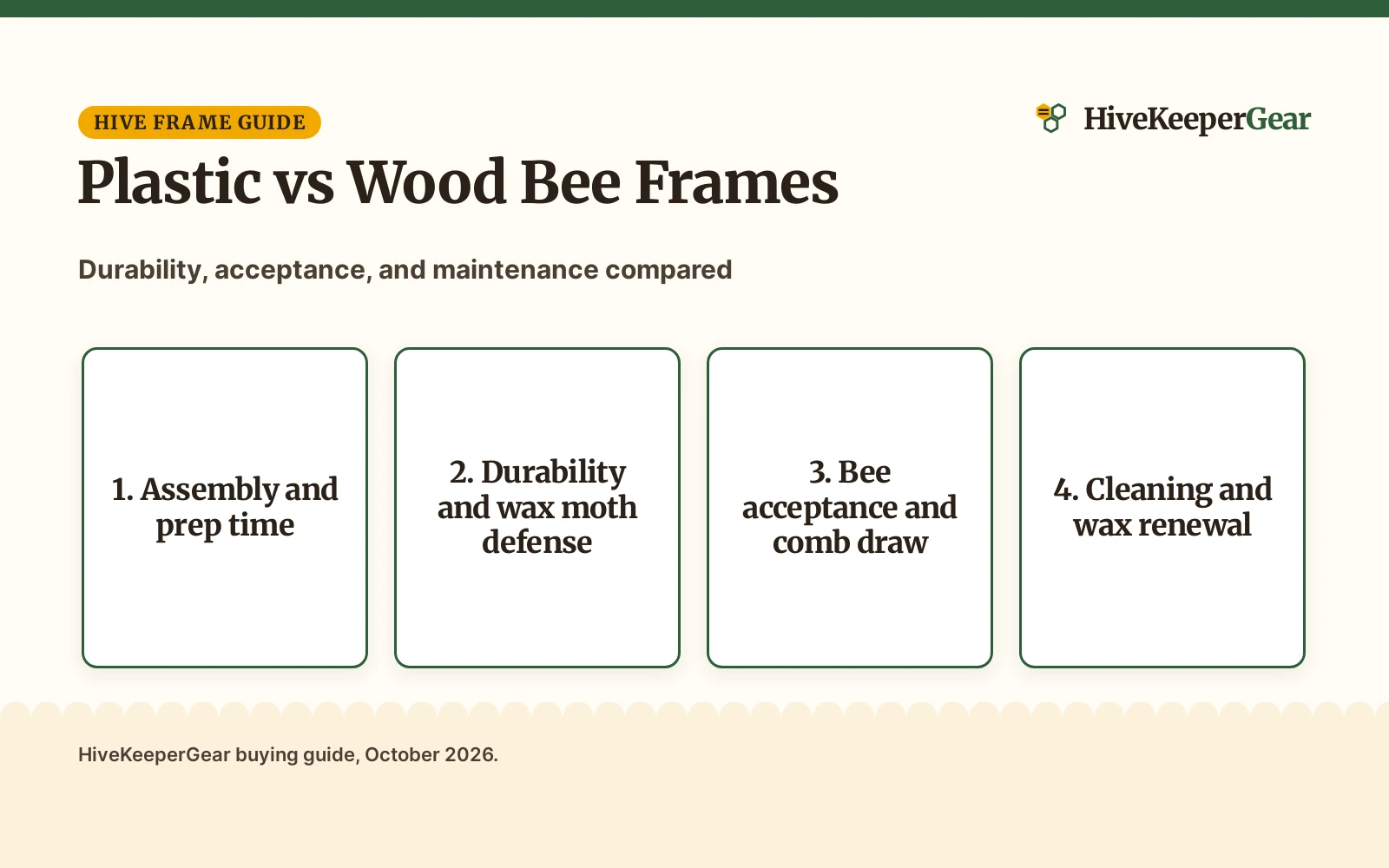
1. Assembly and preparation
Traditional wooden frames often arrive as knocked-down bundles consisting of top, bottom, and end bars that require gluing and fastening by hand. Installing wired beeswax foundation adds the extra step of threading wire through end bar eyelets and embedding it into wax sheets. While pre-assembled wooden frames exist, such as the 20 pack from Swampland Bees featuring factory-installed 304 stainless steel wire, wood equipment generally requires more preparation time.
In contrast, one-piece molded plastic frames integrate frame bars and textured foundation into a single ready-to-use unit with no loose joints, nails, or fragile wax sheets. For apiarists assembling complete Langstroth hive kits ahead of package delivery day, plastic frames eliminate workbench assembly entirely.
2. Durability and pest defense
Wooden frames can suffer loosened joints, split top bar lugs, or cracked side bars over seasons of hive tool prying, and unsupported wax foundation can blow out under centrifugal force in extractors. Plastic frames offer high mechanical strength: molded polymer joints do not loosen, top bar lugs withstand leverage, and the rigid midrib prevents foundation blowout during honey extraction.
Plastic frames also provide superior defense against wax moth damage. Specifications for Mann Lake Rite-Cell frames state the solid plastic midrib is impervious to wax moth and rodent burrowing, preserving the core structure. On wooden frames with pure wax foundation, moth larvae tunnel through comb and chew indentations into wooden bars to pupate.
3. Bee acceptance and comb development
Honey bees naturally favor beeswax. When given wooden frames with pure beeswax foundation during a nectar flow, colonies readily accept the sheets and draw uniform comb. Wooden frames also allow foundationless comb production guided solely by a starter strip for cut-comb honey.
Plastic foundation requires a beeswax coating because bees do not draw comb on bare plastic. Listings for Mann Lake and Acorn Bee specify a 100% beeswax coating on plastic frames to stimulate comb building. During a strong flow, well-coated plastic foundation produces durable, straight brood and honey combs. Beekeepers can compare specialized deep frames for brood rearing and medium frames for honey supers to match frame depth to colony needs.
4. Hive inspections and frame handling
Frame weights remain closely comparable: a 10-pack of Mann Lake deep plastic frames lists an item weight of 7.5 pounds, while a 20 pack of Swampland Bees deep wooden frames lists 14.8 pounds. In handling, wooden frames offer a comfortable natural grip, but wood grain can absorb propolis and bind at contact points. Smooth plastic surfaces make propolis easier to scrape clean with a flat hive tool. Additionally, black plastic foundation provides sharp visual contrast, making white bee eggs and young larvae easy to spot during inspections, while white foundation highlights honey clarity in supers.
5. Cleaning, maintenance, and foundation renewal
When brood comb darkens after several seasons, comb must be refreshed. On wooden frames, keepers cut out old wax and wire, clean frame grooves, and install fresh foundation sheets. One-piece plastic frames cannot be taken apart, but their solid midrib allows scraping old comb straight down to the plastic base with a hive tool without tearing foundation. Scraped plastic frames are then washed in warm water and rolled with fresh melted beeswax. For step-by-step renewal procedures, see our guide on cleaning bee frames for reuse.
Seasonal frame management timeline
Managing frames follows the seasonal rhythm of the apiary. Late winter and early spring: assemble and wire wooden frames, or inspect stored plastic frames to confirm wax coatings remain clean. Spring buildup and honey flow: add new frames into brood boxes or honey supers during active nectar flows or syrup feeding to prompt swift comb construction. Summer extraction: uncap honey frames and extract; plastic foundation provides high resistance to centrifugal blowout. Fall hive consolidation: inspect brood comb, cull damaged frames, and arrange winter stores. Winter storage: store drawn frames in protected supers safe from mice and moisture.
Useful frame accessories to consider
Several apiary accessories simplify frame maintenance and handling:
- A sturdy frame grip or frame perch to hold frames securely outside the hive body during box inspections.
- A handheld wax roller and clean beeswax block to apply extra coating to plastic foundation before installation.
- A heated uncapping knife and fork to slice through honey cappings smoothly.
- A manual or motorized honey extractor that spins honey out while leaving drawn comb intact for reuse.
- Color-coded frame tags to track comb age and queen lineage across hive boxes.
Quality accessories protect your comb investment and make routine inspections smoother across both frame styles.
What is not on this list
Bees, packages, nucleus colonies, and queens are purchased separately; this guide compares frame hardware only. We do not provide disease or chemical treatment advice. For colony health diagnosis and treatment regulations, consult your state apiary inspector or local extension office.
FAQs for beekeepers
How do you clean plastic frames in beekeeping?
Scrape old comb and propolis down to the rigid plastic midrib using a flat hive tool. Wash the scraped frame in warm water, let it dry, and apply a fresh layer of melted beeswax with a foam roller before returning it to the hive.
Do honeybees accept plastic foundation as readily as pure beeswax?
Honeybees accept pure beeswax foundation faster, but they draw plastic foundation readily when it features a generous beeswax coating. Listings for Mann Lake and Acorn Bee specify a 100% beeswax coating on their plastic frames to provide the natural wax scent bees require.
Are plastic bee frames durable against wax moths?
Plastic frames feature a solid polymer midrib that wax moth larvae cannot burrow through, keeping the foundation core intact. While larvae can consume comb on the surface, the frame can be scraped clean and rewaxed for reuse.
Can you mix plastic and wooden frames in the same hive box?
You can mix plastic and wooden frames in one box, but bees sometimes draw the wooden frames first if wax coatings differ. Keeping frame types uniform within each box encourages even comb depth.
Which frame style is better for a beginner beekeeper?
Pre-assembled plastic frames with coated foundation offer the simplest setup for beginners by eliminating assembly and wiring. Wooden frames require assembly labor unless bought pre-assembled, but offer classic appeal and replaceable foundation.
More hive guides
Browse every guide by category: beehives, hive frames, protective gear, hive tools, and honey harvesting.
Explore related frame guides: compare wooden hive frames, review plastic foundation frames, inspect deep brood frames, or learn about cleaning bee frames for reuse.