Double Sieve vs Single Honey Strainer: Which One Should You Buy?
A comparison of double sieve and single honey strainers for beekeepers, covering filtration speed, mesh clogging, honey clarity, and bucket setups.

On this page
Top picks at a glance
As an Amazon Associate I earn from qualifying purchases.
- 1
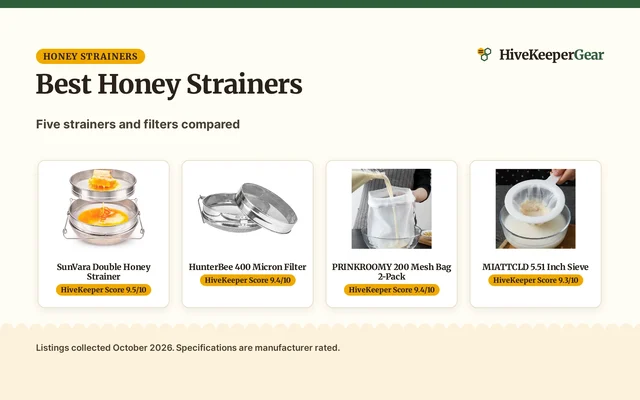
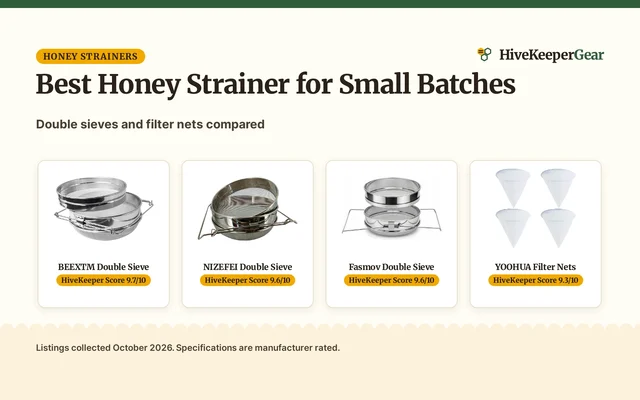
 BEEXTM Honey Strainer Filter Stainless Steel Double Sieve for9.7/10View on Amazon
- 2
 Honey StrainerView on Amazon
- 3
 Flexzion 304 Stainless Steel Honey StrainerView on Amazon
When honey supers come off the hives in late summer and the extractor starts spinning, choosing between a double sieve vs single honey strainer determines how smoothly your harvest flows into settling buckets. For most backyard beekeepers, a double sieve is the better choice because its two-stage filtration captures coarse wax cappings on the upper screen while allowing honey to pass through the fine bottom mesh without rapid clogging. A single honey strainer is simpler and lighter to handle, but filtering raw honey straight from an extractor gate quickly covers the single screen in wax and slows processing to a crawl.
Other hives and gear to compare
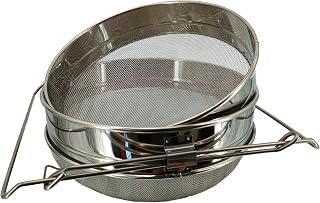 Honey StrainerCheck price on Amazon
 Flexzion 304 Stainless Steel Honey StrainerCheck price on Amazon
HiveKeeperGear earns a commission when you buy through links on this site, at no extra cost to you. As an Amazon Associate I earn from qualifying purchases. Affiliate disclosure.
Double sieve vs single honey strainer: how they compare
Filtering raw honey is an essential step between extracting comb and filling jars. As honey spins out of frames, it carries bits of beeswax cappings, propolis flecks, and small hive particles. Removing these solids keeps honey clear and prevents premature crystallization around floating wax seeds. The central mechanical difference between a double sieve and a single strainer is how they manage particle sizes during that flow.
| Feature | Double Sieve Strainer | Single Honey Strainer |
|---|---|---|
| Filter layers | Two separating mesh screens | Single mesh screen or fabric bag |
| Upper mesh rating | Coarse 1875 microns to catch wax cappings | None |
| Lower mesh rating | Fine 650 microns for smooth honey | Single 400 microns or coarse screen |
| Clogging resistance | High resistance due to two-stage separation | Prone to rapid clogging from raw cappings |
| Flow speed during extraction | Maintains steady flow into bucket | Slows as wax covers the surface |
| Bucket mounting | Sliding adjustable arms fitting 5 gallon buckets | Fixed rim or bucket-top elastic band |
| Cleaning during harvest | Upper screen can be cleared separately | Entire filter must be emptied when blocked |
Filtration speed and why single strainers clog
The primary challenge during harvest is viscosity combined with wax debris. Honey is a thick liquid that moves slowly by gravity, especially in cooler honey house conditions. When you pour unfiltered honey through a single mesh screen, large pieces of wax comb land directly on the wire openings. Quickly, those wax particles compact together, creating an impermeable barrier that traps the honey above the screen. A beekeeper using a single strainer must constantly pause, scrape away the wax layer, or swap out clogged filter bags to keep the bucket filling.
A double sieve solves this bottleneck by separating debris by size in two progressive stages. The upper bowl features a coarse 1875-micron wire mesh. That wide opening allows viscous honey to pass through freely while catching large wax cappings, bee debris, and comb fragments. Below that upper bowl sits a fine 650-micron mesh screen. Because the bulky wax chunks remain trapped on the upper screen, only small particulate reaches the lower layer. The fine screen refines the honey without facing the heavy surface blinding that stops a single strainer. Equipment listings from BEEKNOWS, HunterBee, NIZEFEI, CIMALAB, and Nuogo all build on this exact pairing: an 1875-micron upper mesh combined with a 650-micron lower mesh.
Understanding why filter honey properly helps clarify why this two-stage separation matters. Straining is not about ultra-filtering or removing beneficial pollen grains; it is purely about taking out solid hive debris so honey can settle cleanly into storage pails.
Honey clarity and mesh micron ratings
Micron ratings define the size of particles a screen allows to pass, where smaller numbers represent a finer mesh. In honey processing, selecting the right micron rating requires balancing visual clarity against gravity drainage speed. If a filter screen is too tight, thick honey will not pass without applied pressure or heat, both of which can compromise honey quality.
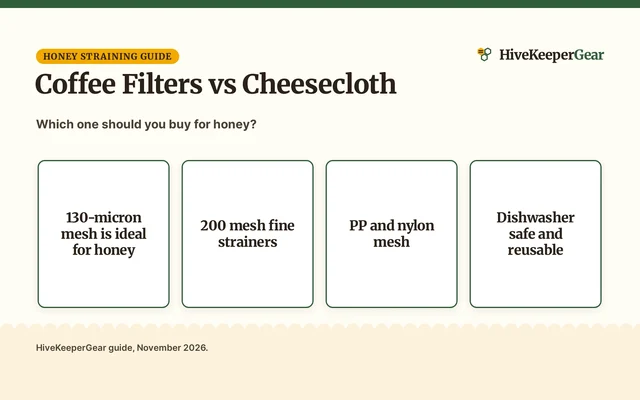
A standard double sieve uses a 650-micron lower screen, which produces clean, bright honey suitable for table use and gift jars. At 650 microns, the screen catches floating wax crumbs and comb splinters while allowing natural pollen to remain in the honey. Some double sieves offer alternative mesh configurations; for example, Golden Palace lists a 16 mesh (100 microns) top screen followed by a 40 mesh (240 microns) bottom filter, along with a 500 microns specification. In contrast, dedicated single filter bags, such as the BEEKNOWS nylon mesh bag, use a single 400-micron fabric barrier. A 400-micron screen delivers slightly finer clarification than 650 microns, but placing that single fine layer directly under an uncapping tank or extractor causes wax buildup almost immediately.
To learn more about how mesh numbers translate to pore sizes and flow rates, consult our detailed guide on honey strainer mesh size options.
Bucket fit and extendable arm designs
Most backyard beekeepers filter honey directly into food-grade 5-gallon pails positioned beneath the extractor honey gate. How a strainer mounts on that container affects harvest stability and mess prevention. A strainer that slips off balance can spill gallons of sticky honey across the floor.
Double sieve strainers solve mounting through extendable stainless steel support arms that slide outward from the frame to rest securely on bucket rims. Manufacturers design these arms to span various pail diameters:
- BEEKNOWS builds a strainer with a 9.4-inch diameter bowl, 4 inches of depth, and extendable arms reaching up to 16 inches over a standard 5-gallon bucket.
- HunterBee provides a 9-inch bowl diameter, 4-inch depth, and extendable arms with a 15.5-inch reach.
- NIZEFEI features a 9-inch diameter bowl with support arms that expand from 10 to 16.5 inches across standard 5-gallon buckets.
- Nuogo lists a 9.06-inch diameter bowl (23 cm) with sliding arms that extend from 9.5 to 15 inches.
- CIMALAB provides a 9.4-inch diameter bowl, 4 inches of depth, and telescopic arms adjusting from 9.4 to 13.7 inches.
- Golden Palace features a 10.23-inch diameter frame with adjustable arms extendable to 17 inches.
- NUOMIC designs its double sieve with expandable support arms that accommodate 5 to 10 gallons buckets.
Single strainers typically lack rigid sliding arms. Nylon filter nets, such as the 13.8 by 15.75-inch YOOHUA filter bag, fit loosely over bucket openings or tie around pail rims. The BEEKNOWS 400-micron nylon bag uses an elastic band to grip the outer rim of a 5-gallon bucket. While elastic rims stay in place, pouring heavy honey into an unsupported fabric bag can cause the center to sag deep into the pail, reducing available holding capacity.
For beekeepers setting up dedicated bottling stations, pairing an adjustable double sieve with a stable bucket creates an efficient harvesting setup. Review our recommendations for the honey strainer for 5 gallon bucket setups to match your containers.
Materials: 304 stainless steel vs fabric nets
Honey is naturally acidic, which requires non-reactive harvesting tools. Using inappropriate metals can cause pitting, rust, and metallic off-flavors in your harvest.
Quality double sieve units rely on stainless steel. Manufacturers such as BEEKNOWS, Golden Palace, NIZEFEI, and CIMALAB construct their strainers from food-grade 304 stainless steel. Grade 304 contains chromium and nickel, providing strong resistance against corrosion and acidic honey contact. Other models, such as HunterBee, use 201 stainless steel mesh. Stainless steel provides rigid structural support that will not deform under the weight of accumulated honey and wax cappings resting in the upper bowl.
Single strainers frequently use woven nylon mesh. Food-grade nylon is durable, tear-resistant, and washable. However, fabric lacks rigid structure. When warm honey passes through nylon, the fabric can stretch, and clearing wax residue from woven fibers requires careful washing compared to rinsing smooth stainless steel wire.
Cleaning and harvest workflow
Harvest day creates plenty of sticky equipment, and cleaning honey strainers requires the correct water temperature. A common beginner mistake is rinsing a honey-covered strainer with hot water. Hot water immediately melts the beeswax, driving liquid wax deep into the mesh pores where it solidifies and permanently clogs the screen openings.
The proper method is to rinse both screens with cold water first. Cold water dissolves the honey and washes it away while keeping beeswax firm and brittle. Once the honey is gone, you can tap out the hardened wax flakes into a compost bin or wax melter. After the wax debris is clear, finish with warm water to remove any remaining sticky residue. Stainless steel double sieves dry rapidly and will not hold odors between seasons.
During active extraction, keep a large spoon or silicone spatula nearby. When the upper 1875-micron coarse screen fills with cappings, gently scoop the wax into your uncapping tank. Because the lower 650-micron screen remains free of large debris, honey continues dripping steadily into your honey bucket with gate below.
Double sieve vs single honey strainer: which one should you choose?
Choosing between these two tools comes down to your harvest volume, your extraction equipment, and how much time you want to spend clearing clogged mesh.
Choose a double sieve if you harvest honey using an extractor or uncapping tank. The combination of an 1875-micron coarse top screen and a 650-micron fine bottom screen allows you to drain directly from your honey gate into a 5-gallon bucket without stopping to unclog the filter. The rigid stainless steel frame and extendable arms from 9.4 to 16 or 17 inches sit securely across your pail, freeing both hands to manage frames and uncapping knives. For almost every hobby and backyard apiary, a double sieve is the most practical, durable investment you can make for harvest day. Explore our full comparison of top picks in our best honey strainer guide.
Choose a single honey strainer if you manage small-scale comb crushing or need a lightweight secondary filter. Single nylon bags, such as a 400-micron filter net, work well when filtering honey that has already passed through a coarse sieve or when clarifying small batches in jars. However, attempting to run raw, cappings-heavy honey through a single screen will lead to frequent stoppages and frustrating delays at the extractor.
For complete harvest preparation, pair your straining setup with dependable uncapping tools and an efficient honey extractor.
FAQs for beekeepers
What mesh sizes are standard on a double sieve honey strainer?
Most stainless steel double sieves use an 1875-micron coarse upper mesh and a 650-micron fine lower mesh. The coarse screen catches large wax cappings and comb particles, while the fine screen refines the honey before it enters the bucket.
Can I use a single honey strainer directly under an extractor gate?
You can, but it will clog quickly. Raw honey from an extractor carries wax fragments that accumulate directly on the single mesh, blocking gravity flow and requiring frequent pauses to clear the screen.
Will a double sieve fit on a standard 5-gallon bucket?
Yes. Double sieve strainers feature extendable sliding arms that adjust from 9.4 inches up to 15, 16, or 17 inches, allowing them to rest securely across the rim of standard 5-gallon pails and honey tanks.
How should I clean wax out of a honey strainer?
Always rinse the strainer with cold water first to wash away the honey without melting the wax. Once the honey is gone and the wax flakes release, wash the screens with warm water and let them air dry.
Does a 650-micron double sieve remove pollen from raw honey?
No. Natural pollen grains are microscopic and easily pass through 650-micron and 400-micron screens. The strainer removes wax cappings, bee debris, and propolis while preserving raw honey characteristics.
More hive guides
See every honey strainers guide and all honey harvesting guides.
More picks: explore our guide to honey strainers, learn about honey strainer mesh size, and read our breakdown on why filter honey. New to beekeeping? Start with our beekeeping supplies for beginners checklist.