Why Filter Honey: Straining Methods, Mesh Sizes, and Equipment Guide
Filtering honey removes wax cappings and hive debris while keeping natural pollen intact, ensuring clean clarity and smooth texture in every harvest jar.

On this page
Top picks at a glance
As an Amazon Associate I earn from qualifying purchases.
- 1
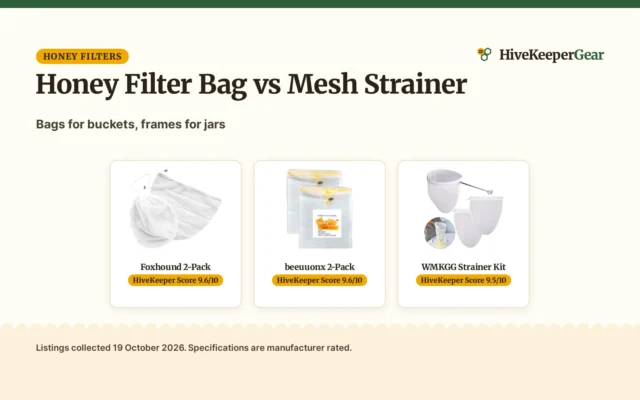
 Foxhound 2-Pack Honey Filter9.6/10View on Amazon
- 2
 beeuuonx 2-Pack Honey Filter9.6/10View on Amazon
- 3
 WMKGG Strainer Kit9.5/10View on Amazon
- 4
 SunVara Parent Honey Strainer Filter Honey Filter 2 PieceView on Amazon
- 5
 Stainless Steel Double Sieve Honey Strainer Filter for 5View on Amazon
- 6
 Stainless Steel Honey StrainerView on Amazon
- 7
 VIVO Double Sieve Stainless Steel Honey StrainerView on Amazon
- 8
 Little Giant® Honey StrainerView on Amazon
- 9
 XTrovbok Stainless Steel Honey Strainer for 5 Gallon BucketView on Amazon
Beekeepers ask why filter honey when harvesting comb, and the direct answer is to remove wax cappings, bee parts, and hive debris so the liquid stays clear and smooth without spoiling its natural raw qualities. Straining separates suspended hive particles that can cause uneven texture or unappealing surface rings in storage jars. Unlike high-heat commercial processing that strips pollen, apiary straining through mesh leaves natural pollen and enzymes intact while separating unwanted hive material. This guide explains how straining works, compares mesh ratings from harvest listings, and shows how to set up clean equipment for your harvest.
Other hives and gear to compare
 SunVara Parent Honey Strainer Filter Honey Filter 2 PieceCheck price on Amazon
 Stainless Steel Double Sieve Honey Strainer Filter for 5Check price on Amazon
 Stainless Steel Honey StrainerCheck price on Amazon
 VIVO Double Sieve Stainless Steel Honey StrainerCheck price on Amazon
 Little Giant® Honey StrainerCheck price on Amazon
 XTrovbok Stainless Steel Honey Strainer for 5 Gallon BucketCheck price on Amazon
HiveKeeperGear earns a commission when you buy through links on this site, at no extra cost to you. As an Amazon Associate I earn from qualifying purchases. Affiliate disclosure.
Before you strain: raw honey versus processed honey
Raw honey is unpasteurized honey taken directly from honeycombs, retaining the natural floral aromas and enzymes produced by bees. Straining raw honey is a mechanical separation process that removes physical hive debris from liquid honey. Unlike commercial processing, straining does not melt, pasteurize, or alter honey composition.
Industrial honey packers often use ultra-filtration under pressure to strip out all pollen grains. Removing pollen creates permanent clarity and prevents crystallization, but it strips away the botanical identity of the harvest. Apiary straining uses gravity through mesh screens to catch wax cappings while allowing natural pollen to remain. Because natural pollen remains in strained raw honey, it will still granulate naturally over time. Filtering honey at home or in a small apiary delivers clean, attractive honey in jars while keeping it genuine raw honey.
Why filter honey: harvest stages and mesh ratings
Harvesting comb produces honey mixed with cappings, propolis, and hive dust. Filtering honey in stages keeps equipment flowing smoothly. Pouring directly through fine mesh clogs the screen immediately with wax chips. Using a coarse screen followed by a fine screen separates large debris first, keeping the fine mesh open.
| Filter style | Mesh or micron rating | Material | Primary purpose | Our guide |
|---|---|---|---|---|
| Coarse upper sieve | 1875 microns | 304 stainless steel | Catches wax cappings and large comb fragments | Honey strainers |
| Fine lower sieve | 650 microns | 304 stainless steel | Refines smaller wax particles and debris | Mesh size guide |
| Medium filter bag | 400 microns | Food-grade nylon | Catches fine wax over 5-gallon buckets | 5-gallon bucket strainers |
| Fine filter net | 150 mesh | Nylon with steel rings | Separates small particles for clean bottling | Honey jars |
| Ultrafine filter bag | 125 mesh | Food-grade nylon | Captures minute residue for clear bottling | Jar dispensers |
All specs repeat what the manufacturer lists, not our own measurements. Listings from BEEKNOWS and NIZEFEI specify a double sieve system with an 1875-micron coarse upper mesh and a 650-micron fine lower mesh. Listings from BEEKNOWS also include a 400-micron nylon filter bag, while Dycica lists a 150-mesh nylon bag and beeuuonx lists a 125-mesh filter bag for 5-gallon containers. Other double sieve listings, such as MayBee and Honey Lake, list dimensions but do not state micron ratings.
1. Coarse straining for wax cappings
After uncapping comb with tools from our uncapping knife guide and spinning frames in equipment from our honey extractor guide, the honey contains broken wax cappings. Coarse filtration provides the initial physical barrier as honey drains from the extractor.
BEEKNOWS and NIZEFEI listings specify an upper coarse mesh of 1875 microns. A screen with 1875-micron openings stops large cappings, bee parts, and wood splinters while letting honey flow freely. MayBee and Honey Lake listings feature double sieve units measuring 9 inches in diameter by 4 inches in height, while BEEKNOWS lists a bowl diameter of 9.4 inches and a depth of 4 inches, providing generous capacity to collect wax buildup without overflowing.
2. Fine mesh straining
Once large cappings are separated, honey passes through a fine mesh screen. In double sieve units, honey drops directly from the upper coarse screen into a lower fine screen. NIZEFEI and BEEKNOWS list a lower fine mesh of 650 microns, which captures tiny wax flakes and comb dust.
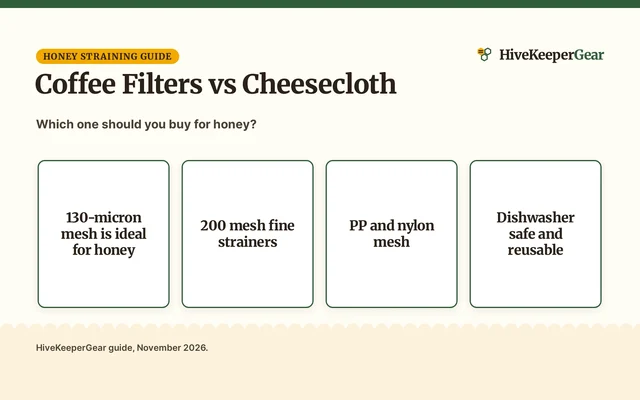
Beekeepers wanting further refinement can add cloth or nylon mesh filter bags. BEEKNOWS lists a 400-micron nylon filter bag. Dycica lists a 150-mesh nylon bag with an opening size of 0.01 inches, claiming it supports longer crystallization time, though natural pollen grains still pass through. beeuuonx lists a 125-mesh food-grade nylon bag. For small batches, Cunhill lists a 200-mesh nylon filter measuring 5 inches in diameter with an opening size of 0.01 inches. Fine mesh screens stop fine particulate matter while letting natural pollen grains pass through.
3. Bucket setup and collection
Straining requires a secure setup over a collection vessel. Most apiary setups filter honey directly into a food-grade 5-gallon bucket as it drains from the extractor gate. Double sieve strainers use extendable arms to rest across the bucket rim without slipping.
BEEKNOWS lists arms extending to 16 inches, MayBee lists extendable arms with a reach of 15.5 inches, and NIZEFEI lists adjustable arms extending from 10.1 inches to 16.7 inches, allowing hands-free pouring over 5-gallon buckets. Nylon filter bags use elastic or rings: BEEKNOWS and beeuuonx feature elastic bands that grip 5-gallon buckets, while Dycica includes steel rings that rest across the opening.
4. Gravity settling and skimming
After honey is strained into the collection bucket, gravity settling completes the clarification process. As honey flows through extractors and strainers, tiny air bubbles become suspended throughout the liquid. Sealing the bucket and letting it rest undisturbed allows lighter air bubbles and residual micro-wax specks to rise slowly to the surface.
Over time, rising air bubbles and fine wax particles form a pale foam layer on top of the liquid honey. Skimming this foam layer off with a clean spoon or paddle leaves clear, polished honey underneath. Combining mesh straining with post-strain settling prevents cloudy jars without needing industrial filters.
5. Bottling from the honey gate
The final step in the harvest process is dispensing clean honey into jars. Fitting the collection container with a valve from our honey gate for 5 gallon bucket guide allows clean bottling from the bottom of the bucket, beneath any surface foam.
Bottling from below prevents re-introducing air bubbles and produces a clean, professional presentation in glass containers from our honey jar sizes guide. Straining removes wax debris that would otherwise float to form a dark ring inside jar necks, ensuring the honey looks clean while retaining its natural raw qualities.
A step-by-step harvest straining workflow
Uncapping: Slice wax cappings from sealed honey frames over an uncapping tank.
Extracting: Spin uncapped frames in a machine from our how to use a honey extractor guide to extract liquid honey from comb cells.
Two-stage straining: Mount a double sieve or a nylon filter bag across a 5-gallon bucket beneath the extractor gate. Open the gate and allow honey to flow through the coarse and fine mesh.
Settling: Seal the collection bucket with an airtight lid and allow honey to rest undisturbed in a warm room so air bubbles and micro-foam rise to the surface.
Skimming: Remove the bucket lid and skim the white surface foam with a clean stainless scraper.
Bottling: Open the honey gate valve at the bucket base and fill clean jars smoothly, avoiding air splashes.
Helpful gear for harvest day
- A 304 stainless steel double sieve strainer with extendable arms fitting 5-gallon buckets.
- Spare nylon filter bags in 400-micron or 150-mesh ratings for quick changes during pouring.
- A food-grade 5-gallon bucket fitted with a secure honey gate valve.
- An uncapping knife and fork for handling frames cleanly.
- Clean stainless scrapers for skimming floating surface foam from settling buckets.
- A small jar strainer from our honey strainer for mason jar guide for smaller extraction lots.
What straining does not remove
Straining removes solid hive debris, but it leaves the natural composition of honey intact. Straining does not remove natural pollen grains, which remain in the honey because they are small enough to pass through mesh screens. It also preserves natural enzymes, aroma compounds, and floral flavors.
Straining cannot correct excessive water content. Honey must be harvested only when bees have properly ripened and capped the comb. Straining also does not prevent natural crystallization over time, because raw honey contains natural glucose nuclei and pollen. Comb that has already crystallized must be handled separately. For beekeepers, straining simply clarifies the harvest while protecting its raw qualities.
FAQs for beekeepers
Why filter honey instead of bottling it straight from the extractor?
Bottling straight from an extractor leaves wax cappings, bee parts, and hive dust suspended in the honey. These particles float to the jar neck, forming an unattractive dark ring and creating a gritty texture. Straining creates clean, clear honey with a smooth appearance while keeping natural pollen intact.
What is the difference between filtering honey and straining honey?
In backyard beekeeping, straining refers to gravity filtration using stainless steel mesh or nylon cloth, such as an 1875-micron coarse screen and a 650-micron fine screen. Straining removes wax debris without altering honey composition. Commercial ultra-filtration heats honey and forces it through fine industrial filters under high pressure, which strips out pollen.
What mesh size should be used to strain raw honey?
A double sieve setup with an 1875-micron upper mesh and a 650-micron lower mesh, as specified by BEEKNOWS and NIZEFEI, handles most harvest volumes. For nylon filter bags over 5-gallon buckets, ratings of 400 microns from BEEKNOWS or 150 mesh from Dycica deliver fine clarity.
Does filtering honey remove the beneficial pollen?
Standard apiary straining does not remove pollen. Natural pollen grains are microscopic and pass through 650-micron, 400-micron, 150-mesh, and 125-mesh screens without obstruction. Only high-pressure commercial ultra-filtration removes pollen from honey.
Can honey be strained without heating it?
Yes. Fresh raw honey flows through mesh screens under gravity at warm room temperature. Keeping honey supers in a warm room prior to extraction helps the honey flow steadily through the screens without requiring direct heat that could harm enzymes.
More hive guides
See every honey strainers guide and all honey harvesting guides, or browse our uncapping tools and honey extractors guides.
More picks: best honey strainer, honey strainer mesh size, and honey strainer for 5 gallon bucket. New to beekeeping? Start with our beekeeping equipment list for beginners.