Motorized vs Hand Crank Honey Extractor: Which One Should You Buy?
Compare motorized and hand crank honey extractors by extraction speed, physical fatigue, frame capacity, power supply needs, and apiary size to pick the right design.

On this page
Top picks at a glance
As an Amazon Associate I earn from qualifying purchases.
- 1
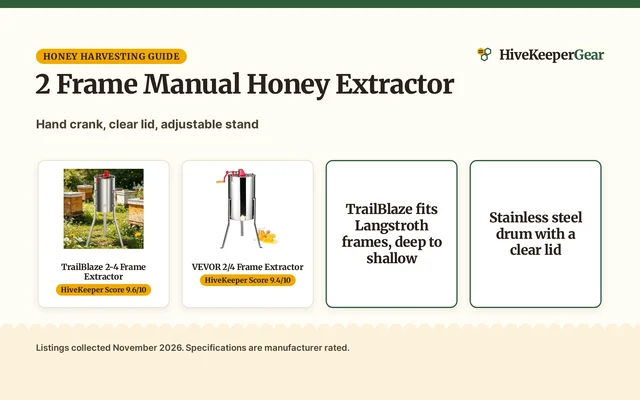
 TrailBlaze Stainless Steel Honey Extractor9.6/10View on Amazon
- 2
 VIVO Electric Honey Extractor for 4 or 8 Frame Rack Food9.7/10View on Amazon
- 3
 VIVO Honey Extractor 8 Frame Rack9.6/10View on Amazon
- 4
 MayBee 2 Pack Honey Gate Valve for ExtractorView on Amazon
- 5
 2Pcs Honey Gate Valve for ExtractorView on Amazon
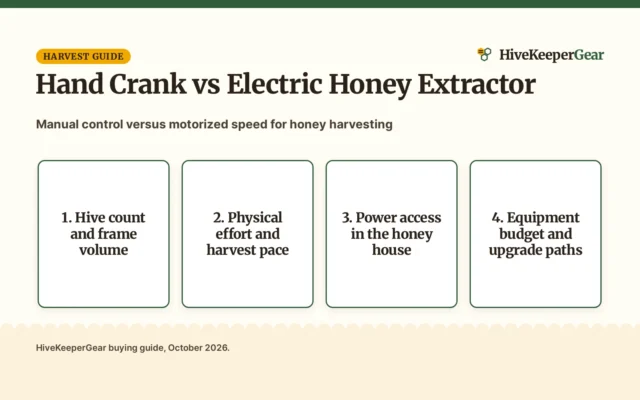
When late summer arrives and the main nectar flow comes to a close, beekeepers pull heavy, capped honey supers from the hives and face the central machinery decision of harvest day: choosing between a motorized vs hand crank honey extractor. A hand crank honey extractor is the sensible choice for a beginner or hobbyist managing a couple of backyard colonies, offering dependable extraction at a lower equipment investment without needing electrical outlets. A motorized honey extractor is the right choice for beekeepers managing expanding apiaries or multiple supers of honey, where motorized spinning eliminates physical arm fatigue and finishes extraction cycles in substantially less time. Deciding between them comes down to your colony count, your physical stamina during long harvest sessions, and whether your extraction workspace has access to electrical power.
Other hives and gear to compare
 MayBee 2 Pack Honey Gate Valve for ExtractorCheck price on Amazon
 2Pcs Honey Gate Valve for ExtractorCheck price on Amazon
HiveKeeperGear earns a commission when you buy through links on this site, at no extra cost to you. As an Amazon Associate I earn from qualifying purchases. Affiliate disclosure.
Motorized vs hand crank honey extractor: key differences
Both extractor types use centrifugal force to spin honey out of uncapped wax comb without destroying the delicate wax foundation, allowing you to return intact frames to your colonies. The primary difference lies in the drive mechanism that powers the spinning drum. Manual units rely on an operator turning a geared hand crank, whereas motorized extractors utilize an electric motor assembly to spin the internal frame basket at consistent speeds.
| Harvest Factor | Hand Crank Extractor | Motorized Extractor | Related Guide |
|---|---|---|---|
| Drive system | Manual steel gears with dual bearings | Electric motor assembly on 110V AC power | Honey extractors |
| Extraction speed | Variable rhythm dependent on operator effort | Consistent motorized rotation with speed settings | Extractor guide |
| Physical effort | Continuous manual turning causing arm fatigue | Motor-driven rotation requiring zero manual cranking | Manual extractors |
| Power requirement | Operates anywhere without electrical power | Requires standard 110V AC outlet or portable generator | Harvesting gear |
| Frame capacity | Commonly 2 frames per batch in compact drums | Accommodates 2 frames up to 6 or 8 frames | Extractor types |
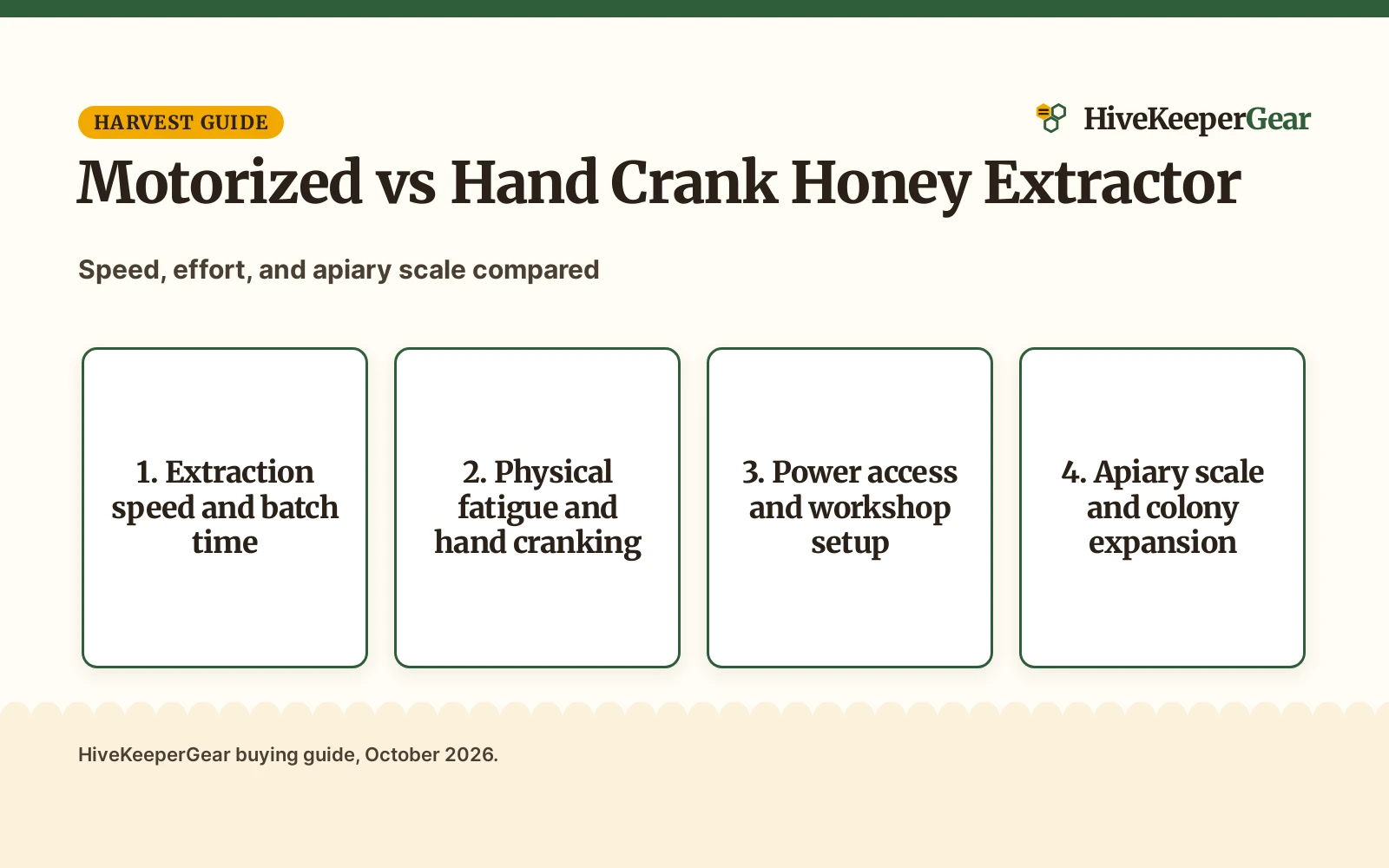
1. Extraction speed and batch efficiency
Extraction speed determines how quickly you can move through full supers of ripe honey on harvest day. When using a manual hand-crank unit, spinning speed depends entirely on your arm cadence. You must gradually accelerate the crank to spin out honey without blowing out delicate fresh comb, then maintain that rotational speed until the comb empties, and finally reverse or flip the frames to extract the opposing side. While a single batch feels manageable, processing multiple supers by hand creates a bottleneck in the honey house because the operator cannot leave the crank to uncap the next set of frames.
A motorized extractor decouples the spinning cycle from manual labor. Once you load uncapped frames and secure the lid, an electric motor spins the basket smoothly and maintains uniform rotational velocity. This allows you to step away from the extractor to uncap subsequent frames, prepare collection buckets, or inspect comb while the batch runs. Commercial-capacity electric units like the 蜂旺 electric extractor accommodate 6 or 8 frames simultaneously with variable speed adjustment, allowing high-throughput honey extraction that significantly cuts total harvest hours compared to manual spinning.
2. Physical fatigue and operator workload
Physical strain is the most noticeable difference between manual and motorized honey extraction. Hand cranking requires sustained rotational effort from your shoulder, elbow, and forearm. Because honey is dense and viscous, initiating drum rotation with heavy, honey-laden frames takes notable torque. Even with smooth dual-bearing assemblies and precision-machined gears, turning a hand crank across several consecutive hours leads to muscle fatigue, wrist soreness, and fatigue-related breaks that slow down harvest day.
Motorized extraction eliminates physical arm fatigue entirely. Instead of turning a steel handle against heavy inertial drag, you simply flip a switch or adjust a speed dial. The electric drive powers through the initial inertia of loaded frames effortlessly, maintaining smooth rotation without straining the beekeeper. For solo beekeepers, older keepers, or anyone managing multiple hives without a team of helpers, avoiding physical exhaustion turns a grueling day of manual cranking into an orderly, relaxed chore.
3. Power access and harvesting locations
Your extraction workspace determines whether an electric extractor is practical. Motorized extractors require a reliable source of electricity. For motorized extractors, GoodLand Bee Supply lists its HE2MOT 2-frame model with an electric motor assembly operating on standard 110V AC power. If your honey extracting occurs in a garage, kitchen, or dedicated honey house with household electrical outlets, plugging in is straightforward. However, if you extract outdoors in an outyard, inside an off-grid barn, or in a remote apiary without grid power, running a motorized unit requires hauling a heavy portable generator or an inverter power bank.
A hand-crank extractor delivers complete mechanical independence. Because it relies exclusively on human power, a manual extractor can be set up anywhere: on a covered porch, in a remote bee yard, or inside an outbuilding without utility connections. For beekeepers keeping colonies on remote outyard properties where transporting power equipment is inconvenient, the simplicity of a manual spinner provides unmatched flexibility.
4. Frame capacity and drum mechanics
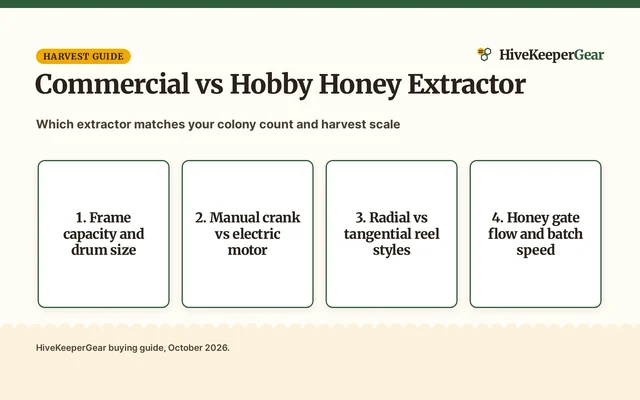
Extractors vary widely in internal basket size, frame orientation, and overall drum capacity. Smaller manual units are predominantly tangential designs built for compact footprints. For manual hand-crank extractors, Little Giant lists its EXT2SS 2-frame tangential extractor in 18/10 stainless steel, accommodating deep or medium frames with an item weight of 26.5 pounds and dimensions of 16 by 16 by 30 inches. In tangential models, the face of each comb rests parallel to the drum wall, requiring you to extract one side, stop the drum, rotate the frames, and spin the opposite side.
Manual extractors also feature specialized gear housings and outlet spouts. The Kaponbon 2-frame manual extractor listing specifies a double-bearing crank with forward and reverse rotation, a 1.77-inch diameter honey flow spout, an item weight of 20.5 pounds, and a honey holding capacity of 49.6 lbs. Similarly, the manual model from HIPUDNLM lists an item weight of 19.45 pounds, a 1.77-inch outlet, dual baskets holding 2 frames, and 49.6 lbs of honey capacity. Motorized models, such as the GoodLand Bee Supply HE2MOT with a frame cage measuring approximately 17 inches tall by 11 inches wide, accommodate deep, medium, or shallow Langstroth frames in a 22-gauge 304 stainless steel drum, providing motorized efficiency across varying frame depths.
5. Equipment maintenance, weight, and storage
Cleaning, handling, and seasonal storage are practical factors to evaluate before purchasing your harvest equipment. Manual extractors are lightweight and mechanically uncomplicated. Without electrical cords, motor enclosures, or switches to protect from water, washing a manual stainless steel drum with warm water is straightforward. Their lighter overall weight makes carrying the unit between your storage shed and extraction area manageable for a single person.
Motorized extractors are heavier and require more careful cleaning protocols. The GoodLand Bee Supply motorized extractor weighs 40.2 pounds and incorporates an adjustable 3 leg stand that elevates the drum to drain directly into a 5-gallon bucket. When washing motorized extractors, you must prevent wash water from entering the electric motor housing, switches, or wiring connections. In addition, electric drive gears and sealed bearings should be inspected periodically for wear, and replacement parts like drive belts, joints, or replacement motor assemblies must be sourced if electrical components degrade over seasons of use.
How to choose between manual and motorized
Selecting the right extractor design depends on your immediate harvest needs and your future beekeeping goals. Consider these central decision factors:
- Choose a hand crank extractor if you manage a small backyard apiary with a couple of colonies, harvest honey in off-grid outyards without electrical outlets, seek a lightweight machine that is simple to clean, or want to keep initial equipment costs low.
- Choose a motorized extractor if you manage multiple producing colonies, plan to expand your hive count in coming seasons, experience physical arm fatigue or joint discomfort when turning manual cranks, or want to uncap frames concurrently while the extractor spins unattended.
If you are just getting started and want to understand how manual extractors fit into a starter apiary setup, consult our guide on manual honey extractors, or explore our full honey extractor buying guide to compare configurations across both drive types.
Harvest setup essentials beyond the extractor
An extractor is only one component of a smooth honey extraction line. Regardless of whether you turn a manual crank or run an electric motor, you need complementary harvest equipment to uncap, strain, and store your honey crop cleanly:
- Uncapping tools: Before loading frames into the extractor basket, the wax cappings sealing the honey cells must be sliced or pricked open. Review our guide to the uncapping knife and uncapping tools to compare heated blades, cold knives, and uncapping rollers.
- Filtration and straining sieves: As honey flows from the extractor gate, it carries small bits of wax cappings and hive debris. Placing a dual-sieve system over your collection pail ensures clean, clear honey. Browse our top picks in honey strainers for coarse and fine stainless mesh setups.
- Bottling buckets and gates: Draining honey into a dedicated food-grade pail equipped with an airtight valve simplifies jar filling. See our recommendations for a honey bucket with gate to manage mess-free settling and bottling.
- Operational techniques: Learning proper drum balancing, comb handling, and spin speeds prevents comb blowout during harvest runs. Follow our detailed walkthrough on how to use a honey extractor for step-by-step guidance from loading to final cleanup.
FAQs for beekeepers
Can a beginner start with a motorized honey extractor?
Yes, beginners can use a motorized extractor if their budget permits and they have access to standard electrical power. An electric model eliminates the physical arm fatigue of manual cranking and allows the keeper to focus on learning clean uncapping and honey handling techniques.
How many frames do entry-level honey extractors hold?
Entry-level extractors typically feature a 2-frame basket capacity in compact drums, as seen on the Little Giant EXT2SS and GoodLand Bee Supply HE2MOT. Larger motorized units can accommodate 6 or 8 frames at once for faster batch turnaround.
What electrical power is needed for a motorized honey extractor?
Motorized extractors for backyard and small-scale beekeeping, such as the GoodLand Bee Supply HE2MOT, operate on standard household 110V AC electrical service. If extracting at an off-grid outyard, you must supply power with a portable generator or power inverter.
Does hand cranking damage delicate honeycomb foundation?
Hand cranking will not damage wax comb if you start the spin cycle slowly and accelerate gradually. Because manual spinners allow direct tactile control over rotational resistance, you can adjust crank speed carefully when handling fragile, newly drawn comb.
How much honey can manual extractor drums hold before draining?
Manual extractor drums from makers like Kaponbon and HIPUDNLM state a honey holding capacity of 49.6 lbs beneath the spinning basket. Draining through a 1.77-inch honey gate into a bucket prevents honey buildup from dragging against the spinning frame basket.
More hive guides
See every honey extractors guide and all honey harvesting guides.
More harvesting guides: explore our picks for uncapping tools, browse honey strainers, or check our radial vs tangential extractor comparison. New to apiary work? Start with our beekeeping supplies for beginners checklist.