Commercial vs Hobby Honey Extractor: Which One Should You Buy?
Compare commercial and hobby honey extractors by frame capacity, drive mechanisms, harvest volume, and workflow to pick the right extraction setup.

On this page
Top picks at a glance
As an Amazon Associate I earn from qualifying purchases.
- 1
 VIVO Electric Honey Extractor for 4 or 8 Frame Rack Food9.7/10View on Amazon
- 2
 VIVO Honey Extractor 8 Frame Rack9.6/10View on Amazon
- 3
 Goplus 3 Frame Honey Extractor9.6/10View on Amazon
- 4
 MayBee 2 Pack Honey Gate Valve for ExtractorView on Amazon
- 5
 2Pcs Honey Gate Valve for ExtractorView on Amazon
As the main summer nectar flow tapers off and honey supers sit heavy across the yard, deciding between a commercial vs hobby honey extractor comes down to your colony count, available harvesting time, and seasonal honey volume. For a beekeeper managing a small home apiary, a hobby honey extractor provides an accessible, compact way to spin comb without requiring permanent honey house space or heavy capital investment. Commercial honey extractors are engineered for larger operations where high frame capacity, motorized radial reels, and rapid cycle turnover are necessary to process supers efficiently before comb cools.
Other hives and gear to compare
 MayBee 2 Pack Honey Gate Valve for ExtractorCheck price on Amazon
 2Pcs Honey Gate Valve for ExtractorCheck price on Amazon
HiveKeeperGear earns a commission when you buy through links on this site, at no extra cost to you. As an Amazon Associate I earn from qualifying purchases. Affiliate disclosure.
Before you buy: assess your harvest volume and yard scale
Extracting honey is one of the most physically demanding tasks of the beekeeping year. Uncapping frames, loading baskets, spinning comb, and managing honey flow requires a smooth rhythm. Before investing in machinery, examine how many supers you pull during a typical harvest. A keeper managing a small backyard apiary might harvest occasionally during the season, while a commercial apiary processes truckloads of supers continuously. Matching the machine to your colony count avoids overspending on equipment that sits idle for months or buying an extractor so small that harvest weekend becomes an exhausting chore.
Space and cleaning requirements also dictate your choice. A small hobby spinner can be brought out to a garage or kitchen workspace for an afternoon and wiped down easily. A commercial unit requires dedicated floor space, reinforced mounting, and high-volume washdown drainage.
Commercial vs hobby honey extractor: comparison overview
Hobby extractors emphasize portability, simple manual or light electric drive mechanisms, and tangential or small radial baskets that store easily between seasons. Commercial units prioritize continuous batch processing, heavy stainless steel construction, variable-speed electric motors, and high-capacity radial reels that spin both sides of the comb simultaneously. The table below outlines how these two categories compare across essential workshop features.
| Factor | Hobby extractor | Commercial extractor | Related guide |
|---|---|---|---|
| Frame capacity | Modest capacity, such as 2 frames in entry manual units | Larger reels that hold more frames per load | Honey extractors |
| Drive mechanism | Manual hand crank or light motor | Electric motor for continuous running | Manual vs electric |
| Reel design | Often tangential, requiring manual flipping | Radial reel spinning both sides simultaneously | Reversible vs radial |
| Honey flow gate | Manual honey gate, such as a 1.77-inch diameter spout | Wider outlet, often feeding a pump | Conical vs flat bottom |
| Drum construction | Lightweight stainless steel for easy storage | Heavier stainless steel for stability | Seamless vs welded |
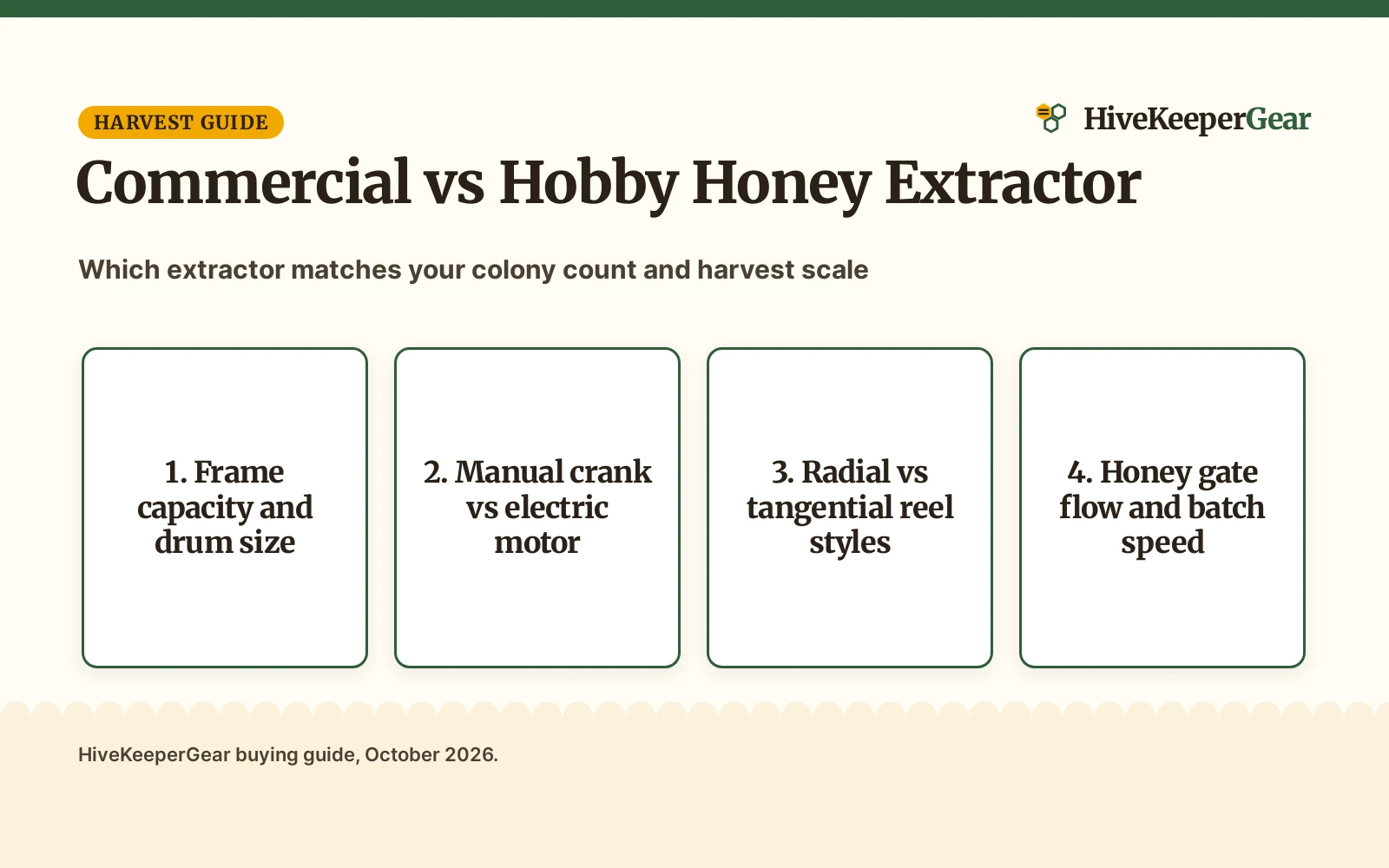
1. Frame capacity and drum volume
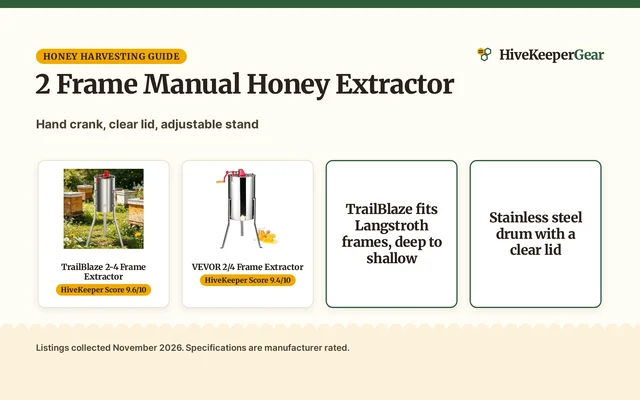
A primary distinction between hobby and commercial equipment is the frame capacity of the reel per spin cycle. Hobby extractors are designed for modest harvests. For example, a manual hobby extractor from Kaponbon is rated to handle 2 frames simultaneously, with a drum holding up to about 49.6 lbs of honey according to the maker. In common apiary practice, beekeepers keep the gate open so honey flows steadily into a collection bucket, preventing the reel from dragging through standing honey. That compact drum volume suits a hobbyist extracting several supers in an afternoon. Because the total weight of the Kaponbon unit is listed at 20.5 pounds, one person can easily carry the empty machine from storage to the work area.
In contrast, commercial extractors feature larger drum bodies engineered to hold more frames in a single loading cycle. That higher frame capacity means operators spend their hours uncapping and processing rather than repeatedly loading small baskets. For growing yards, learning how to use a honey extractor efficiently keeps frame loading smooth regardless of drum capacity.
2. Drive mechanism and motor power
Hobby extractors frequently rely on manual hand cranks, though some entry models offer light electric motors. Manual hobby extractors, like the 2-frame manual unit from Kaponbon, feature a double-bearing crank handle capable of forward and reverse rotation with a closed gear design to keep honey pristine. Hand cranking gives the beekeeper direct tactile control over rotational acceleration, which helps prevent blowing out delicate, freshly drawn wax comb during the spin. However, manual cranking requires physical endurance over extended sessions.
Commercial extractors typically rely on continuous-duty, high-torque electric motors. These motors maintain steady rotational speed under heavy centrifugal loads, feature variable-speed controllers with gradual ramp-up cycles, and allow the operator to uncap the next batch of frames while the extractor spins unattended. Beekeepers evaluating motorized options can compare drive systems in our hand crank vs electric honey extractor guide.
3. Radial versus tangential spinning
How frames sit inside the drum determines extraction efficiency. Many compact hobby units utilize a tangential basket layout where the comb faces the drum wall directly. In a tangential extractor, centrifugal force pulls honey from the outward-facing comb surface. To avoid breaking comb under centrifugal pressure, the operator spins the first side gently, flips each frame, spins the second side fully, then flips the frames back and finishes the first side. This extra step increases handling time per batch.
Commercial extractors operate on a radial design where top bars face outward toward the drum perimeter and bottom bars point toward the central axle. In a radial reel, centrifugal force draws honey from both sides of the comb at the same time, expelling it outward against the stainless steel drum walls. This eliminates manual frame flipping entirely, streamlining high-volume extraction. You can read more about reel geometry in our guide to radial vs tangential honey extractors.
4. Honey gate diameter and draining
As honey spins out of comb, it coats the interior drum walls and pools at the bottom of the extractor. Efficient drainage prevents the spinning reel from dragging through standing honey, which creates motor drag and introduces unwanted air bubbles. Hobby units feature a manual honey gate designed to drain honey into a settling pail through a sieve. The Kaponbon hobby model includes a 1.77-inch diameter honey flow spout with a sliding lid to direct liquid honey smoothly into collection pails.
Commercial extractors require higher discharge capacity. In a commercial setup, honey flows through larger outlets directly into heated sumps or mechanical pumps that move liquid honey into bulk storage tanks. Understanding how to manage settling and filtration is detailed in our honey strainers guide.
5. Physical footprint and apiary workflow
Physical footprint and storage considerations often decide the purchase for backyard beekeepers. A hobby extractor can be set atop a bench or sturdy legs during harvest weekend, washed with warm water, and tucked into a shed or garage corner for the remainder of the year. Its light build and modest footprint make seasonal storage effortless.
A commercial extractor, however, typically requires dedicated space in an extraction room or honey house with level flooring, stable mounting to manage rotational vibration, washdown plumbing, and wide doorways. Moving a commercial machine requires multiple helpers, making it a permanent apiary fixture rather than portable gear.
When to upgrade to a commercial extractor
Beekeepers rarely start with commercial extraction machinery. A common path begins with a manual hobby extractor for the first seasons while colonies establish and comb builds up. As an apiary expands from several backyard hives to numerous colonies across several bee yards, harvesting with a small extractor creates a severe bottleneck. When spending entire days hand-cranking or waiting on small batches begins to limit apiary growth, investing in a commercial radial machine becomes worthwhile in saved labor. For those considering an intermediate step, our guide on variable-speed extractors covers motorized options that bridge the gap.
What to keep in mind before harvesting
An extractor alone does not complete a honey harvest. You will also need bee removal tools such as escape boards or brushes to clear bees from supers before bringing boxes indoors. Extracting should always take place in an enclosed, bee-tight space with proper sanitation to prevent robbing bees from entering. We cover equipment specifications and harvesting mechanics only; for regional nectar flow dates or local food processing regulations, check with your local beekeeping association or agricultural extension office.
FAQs for beekeepers
Can a beginner start with a commercial honey extractor?
A beginner can use a commercial extractor if space allows, but the large size and high investment are usually unnecessary for managing a small home yard. A compact hobby unit handles early harvests comfortably while you learn the craft.
How many frames does a hobby extractor hold?
Hobby extractors typically hold small batches to keep the machine portable. For instance, the Kaponbon manual listing is rated to handle 2 frames at a time, with a drum capacity listed by the maker at about 49.6 lbs.
What is the main advantage of a commercial honey extractor?
The primary advantage is batch throughput. Commercial units spin more frames radially without requiring manual flipping, powered by electric motors that allow continuous operation throughout harvest day.
Is a manual honey extractor difficult to turn?
Manual extractors with smooth double bearings on the cranking handle turn with minimal resistance once spinning. However, extracting many frames by hand over several hours requires physical effort, making motorized options appealing as colony counts grow.
How do I clean and store a honey extractor?
Rinse the stainless steel drum with warm water to dissolve residual honey, avoiding harsh detergents that could taint future harvests. Dry the drum thoroughly to protect components, lubricate bearings with food-grade mineral oil if specified by the maker, and store the machine covered in a dry room.
More hive guides
See every Honey Extractors guide and all Honey Harvesting guides.
More picks: compare manual vs electric honey extractors, explore radial vs tangential honey extractors, or review our top honey extractor picks. New to beekeeping? Start with our guide to beekeeping supplies for beginners.