Seamless vs Welded Honey Extractor: Which One Should You Buy?
A comparison of seamless and welded honey extractor drums, focusing on sanitation, cleaning effort, honey gate construction, and long-term durability.

On this page
Top picks at a glance
As an Amazon Associate I earn from qualifying purchases.
- 1
 VIVO Electric Honey Extractor for 4 or 8 Frame Rack Food9.7/10View on Amazon
- 2
 VIVO Honey Extractor 8 Frame Rack9.6/10View on Amazon
- 3
 Goplus 3 Frame Honey Extractor9.6/10View on Amazon
- 4
 MayBee 2 Pack Honey Gate Valve for ExtractorView on Amazon
- 5
 2Pcs Honey Gate Valve for ExtractorView on Amazon
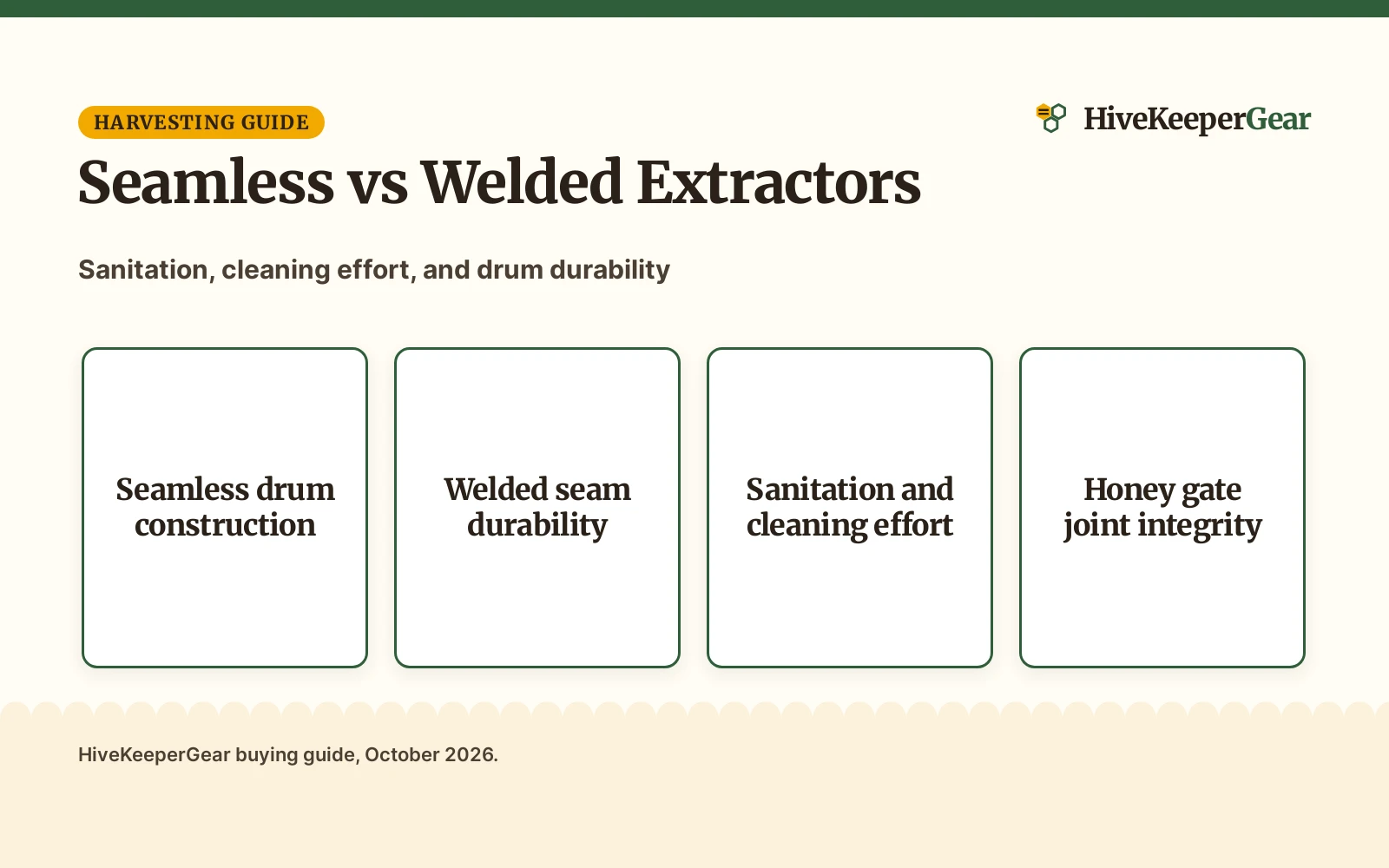
When honey supers fill the honey house at the end of the main nectar flow, evaluating a seamless vs welded honey extractor comes down to sanitation, cleaning speed, and durability. A seamless honey extractor represents the preferred choice for most beekeepers because its smooth stainless drum eliminates crevices where honey, wax, and wash water collect. A welded extractor still performs well if properly made, but requires extra vigilance during post-harvest cleanup. Below, we break down how drum construction affects extraction, hygiene, and maintenance step by step.
Other hives and gear to compare
 MayBee 2 Pack Honey Gate Valve for ExtractorCheck price on Amazon
 2Pcs Honey Gate Valve for ExtractorCheck price on Amazon
HiveKeeperGear earns a commission when you buy through links on this site, at no extra cost to you. As an Amazon Associate I earn from qualifying purchases. Affiliate disclosure.
How extractor drums are manufactured
An extractor drum serves as the outer containment tank during harvest. As uncapped frames spin inside the internal reel, centrifugal force flings honey against the drum walls, where gravity pulls it downward toward the drain. Because honey contacts the metal before flowing into settling tanks, drum fabrication directly affects harvest purity.
Drums described as seamless are produced through metal spinning, deep drawing, or precision seamless welding that finishes joints flush. The resulting interior surface is continuous and smooth. Welded drums are rolled from flat stainless sheets joined with vertical seams, with a separate floor piece welded into the cylinder. For an overview of available equipment, browse our guide to the best honey extractor models.
Seamless vs welded honey extractor: key differences
Choosing between drum designs involves balancing equipment availability against maintenance convenience. The comparison table below highlights key structural differences between both fabrication styles.
| Design Feature | Seamless Extractor | Welded Extractor |
|---|---|---|
| Drum wall | Smooth continuous cylinder without raised seams | Rolled sheet joined with a vertical weld |
| Floor joint | Smooth radiused curve or flush sanitary seam | Circumferential weld seam joining base to wall |
| Internal crevices | No seams along walls or floor transitions | Weld bead texture and potential micro-crevices |
| Cleaning effort | Quick wipe and warm water rinse | Scrubbing along seam beads and joint lines |
| Sanitation risk | Minimal risk of trapped wax or moisture | Higher risk of fermentation in uneven welds |
| Corrosion risk | Uniform stainless steel surface passivity | Heat-affected zones require thorough drying |
| Honey gate port | Smooth port opening with flat gasket seating | Welded or punched port with surrounding seam |
Drum sanitation and food hygiene
Honey is a raw food product that must remain clean from hive to jar. Although ripe honey resists bacteria due to low moisture and natural acidity, honey is hygroscopic. If wash water lingers in the drum or if residual honey in crevices absorbs humidity, sugar concentrations dilute, allowing wild yeasts to activate and cause fermentation.
A seamless extractor drum provides a polished interior without seams where honey, propolis, or wax can lodge. Honey sheets cleanly down the metal toward the gate, and rinse water drains completely away. In a welded drum, sanitation depends on weld quality. If a seam exhibits porosity or rough texture, microscopic pockets trap residue that can sour during seasonal storage.
Post-harvest washdown and cleaning effort
Cleaning equipment promptly after spinning supers prevents attracting robber bees to the honey house. Once extraction finishes, drums must be washed and dried before storage.
Cleaning a seamless drum requires minimal effort. Warm water sprayed along the rim dissolves residual honey, which flows freely out through the open honey gate. A soft cloth removes any remaining wax film, and the smooth floor transition leaves no corners where wash water pools. Welded drums demand methodical scrubbing. Beekeepers must inspect seams with a soft brush to clear wax cappings lodged in weld beads, ensuring joints dry thoroughly. To filter cappings as honey exits the drum, explore our guide to the best honey strainer options.
Long-term durability and weld integrity
Stainless steel resists rust through a passive chromium oxide layer that naturally forms on the surface when exposed to oxygen.
When stainless steel is welded, intense heat creates a heat-affected zone adjacent to the seam. High-grade manufacturers passivate these welds to restore corrosion resistance, but budget extractors with unpassivated seams can become vulnerable over time. Because raw honey is naturally acidic, poorly finished welds exposed to moisture during storage can develop localized pitting along the seam line. Seamless drum surfaces maintain a uniform passive layer across the interior, reducing the likelihood of localized corrosion.
Honey gate construction and leak prevention
The honey gate sits near the base of the drum, acting as the drain valve for harvested honey. This fitting endures mechanical stress whenever beekeepers open the valve or attach collection containers.
On seamless drums, the area surrounding the drain hole is smooth and continuous, allowing gate gaskets to seat flush against the tank wall without weld interference. On welded drums, gates placed close to seams or welded bungs require extra care to ensure a liquid-tight seal. Complete drainage depends on floor shape rather than seam construction; as detailed in our conical bottom vs flat bottom honey extractor guide, sloped bottoms assist gravity draining, while seamless walls ensure the outlet wipes clean. For operating advice, read our guide on how to use a honey extractor.
Vibration handling and basket alignment
Centrifugal extraction produces substantial kinetic force. Even when matching frames across the reel, comb density variations cause rotational wobble during spinning, transmitting vibration through bearings into the stationary drum and legs.
The extractor drum serves as the rigid chassis holding the top crossbar and lower bearing in alignment. A seamless drum offers consistent cylindrical geometry around its circumference, providing a level rim for mounting the upper crossbar. Welded drums provide comparable stability when built from sturdy stainless steel, though uneven weld cooling can occasionally pull budget drums slightly out of round. To compare drive and reel mechanisms, read our comparisons of manual vs electric honey extractor styles and radial vs tangential honey extractor baskets.
How to choose between seamless and welded extractors
When deciding between drum designs, consider your seasonal harvest volume, cleanup preferences, and budget.
A seamless honey extractor is the premier choice for beekeepers seeking rapid washdown, strict food sanitation, and long-term durability without seam maintenance. If you extract multiple times per season or want equipment that cleans in minutes, a seamless drum delivers noticeable convenience. A welded extractor remains a practical option for small apiaries where initial equipment availability matters most. When evaluating a welded model, verify that internal seams feel smooth and level. Pairing either drum style with an effective floor profile ensures dependable performance across every harvest season.
FAQs for beekeepers
Are seamless honey extractors easier to clean than welded extractors?
Yes. Seamless extractors lack raised weld beads and internal crevices along the drum walls and floor joint. Honey and wash water rinse away with warm water and a soft cloth, whereas welded drums require careful brushing along seams to clear trapped wax particles.
Can honey cause corrosion along welded extractor seams?
Honey is naturally acidic, and welding creates localized heat zones that can reduce corrosion resistance if seams are not properly passivated during manufacturing. Over seasons of damp storage, unpassivated welds can develop micro-pitting, whereas seamless drums maintain uniform corrosion resistance throughout the vessel.
Does drum construction affect honey purity?
Yes. Extractor drums act as food-contact surfaces during harvest. A seamless drum provides a continuous sanitary surface that prevents residual honey and wash water from stagnating, minimizing the risk of fermentation or wax buildup contaminating subsequent batches.
Why are welded honey extractors widely available?
Rolling flat stainless steel sheet and joining it with a standard weld requires less specialized tooling than spinning, deep-drawing, or precision seamless finishing. This simpler fabrication process makes traditionally welded extractors common among introductory equipment lines.
What should beekeepers check when inspecting a welded drum?
Run a clean cloth or gloved hand along the vertical wall seam and bottom rim. The weld bead should feel smooth, continuous, and level with adjacent sheet metal, showing no rough splatter, pinholes, or sharp edges that could harbor wax or tear cleaning rags.
More hive guides
Explore our complete harvesting coverage with our honey extractors category guide and all honey harvesting guides.
More picks: compare radial vs tangential honey extractor baskets, choose between manual vs electric honey extractor drives, or review our conical bottom vs flat bottom honey extractor guide. New to beekeeping? Check out our beekeeping supplies for beginners checklist.