Top Motor vs Bottom Motor Honey Extractor: Which One Should You Buy?
Compare top motor and bottom motor honey extractors by drum stability, frame loading clearance, honey gate height, and motor maintenance before choosing one.

On this page
Top picks at a glance
As an Amazon Associate I earn from qualifying purchases.
- 1
 Goplus 3 Frame Honey Extractor9.6/10View on Amazon
- 2
 VIVO Electric Honey Extractor for 4 or 8 Frame Rack Food9.7/10View on Amazon
- 3
 VIVO Honey Extractor 8 Frame Rack9.6/10View on Amazon
- 4
 MayBee 2 Pack Honey Gate Valve for ExtractorView on Amazon
- 5
 2Pcs Honey Gate Valve for ExtractorView on Amazon
When honey supers come off the hives at the close of the summer nectar flow, choosing a top motor vs bottom motor honey extractor determines how smoothly your harvest runs. A top motor honey extractor mounts the electric drive on the upper crossbar, keeping the motor above pooled honey for simple maintenance. A bottom motor honey extractor positions the drive beneath the drum, lowering the center of gravity to minimize wobble and leaving the top rim completely clear for loading frames.
Other hives and gear to compare
 MayBee 2 Pack Honey Gate Valve for ExtractorCheck price on Amazon
 2Pcs Honey Gate Valve for ExtractorCheck price on Amazon
HiveKeeperGear earns a commission when you buy through links on this site, at no extra cost to you. As an Amazon Associate I earn from qualifying purchases. Affiliate disclosure.
Before you buy: how motor placement changes your harvest
In a motorized honey extractor, a central axle spins a frame basket inside a stainless steel drum to sling honey out by centrifugal force. Top-mounted models secure the motor and controls atop a steel bridge across the upper rim, keeping the drive accessible and above the honey line. Bottom-mounted extractors place the motor and drive pulley underneath the tank, turning the axle from below to lower the center of gravity and leave the top opening clear. Both styles harvest honey effectively, but they differ in loading clearance, stability, drainage, and cleaning.
Top motor vs bottom motor honey extractor: key differences
Top motor extractors keep the drive simple and elevated away from draining honey. Bottom motor extractors prioritize open-top loading and reduced vibration during high-speed spinning.
| Feature | Top Motor Extractor | Bottom Motor Extractor |
|---|---|---|
| Drive placement | Crossbar spanning upper drum rim | Underneath drum base below tank floor |
| Frame loading | Partially obstructed by motor crossbar | Fully open rim for vertical frame drops |
| Drum stability | Higher center of gravity; prone to wobble | Lower center of gravity; reduced vibration |
| Honey contact risk | Zero contact; motor sits above honey | Requires sealed lower bearing against leaks |
| Underside clearance | Clear drum base; standard leg clearance | Requires ground clearance for motor housing |
| Cleaning | Crossbar removes or tilts away from water | Underneath motor must stay dry during wash |
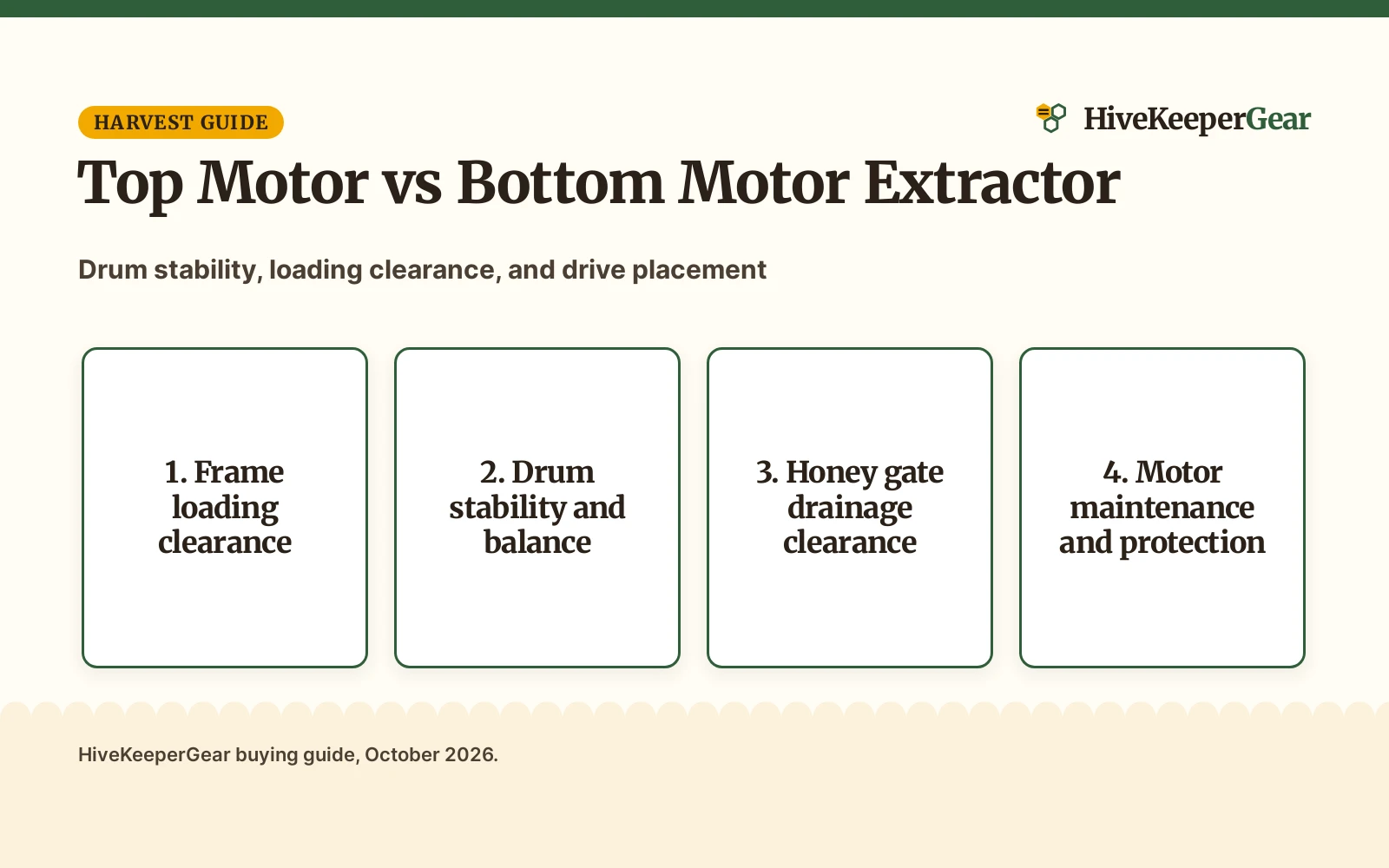
1. Frame loading and top opening clearance
On top motor extractors, a steel bridge spans the center of the drum, dividing the top opening. Beekeepers must angle frames around the central shaft and motor housing. For example, GoodLand Bee Supply builds motorized extractors for 2 frames with frame cage dimensions of 17 inches tall by 11 inches wide in a 22-gauge 304 stainless steel drum, while TECHTONGDA equips a 4 frame drum with an 18.9-inch barrel diameter and a 24-inch barrel height, both placing the drive bridge across the top opening.
Bottom motor extractors eliminate overhead obstructions. Because the motor connects beneath the tank, the entire rim remains clear when lids open. Beekeepers can lower frames straight down and lift dry comb out vertically, speeding up loading during large harvest runs.
2. Drum stability and center of gravity
Spinning comb generates rotational forces that amplify slight weight differences between frames. Top motor extractors place the motor at the highest point of the drum, creating a top-heavy balance that wobbles if frames are uneven. GoodLand Bee Supply lists an overall motorized extractor weight of 40.2 pounds on an adjustable 3 leg stand, while manual reference units like Kaponbon list an extractor weight of 20.5 pounds supporting up to 49.6 lbs of honey capacity. Clamping or bolting legs to a solid platform stabilizes top-heavy extractors.
Bottom motor extractors place the drive mass beneath the drum floor. This low center of gravity anchors the machine, dampening vibration and reducing drum sway during acceleration.
3. Motor protection and honey seal integrity
Top motor extractors mount the motor and wiring above the drum, so slung honey flows down the walls by gravity without contacting the drive. This eliminates liquid seals inside the honey reservoir.
Bottom motor extractors drive the central shaft through the drum floor, requiring a food-grade mechanical shaft seal and sealed bearings to prevent honey from leaking into the drive underneath. Beekeepers must inspect this lower seal to avoid bearing wear or motor drag.
4. Drum height and honey gate drainage
Top motor extractors leave the underside of the drum clear. GoodLand Bee Supply equips its motorized extractor with an adjustable 3 leg stand engineered to drain directly into a 5-gallon bucket, and reference specifications from Kaponbon note a 1.77-inch diameter honey flow spout. Paired with a honey strainer over a pail, top-mount extractors drain cleanly at standard working height.
Bottom motor extractors mount the drive under the center of the tank, with the honey gate positioned at the outer wall. The stand must provide sufficient ground clearance for the central motor assembly. To compare tank floor shapes, see our guide to conical bottom vs flat bottom honey extractor models.
5. Motor power and drive maintenance
TECHTONGDA equips its electric stainless steel extractor with a 140w motor operating at 280rpm on standard 110V power, with variable speed and a lid safety switch. GoodLand Bee Supply offers replacement HEMOTOR units on 110V AC power with a speed dial for 2 and 3 frame extractors. Variable speed lets beekeepers empty comb gently at low speed before accelerating.
Drive couplings also require routine inspection. VIVO provides replacement plastic bushing connectors in a 5 pack backed by a 1 Year Warranty, while Anvpkun offers a 6 pack of plastic bushings for 2 to 4 frame extractors. For drive designs, see our comparison of direct drive vs belt drive honey extractor models, or read how to use a honey extractor.
Harvest day workflow and operation
Uncapping frames: Remove wax cappings with an uncapping knife so honey drains freely.
Balancing the basket: Pair frames of similar weight opposite each other to minimize vibration.
Initial low-speed spin: Spin at low speed to empty the outer face without blowing out comb.
Flipping frames: Turn frames and increase speed to clear the second side thoroughly.
Draining through the gate: Keep the honey gate open so liquid drains into pails without dragging against the spinning basket.
Harvest accessories that help either drive
Supportive harvest accessories improve extraction with either drive style:
- Leg clamps or floor straps to anchor extractor legs against vibration.
- A double-sieve strainer resting over a food-grade bucket to filter wax.
- An uncapping fork for low comb pockets.
- Food-grade grease for drive joints and bearings.
- Spare drive bushings to replace worn couplings before harvest.
What is not on this list
This guide covers motorized extractors with top or bottom electric drives. For manual hand-crank options, see our motorized vs hand crank honey extractor guide. We exclude industrial multi-drum extraction lines, and we do not provide treatment advice or medical guidance for stings.
FAQs for beekeepers
Which motor position provides better drum stability during extraction?
Bottom-mounted motors provide superior drum stability because the drive mass sits low to the ground. Top-mounted models, like GoodLand Bee Supply units on a 3 leg stand, benefit from clamping the legs to minimize sway.
Is a top motor or bottom motor honey extractor easier to load with frames?
Bottom motor extractors are easier to load because the top rim is completely open. Top motor extractors require maneuvering frames around the overhead motor bridge.
Can honey leak into the motor on a bottom motor honey extractor?
Bottom motor extractors use sealed bearings and a food-grade shaft seal to keep honey inside the drum. Top motor extractors keep the drive completely above the honey reservoir.
What motor power and rotational speed do electric honey extractors use?
TECHTONGDA equips its 4 frame extractor with a 140w motor running at 280rpm on 110V power, while GoodLand Bee Supply provides 110V motors for 2 and 3 frame extractors.
Which extractor style is simpler to clean after harvest?
Top motor extractors allow beekeepers to remove the upper crossbar so the drum can be rinsed without wetting the motor. Bottom motor extractors require keeping wash water away from the underside drive.
More hive guides
See every honey extractors guide and all honey harvesting guides.
More picks: Honey extractors, radial vs tangential honey extractor, and conical bottom vs flat bottom honey extractor. New to beekeeping? Start with our beekeeping supplies for beginners checklist.