Direct Drive vs Belt Drive Honey Extractor: Which One Should You Buy?
Compare direct drive and belt drive honey extractors by examining motor torque, pulley wear, vibration dampening, and maintenance needs for your apiary.

On this page
Top picks at a glance
As an Amazon Associate I earn from qualifying purchases.
- 1
 VIVO Electric Honey Extractor for 4 or 8 Frame Rack Food9.7/10View on Amazon
- 2
 VIVO Honey Extractor 8 Frame Rack9.6/10View on Amazon
- 3
 Goplus 3 Frame Honey Extractor9.6/10View on Amazon
- 4
 MayBee 2 Pack Honey Gate Valve for ExtractorView on Amazon
- 5
 2Pcs Honey Gate Valve for ExtractorView on Amazon
When late summer honey supers come off the hives and extracting begins in the honey house, choosing between a direct drive vs belt drive honey extractor determines how smoothly your harvest runs. Direct drive mechanisms mount the motor directly to the basket spindle for quiet operation, compact storage, and no belt maintenance, while belt drive systems use pulleys and a drive belt to provide mechanical gear reduction and isolate the motor from basket vibration. Direct drive suits beekeepers who want a streamlined machine with fewer wear components, whereas belt drive benefits apiaries seeking mechanical torque multiplication and accessible replacement parts. We compared motor torque delivery, speed control, maintenance demands, acoustic noise, and frame protection to help you select the drive system that fits your apiary.
Other hives and gear to compare
 MayBee 2 Pack Honey Gate Valve for ExtractorCheck price on Amazon
 2Pcs Honey Gate Valve for ExtractorCheck price on Amazon
HiveKeeperGear earns a commission when you buy through links on this site, at no extra cost to you. As an Amazon Associate I earn from qualifying purchases. Affiliate disclosure.
How extractor drive systems work
A motorized honey extractor relies on mechanical power to spin frames of uncapped honeycomb inside a stainless steel drum. As the basket spins, centrifugal force pulls liquid honey out of wax cells and throws droplets against the interior drum wall, where honey drains downward toward the honey gate. The drive system bridges the gap between the electric motor and the central spindle that supports the spinning frame basket.
The mechanical difference between drive types lies in how rotational energy travels from the motor to that central spindle. Direct drive configurations connect the motor directly to the basket spindle without belts or external pulleys, delivering rotational power straight to the basket assembly. Belt drive configurations place the motor beside the drum rim and connect the motor shaft to the basket spindle using a small drive pulley, a continuous rubber belt, and a larger driven pulley. This difference in power transmission alters how torque reaches the frames, how much maintenance the machine demands across harvesting seasons, and how the drive assembly handles rotational strain from unbalanced comb.
Direct drive vs belt drive honey extractor: core differences
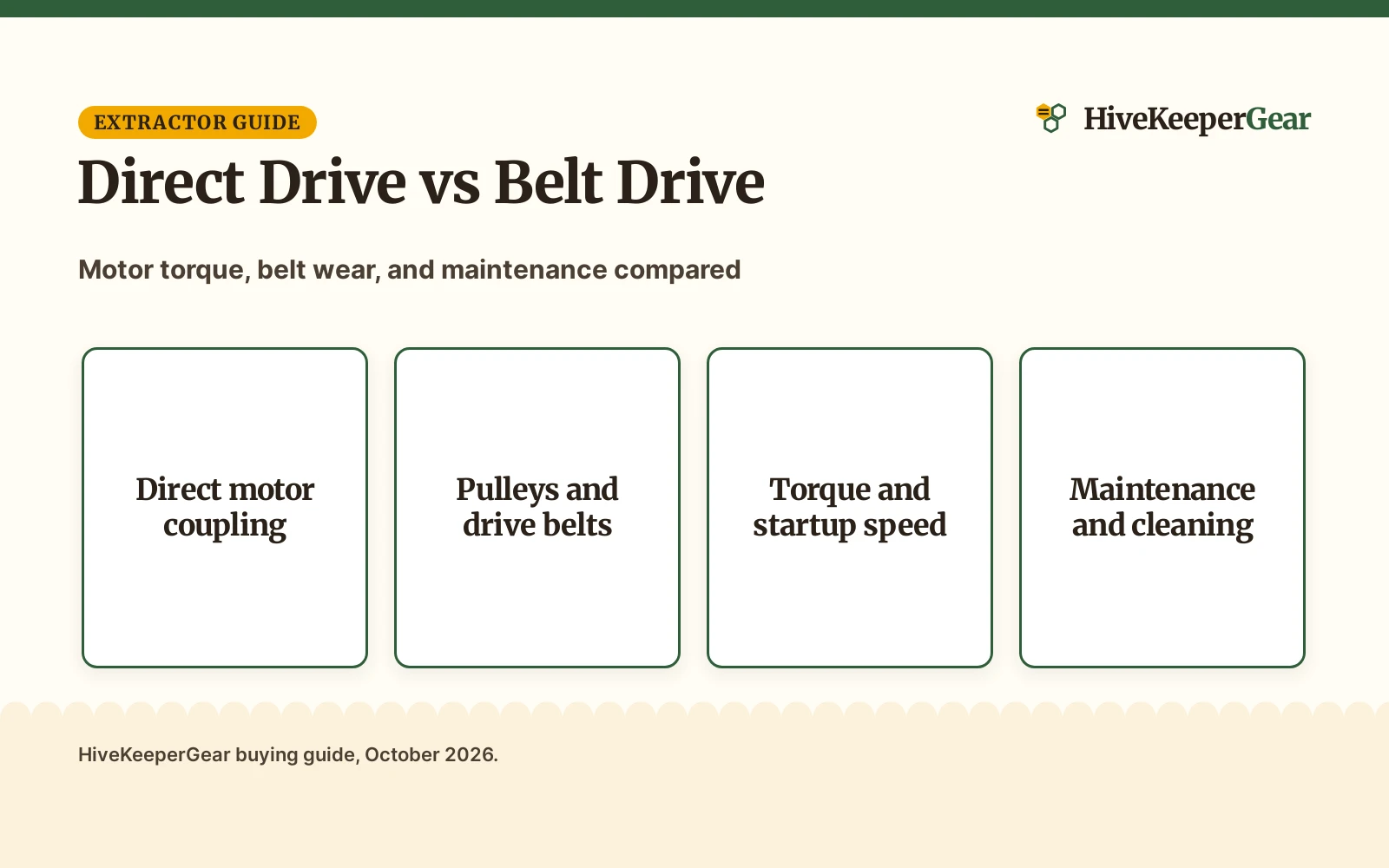
Understanding the mechanical differences helps clarify why each design appeals to different harvesting routines. Direct drive emphasizes mechanical simplicity, quiet running, and an enclosed profile with no belts to replace. Belt drive emphasizes mechanical torque multiplication through pulley reduction, physical motor isolation, and standard wear parts that an apiarist can replace without specialized tools.
| Feature | Direct Drive Extractor | Belt Drive Extractor |
|---|---|---|
| Mechanical connection | Motor shaft connects directly to the basket spindle | Motor turns a drive pulley connected by a belt to the spindle pulley |
| Moving components | Motor armature, shaft joint, and basket spindle | Motor shaft, drive pulley, rubber belt, driven pulley, and spindle |
| Torque delivery | Direct power transfer governed by electronic motor control | Mechanical torque multiplication through pulley reduction |
| Acoustic noise | Quiet operation with minimal mechanical whirring | Audible mechanical noise from belt travel and pulley rotation |
| Routine maintenance | Spindle bearing lubrication and motor housing wipe down | Periodic belt tension checks, pulley alignment, and belt replacement |
| Motor isolation | Motor mounts in line with spindle above or below drum | Motor mounts away from center, isolated by the flexible drive belt |
These mechanical distinctions influence everyday operation during harvest days, especially regarding how the machine manages rotational speed on heavy comb and how much upkeep the drive components demand between extraction seasons.
Motor torque and startup speed control
In honey extraction, managing startup speed and acceleration is critical because freshly drawn honeycomb and unreinforced wax comb are fragile when loaded with dense honey. When an extractor accelerates too abruptly, excessive centrifugal force can blow out comb walls, collapsing wax cells against frame wires or cage walls before honey has emptied from the comb.
Direct drive extractors transfer motor power immediately to the basket spindle. Without intermediate pulleys to create mechanical reduction, modern direct drive extractors rely on sophisticated electronic speed controllers that regulate current to ramp up rotational velocity smoothly. Apiarists upgrading from hand-turned equipment, as discussed in our comparison of manual vs electric honey extractors, find that electronic regulation makes direct drive manageable. When starting with heavy, uncapped frames, an operator begins at a low rotational speed until the bulk of honey empties before dialing up to higher finishing speeds.
Belt drive extractors manage startup loads through mechanical gear reduction. By combining a small pulley on the motor with a larger pulley on the basket spindle, the drive system multiplies motor torque while naturally reducing rotational speed. This mechanical advantage allows a modest motor to start a fully loaded basket without straining electrical components. Additionally, the slight elastic resilience of the rubber drive belt absorbs motor startup pulses, providing smooth mechanical engagement. While a properly tensioned belt maintains positive grip without slipping during normal acceleration, the belt can act as a mechanical buffer if a frame jams in the drum.
Drive belt wear and maintenance demands
Maintenance requirements reveal a major day-to-day distinction between these drive styles. Extraction takes place during warm summer and early autumn days when apiary equipment must run reliably without unexpected breakdowns.
Direct drive extractors provide minimal maintenance requirements throughout the harvesting season. Because the motor connects straight to the basket shaft, there are no drive belts to inspect, tension, or replace. There are no pulleys to align and no rubber dust shedding near the top of the drum. Routine care consists primarily of wiping down the motor casing, ensuring honey does not foul the shaft seal, and adding food-grade grease to the spindle bearing according to maker recommendations. For hobby beekeepers who extract honey during an annual harvest window and store the machine for the remainder of the year, direct drive eliminates concerns about rubber belts degrading during storage.
Belt drive extractors demand periodic mechanical attention to maintain proper operation. Drive belts are wear items made from reinforced rubber compounds that can stretch with prolonged use, dry out over multiple storage seasons, or lose tension. A belt with insufficient tension slips under load, causing squealing, friction heat, and loss of rotational speed. Maintaining a belt drive requires checking belt tension before each extraction season, adjusting motor bracket fasteners when slack develops, and verifying that the motor pulley remains in parallel alignment with the spindle pulley. If a belt wears out, an apiarist can readily source a standard industrial replacement belt from local suppliers to keep the harvest moving.
Vibration dampening and operating noise
Honey frames rarely weigh the exact same amount when pulled from supers. Variations in brood history, wax thickness, and nectar fullness mean that every basket load carries minor weight imbalances. When an extractor basket spins at full operating velocity, weight discrepancies create centrifugal wobble that causes the drum to vibrate.
Direct drive extractors operate with noticeably less mechanical noise because there are no belts rubbing across pulley grooves and no secondary pulley bearings rotating. However, because the motor connects directly to the spindle, rotational wobble from unbalanced frames transmits straight into the central drive assembly. If frames are severely unbalanced, this mechanical feedback can accelerate bearing wear and cause the extractor drum to shake unless frames are carefully balanced by weight across the basket. Proper frame sorting and weight balancing are essential when loading a direct drive basket.
Belt drive extractors provide mechanical vibration isolation between the basket and the motor. The flexible rubber belt acts as a dampener, absorbing lateral oscillations from an unbalanced basket rather than transmitting them directly into the motor shaft. Separating the motor from the center spindle also allows makers to isolate the motor mount. As noted in our review of radial vs tangential honey extractors, dampening rotational harmonics helps stabilize the drum during long extracting sessions, though the belt and pulleys do generate more audible whirring during operation than a direct drive setup.
Motor placement, washdown, and honey clearance
After uncapping frames and spinning out the crop, cleaning and sanitizing equipment is an essential step in honey harvesting. How motor placement interacts with water washdown and honey flow affects operational convenience.
Direct drive motors typically sit directly above the center of the extractor drum on the upper crossbar, or underneath the drum base. A top-mounted direct drive motor concentrates weight right above the center basket, keeping the overall footprint compact. However, washing out sticky honey residue from the upper drum walls requires caution to prevent water spray from penetrating motor ventilation openings or electrical switches. Maintaining a clean work area keeps the motor assembly free from sticky build-up.
Belt drive motors are offset from the center spindle, typically mounted beside the top crossbar or along the outer perimeter of the drum rim. Placing the motor away from the central basket opening keeps the motor housing further from warm wash water and honey splatter during frame loading and unloading. Honey extractors used alongside dedicated bottling pails, such as the setups detailed in our guide to the honey bucket with gate, benefit from open basket access when transferring frames from uncapping stations. For step-by-step operating recommendations, consult our walkthrough on how to use a honey extractor.
Which drive system fits your apiary
Selecting the right drive configuration depends on apiary scale, maintenance preferences, and how you manage comb preservation during the harvesting season.
Choose a direct drive honey extractor if you prioritize quiet operation, compact storage, quick setup, and freedom from belt maintenance. Hobby beekeepers managing a backyard yard benefit from direct drive simplicity because the machine requires no belt tensioning, no pulley alignment, and no stocking of spare drive belts. With fewer mechanical wear components exposed to dust, a direct drive model can sit on a storage shelf between seasons and remain ready for extracting whenever honey supers are filled.
Choose a belt drive honey extractor if you manage a growing apiary, spin heavy comb where mechanical gear reduction helps start large loads, or prefer equipment with easily sourced replacement parts. The pulley reduction of a belt drive multiplies motor torque to turn heavy frame baskets smoothly, while belt flexibility isolates motor bearings from frame wobble. If a belt wears out, an apiarist can purchase a standard replacement belt from an industrial supply merchant and resume extracting without waiting for proprietary motor attachments. For broader equipment comparisons across drum sizes and basket styles, review our comprehensive honey extractor buying guide.
FAQs for beekeepers
Can a direct drive honey extractor break fresh wax comb?
Any motorized extractor can break comb if accelerated too rapidly before honey empties. Direct drive units with electronic speed regulation allow operators to begin at a low rotational speed to protect delicate wax cells.
How often does a belt drive honey extractor need belt replacement?
Belt replacement depends on operating hours and storage conditions. Inspecting belt tension before each extraction season and replacing belts when signs of cracking, stretching, or slipping appear keeps the drive running reliably.
Is a direct drive honey extractor quieter than a belt drive model?
Yes. Direct drive extractors produce less mechanical noise because they eliminate belt friction, pulley whine, and belt vibration, running with only the quiet sound of the motor and spinning basket.
What happens if an extractor basket jams during operation?
On a belt drive extractor, a jammed basket allows the belt to slip or be thrown, which can help protect the motor from immediate burnout. On a direct drive extractor, a jam stalls the motor directly, requiring prompt shutoff to prevent electrical overload.
Can you convert a manual honey extractor to direct drive or belt drive?
Motor conversion kits are available for many manual extractors, with belt drive kits being common because an offset motor easily connects to existing top gears. Check manufacturer specifications to verify spindle compatibility before installing a motor kit.
More hive guides
See every honey extractor guide and all honey harvesting guides.
Related harvesting guides: compare top drive vs side drive extractors, explore uncapping tools for harvesting comb, or learn about filtering with a honey strainer.