Radial vs Tangential Honey Extractor: Which One Should You Buy?
Compare radial and tangential honey extractors to understand frame positioning, extraction speed, comb support, and which style matches your apiary workflow.

On this page
Top picks at a glance
As an Amazon Associate I earn from qualifying purchases.
- 1
 VIVO Electric Honey Extractor for 4 or 8 Frame Rack Food9.7/10View on Amazon
- 2
 VIVO Honey Extractor 8 Frame Rack9.6/10View on Amazon
- 3
 Goplus 3 Frame Honey Extractor9.6/10View on Amazon
- 4
 MayBee 2 Pack Honey Gate Valve for ExtractorView on Amazon
- 5
 2Pcs Honey Gate Valve for ExtractorView on Amazon
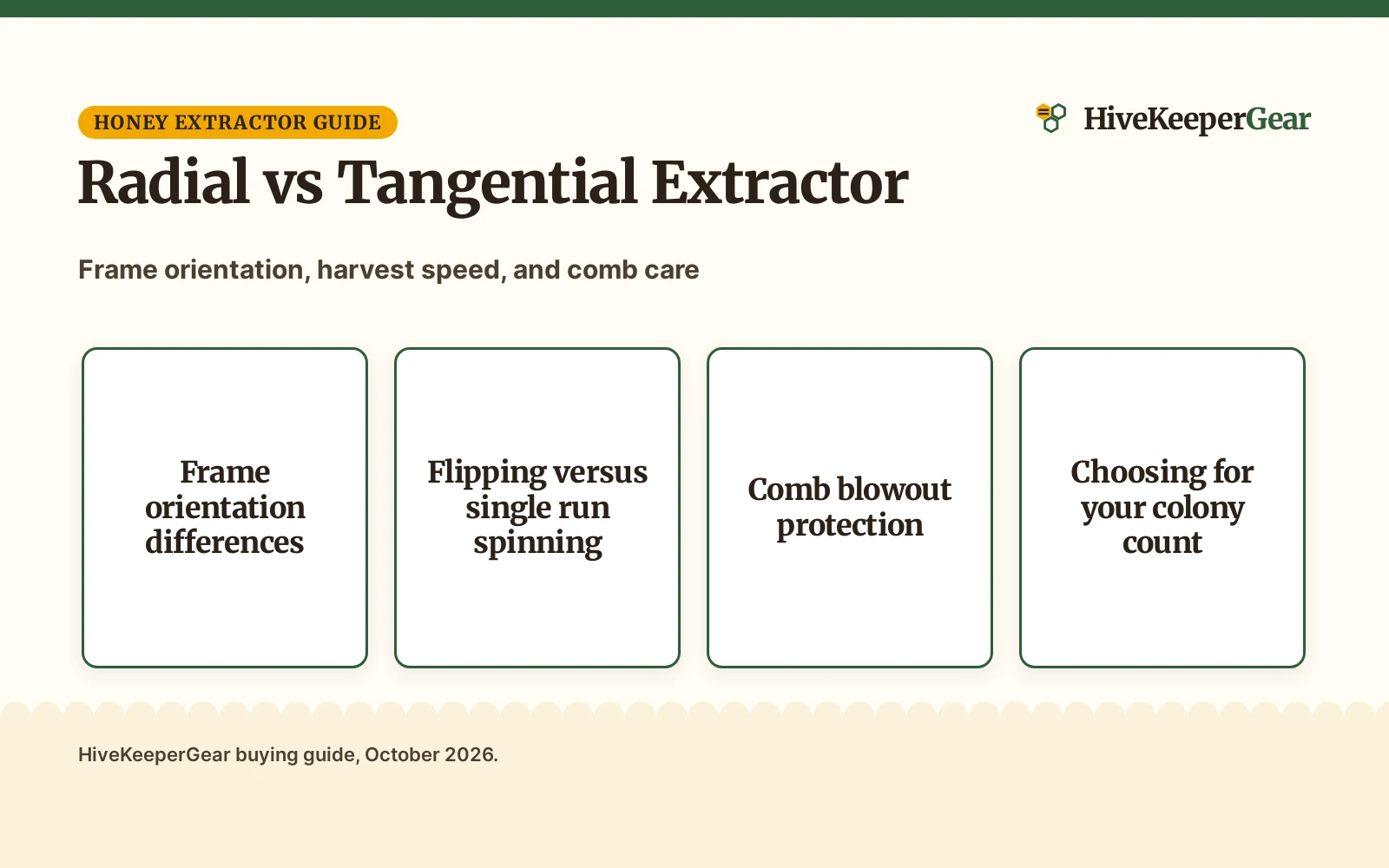
When the late summer nectar flow winds down and honey supers stack up in the apiary, deciding between a radial vs tangential honey extractor shapes your entire harvest workflow. A radial extractor holds frames like spokes on a wheel, extracting both comb faces simultaneously without mid-run flipping. A tangential extractor positions comb faces flat against perimeter basket screens to extract a single face per spin, requiring frame reversal while providing wire support for the wax. Backyard apiaries with few colonies often favor compact tangential units, while expanding yards processing multiple supers save hours with radial reels.
Other hives and gear to compare
 MayBee 2 Pack Honey Gate Valve for ExtractorCheck price on Amazon
 2Pcs Honey Gate Valve for ExtractorCheck price on Amazon
HiveKeeperGear earns a commission when you buy through links on this site, at no extra cost to you. As an Amazon Associate I earn from qualifying purchases. Affiliate disclosure.
Radial vs tangential honey extractor: key differences
The core distinction between both extractor styles lies in frame geometry relative to the rotational axis. Centrifugal force acts on uncapped comb cells, but comb orientation determines whether you must pause to reverse frames. The table below compares their mechanical performance and workflow trade-offs.
| Feature | Radial Extractor | Tangential Extractor | Beekeeper Impact |
|---|---|---|---|
| Frame placement | Spokes radiating outward from center spindle | Flat against basket grid perpendicular to radius | Radial accommodates more frames in equivalent drum width |
| Extraction cycle | Both comb faces extract simultaneously | Single comb face extracts per spin cycle | Tangential requires pausing the spin to reverse frames |
| Comb blowout risk | Low on reinforced comb; unreinforced wax can tear if spun fast | Protected by screen; midrib can rupture if spun fast before reversing | Both styles require gradual acceleration on delicate wax |
| Frame manipulation | Load initially, spin, and unload empty frames | Load, spin, reverse each frame, spin, finish | Radial cuts physical frame handling during harvest |
| Deep frame capacity | Requires barrel radius exceeding frame depth | Accommodates deep frames across basket chord | Tangential allows narrower drums to accept tall deep frames |
| Recommended scale | Multi-super harvests and expanding apiaries | Small-scale harvests and modest colony counts | Radial prioritizes processing speed; tangential saves space |
Understanding frame orientation and physics
Honeybees construct comb cells tilted slightly upward toward the top bar of the frame. This natural incline keeps raw nectar from slumping before bees dehydrate and cap it with wax.
A radial extractor utilizes this geometry directly. Frames stand vertically in the reel with top bars facing outward toward the stationary drum wall. As the reel rotates, centrifugal force flings honey out of the angled cells along the comb surface from both faces at the same time, draining down the barrel wall into the sump.
In a tangential extractor, frames sit flat against perimeter basket screens. Centrifugal force pulls honey straight out of the outward-facing cells. However, the inward-facing cells remain blocked behind the wax foundation. Because centrifugal force cannot pull honey through the solid midrib, only the outward face empties during a run.
Extraction workflow: simultaneous spinning versus manual flipping
The mechanical difference between both designs dictates how much time you spend processing supers after uncapping frames with an uncapping knife.
A radial workflow is continuous. Once loaded, the operator secures the transparent lid and accelerates smoothly so honey flows without stressing the comb. Because both faces empty together, the cycle runs without interruption, leaving frames evacuated in a single operation.
A tangential workflow requires staged spinning to protect the wax:
- Preliminary spin: Spin gently at moderate speed to clear partial honey weight from the outward face.
- Reversing frames: Stop the machine, reverse each frame so the opposite face points outward, and reseat it in the basket.
- Opposite face extraction: Spin the reverse face up to operational speed, emptying that comb surface completely.
- Final spin: Stop the machine, reverse the frames again, and spin at full speed to evacuate remaining honey from the initial face.
For a few garden hives, reversing frames remains manageable. When processing multiple supers, however, repetitive stops and reversals add substantial time to the harvest.
Comb blowout risk and wax preservation
Drawn comb represents significant nectar and energy investment by worker bees. Returning intact drawn comb after harvest allows colonies to store surplus nectar immediately without rebuilding wax foundation.
Comb blowout happens when hydrostatic pressure from heavy honey collapses delicate cell walls. Tangential baskets support the comb face directly against wire mesh screens, preventing fresh wax from blowing outward under moderate speeds. However, spinning too fast before reversing frames forces the heavy honey behind the midrib straight through the comb. Staged spinning prevents this pressure buildup.
Radial reels distribute centrifugal force along the foundation plane toward the top bar rather than pressing against the midrib. This protects reinforced comb exceptionally well, allowing wired wax and plastic foundation in medium frames for honey supers to spin at full speed. However, unreinforced foundationless comb lacks backstop support in a radial reel and can tear if spun aggressively.
Drum dimensions, frame fit, and manual operation
Because radial reels hold frames extending outward like spokes, the drum radius must exceed the depth of the frame plus spindle clearance. Radial extractors accommodating deep frames require wide barrels, making compact radial extractors best suited for medium and shallow supers.
In entry-level equipment, a tangential layout fits deep frames within narrower drums. For example, VEVOR publishes reference specifications for a manual model with a drum measuring 28 inches tall by 16 inches wide, accommodating deep frames measuring 18.9 inches by 9 inches (48 by 23 cm) and medium frames measuring 18.9 inches by 6.3 inches (48 by 16 cm). In that configuration, the maker lists a capacity for up to 2 deep frames and 2 medium frames, with an overall weight of 21.4 pounds. While commercial apiaries use wider motorized units, compact manual drums of these dimensions provide a practical footprint for hobbyists.
The VEVOR manual listing also includes height adjustable legs ranging from 39.3 inches (100 cm) to 42.5 inches (108 cm) that bolt to plywood for stability during hand cranking, leaving clearance underneath the gate to position a settling pail and honey strainer. For drive comparisons, our guides on manual vs electric honey extractor options and hand crank vs electric honey extractor models detail motor kit trade-offs.
Harvest room setup: uncapping, straining, and bottling
An extractor anchors your harvest workspace alongside uncapping tools and straining buckets.
Before loading frames, wax cappings must be removed. Using a heated blade or cold serrated tool from our uncapping tools guide cleanly removes cappings, while an uncapping fork clears low spots without gouging foundation. Reviewing what an uncapping knife is helps match tool styles to your harvest volume.
As honey drains from the bottom gate, a double sieve positioned over a honey bucket with gate filters wax debris. Our overview on why filter honey outlines how mesh porosity protects clarity while preserving natural pollen. If managing brood boxes alongside supers, dedicating separate gear for deep frames for brood rearing keeps brood comb out of your honey extractor.
Which honey extractor style should you choose?
Choosing between radial and tangential equipment depends on your colony count, frame sizes, and harvest ambitions.
Choose a tangential extractor if:
- You manage a small backyard apiary and harvest occasionally during the season.
- You harvest deep frames and prefer a compact drum that fits through standard doorways.
- You spin delicate foundationless comb that relies on wire basket screens for support.
- You want an accessible starter unit. See our manual honey extractor guide for hand-crank tips.
Choose a radial extractor if:
- You manage an expanding apiary with plans to grow colony numbers.
- Your honey comes primarily from medium or shallow supers with wired or plastic foundation.
- You want to eliminate the labor of pausing, lifting, and reversing sticky frames.
- Processing speed is your top priority. Browse our roundup of the best honey extractor picks to compare radial models.
Local beekeeping clubs often lend extractors, providing a practical way to evaluate both reel styles before buying.
FAQs for beekeepers
What is a radial honey extractor?
A radial extractor arranges frames like wheel spokes with top bars facing outward. Centrifugal force extracts honey from both comb faces simultaneously without requiring frame reversal.
What is a tangential honey extractor?
A tangential extractor holds frames flat against perimeter screens. Centrifugal force empties only the outward-facing cells, requiring the operator to stop and reverse frames to extract the opposite face.
How long does a manual honey extractor take?
Manual extraction time depends on honey warmth, viscosity, and basket type. A radial reel empties both faces in a continuous run of several minutes, while a tangential reel requires staged spins with pauses to reverse frames.
How to clean a manual honey extractor?
Rinse the drum interior, basket, and honey gate with cold or lukewarm water to dissolve honey without melting beeswax onto metal. Wipe dry with a cloth and lubricate drive gears with food-grade mineral oil.
How to clean a stainless steel honey extractor?
Rinse away honey and wax bits using cold water first so wax does not melt into seams. Wash with lukewarm water and mild dish soap using a soft sponge, rinse clean, and leave the gate open to dry.
More hive guides
Browse every guide by category: honey harvesting, honey extractors, hive tools, beehives, and protective gear.
More harvest resources: learn how to use a honey extractor, evaluate manual vs electric honey extractor options, or find sieves in our guide to the best honey strainer options.