Reversible vs Radial Honey Extractor: Which One Should You Buy?
Compare reversible and radial honey extractors to understand how basket orientation affects comb blowout, batch harvest speed, and frame handling.

On this page
Top picks at a glance
As an Amazon Associate I earn from qualifying purchases.
- 1
 VIVO Electric Honey Extractor for 4 or 8 Frame Rack Food9.7/10View on Amazon
- 2
 VIVO Honey Extractor 8 Frame Rack9.6/10View on Amazon
- 3
 Goplus 3 Frame Honey Extractor9.6/10View on Amazon
- 4
 MayBee 2 Pack Honey Gate Valve for ExtractorView on Amazon
- 5
 2Pcs Honey Gate Valve for ExtractorView on Amazon
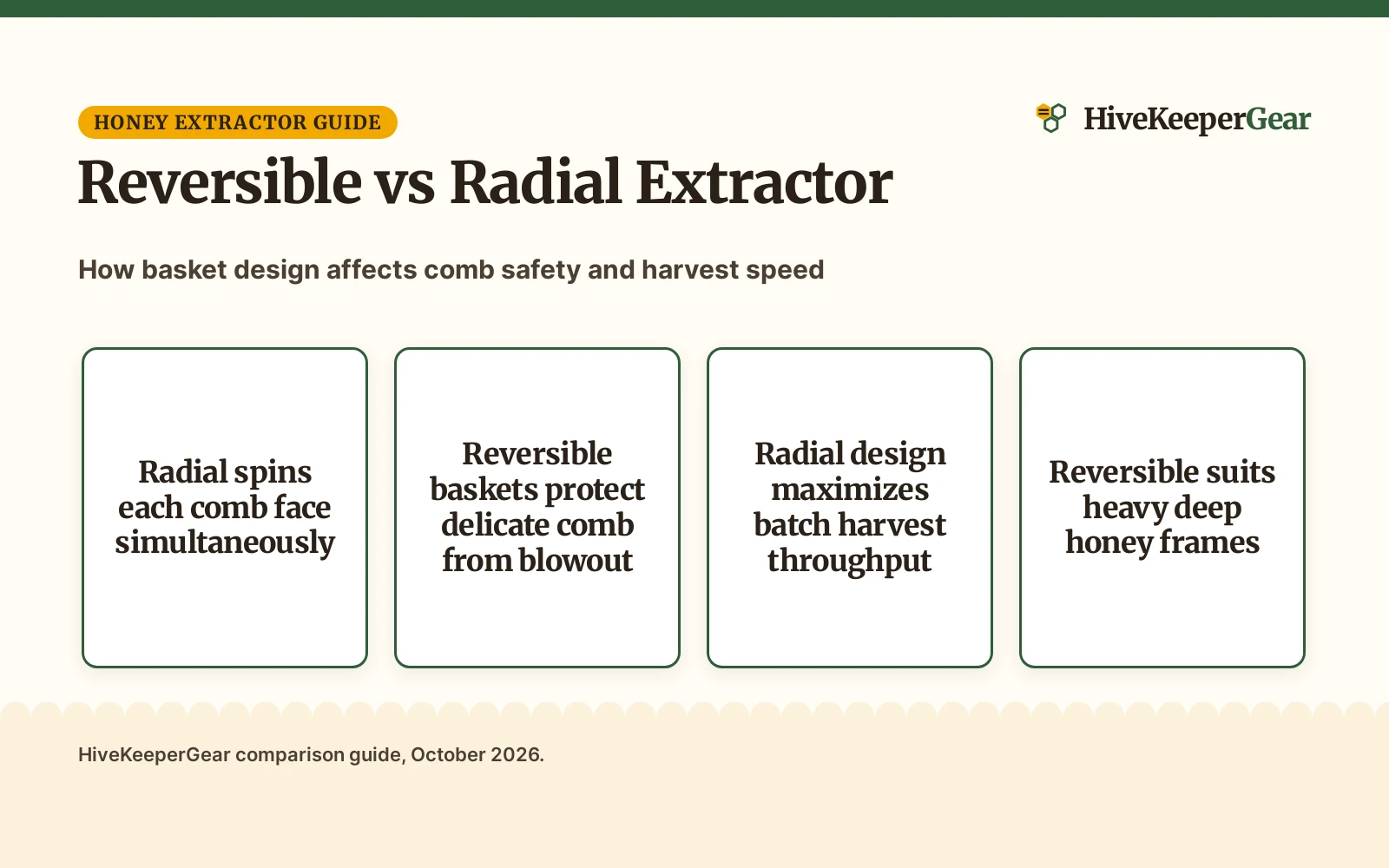
As the main summer honey flow winds down and honey supers fill the extraction room with the warm scent of beeswax, deciding between a reversible vs radial honey extractor comes down to your frame sizes, comb age, and harvest volume. For beekeepers running shallow or medium supers, a radial extractor is the practical choice because it spins honey from each face of every frame simultaneously to speed up batch processing. A reversible extractor is the better investment if you regularly harvest heavy deep frames or fragile foundationless combs, because its pivoting tangential baskets support the wax face directly against wire mesh to prevent comb blowout.
Other hives and gear to compare
 MayBee 2 Pack Honey Gate Valve for ExtractorCheck price on Amazon
 2Pcs Honey Gate Valve for ExtractorCheck price on Amazon
HiveKeeperGear earns a commission when you buy through links on this site, at no extra cost to you. As an Amazon Associate I earn from qualifying purchases. Affiliate disclosure.
Understanding extractor reel geometry
Centrifugal extractors remove honey from uncapped honeycomb without destroying the wax structure, allowing bees to refill the empty comb during subsequent nectar flows. The mechanical difference between extractor models lies in how frames sit inside the spinning drum relative to the central drive shaft. In a tangential arrangement, the comb face rests parallel to the outer drum wall, with honey slinging directly outward against the stainless steel perimeter. In a radial arrangement, frames sit like spokes in a bicycle wheel, with top bars facing the drum perimeter and bottom bars pointing inward toward the center axle.
Traditional tangential extractors require stopping the reel mid-cycle to pull frames out by hand, turn them around, and reinsert them to spin the opposing comb face. Modern designs overcome this manual handling through automated swinging baskets or radial reel geometry. To understand how basic tangential baskets contrast with spoke-style loading, review our detailed guide to radial vs tangential honey extractor designs.
Reversible vs radial honey extractor: how each design works
A reversible honey extractor is an advanced tangential machine equipped with hinged, swinging wire baskets. When the basket rotor accelerates, inertia and directional linkages cause each basket to pivot flat against the outer perimeter, exposing the outward-facing comb to direct centrifugal force. When that face clears, the operator slows the rotor and engages reverse rotation. The baskets swing smoothly on their pivots to present the opposite comb face against the drum wall, clearing the entire frame without manual handling.
A radial honey extractor takes advantage of natural comb architecture. Honeybees build honeycomb cells with a slight upward tilt toward the top bar of the frame. By positioning frames radially with top bars facing the outer wall, centrifugal force pulls honey outward along the natural angle of the cells. As the reel spins, honey discharges from cell openings on both faces of the comb at the exact same moment, draining down the drum walls to the honey gate below.
| Feature | Radial Extractor | Reversible Extractor |
|---|---|---|
| Frame orientation | Top bar points outward toward drum perimeter | Comb face sits flat against tangential basket mesh |
| Extraction cycle | Spins honey from each comb face simultaneously | Spins outward face, baskets pivot, spins reverse face |
| Comb face support | Centrifugal force acts along the comb midrib | Full wire mesh backing supports entire comb face |
| Optimal frame sizes | Shallow and medium honey supers | Deep brood frames and medium honey supers |
| Blowout vulnerability | Higher on warm, fresh, or heavy deep combs | Minimal due to continuous wire basket backing |
| Turnaround efficiency | Continuous single run without reversing rotation | Requires multi-stage cycles with rotation reversal |
| Reel mechanisms | Fixed vertical slots or spoke channels | Hinged swing baskets with mechanical linkages |
| Recommended apiary fit | Expanding yards prioritizing rapid supers processing | Keepers extracting deep combs or delicate natural wax |
Comb support and blowout prevention
Wax comb integrity is a primary concern during extraction. Freshly drawn beeswax, natural foundationless combs, and fully capped deep frames carry significant weight. When warm honey spins out of cells, internal hydraulic pressure pushes against the wax cell walls. If that pressure exceeds the structural strength of the wax, the comb tears, collapses, or blows out entirely, ruining drawn comb that required substantial bee energy to produce.
Reversible extractors excel at comb protection because the wire mesh of each swing basket cradles the entire surface of the comb. During an extraction cycle, the operator runs a gentle initial spin on the outward face to remove surface honey and relieve internal pressure. The rotor then reverses direction, allowing the opposing face to be emptied completely at higher speed against the basket mesh. A final clearing spin on the initial face finishes the job without structural damage. Before loading delicate combs into any extractor, using a proper uncapping knife ensures clean cappings removal without gouging underlying cell walls.
Batch processing speed and harvest workflow
When multiple honey supers await extraction, harvest day efficiency depends on batch throughput. Radial extractors are widely recognized as the standard for efficient processing because they do not require basket swing clearance. A radial drum of a given diameter accommodates substantially more frames than a reversible drum of matching size. Because honey exits each comb face simultaneously, an entire batch finishes in an uninterrupted run.
Reversible extractors, by contrast, require a structured multi-stage spin routine to prevent comb blowout: a low-speed run for the outward face, a full-speed run in reverse for the opposing face, and a final clearing run for the initial face. While swinging baskets eliminate the tedious chore of lifting frames by hand, managing rotation directions and speed adjustments adds time to every batch. Apiaries focused on rapid turnaround across multiple shallow or medium supers achieve faster results with radial machines. To learn about proper operational techniques and loading balance, read our step-by-step walkthrough on how to use a honey extractor.
Frame compatibility across hive depths
Standard Langstroth equipment includes shallow, medium, and deep boxes. Frame depth plays a critical role in choosing between radial and reversible mechanisms. Shallow and medium frames are ideal for radial extraction. Because their comb height is compact, the distance between the bottom bar and top bar is short, ensuring relatively uniform centrifugal force across the entire comb face.
Deep frames present a physical challenge inside radial extractors. In compact or mid-sized radial drums, the bottom bar of a deep frame sits close to the central axle where rotational velocity and centrifugal force are low, while the top bar spins near the outer rim where force is highest. This velocity gradient can leave honey stranded near the bottom bar unless the reel spins at high speeds that risk blowing out the top portion of the comb. Reversible extractors eliminate this gradient entirely. Because deep frames sit tangentially against the outer drum perimeter, every section of the comb face experiences identical centrifugal force from top to bottom.
Drive mechanisms and power options
Reversible and radial extractors come in manual hand-crank and electric motorized configurations. Hand-crank models work well for a modest apiary, offering portability and independence from electrical outlets. However, operating a reversible machine by hand requires stopping the reel, reversing crank direction, and gradually building speed across multiple cycle stages.
Electric motorized drives transform extractor performance, particularly for reversible units with automated cycle programmers. Advanced electric reversible extractors feature variable-speed controllers that automatically execute the initial gentle spin, reverse the basket direction, ramp up to full speed, and complete the final clearing spin without operator intervention. If you are debating between manual and powered drive systems, consult our guide to manual vs electric honey extractor models.
Choosing the right extractor for your apiary
Selecting between these extractor styles comes down to your comb management, frame standardization, and seasonal harvest volume:
- Choose a radial honey extractor if: you harvest primarily from shallow or medium honey supers, use wired wax or plastic foundation, manage multiple production colonies, and prioritize fast batch processing without stopping to reverse rotation. Explore our comprehensive reviews of top honey extractors to compare commercial and hobby designs.
- Choose a reversible honey extractor if: you extract honey from deep brood frames, manage delicate foundationless combs or cut-comb wax, frequently process thick or cold honey, or want the absolute highest level of comb face support during extraction.
Regardless of which basket design you select, draining honey directly into a settling tank through a stainless mesh honey strainer keeps your bottled harvest clear of wax particles and hive debris.
FAQs for beekeepers
Can deep frames be extracted in a radial honey extractor?
Deep frames fit radially only in large commercial extractors where drum diameter provides adequate clearance and balanced centrifugal force. In compact radial drums, deep frames must be extracted tangentially or processed in a reversible machine to avoid uneven extraction and comb damage.
Why do delicate wax combs blow out in honey extractors?
Comb blowout occurs when the weight of dense honey pushes against unsupported beeswax cell walls under intense centrifugal force. Reversible extractors prevent blowouts by supporting the full face of the comb against rigid wire mesh while the reel spins.
Do you have to flip frames manually in a reversible extractor?
No manual frame flipping is required. Reversible extractors feature hinged baskets that pivot smoothly when the rotor reverses direction, presenting the reverse face of the comb to the drum wall without removing frames from the reel.
Which extractor style finishes a honey harvest faster?
A radial extractor completes batch harvests faster because it empties each face of every frame simultaneously during a single continuous run. Reversible units require multi-stage cycles with rotation reversals between comb faces, adding time to each batch.
Can foundationless frames be spun in a radial extractor?
Foundationless comb lacks internal wire or plastic reinforcement, making it vulnerable to breakage in radial reels where comb faces remain unsupported. Beekeepers spinning foundationless or fresh natural comb achieve safer results using the fully supported baskets of a reversible extractor.
More hive guides
See every honey extractor guide and all honey harvesting guides.
More picks: Explore our recommendations for honey extractors, uncapping tools, honey strainers, and manual vs electric honey extractor options.