Conical Bottom vs Flat Bottom Honey Extractor: Which One Should You Buy?
Understand the differences between conical and flat bottom honey extractors, including honey flow, tipping, cleanup, and drum stability.

On this page
Top picks at a glance
As an Amazon Associate I earn from qualifying purchases.
- 1
 Goplus 3 Frame Honey Extractor9.6/10View on Amazon
- 2
 VIVO Electric Honey Extractor for 4 or 8 Frame Rack Food9.7/10View on Amazon
- 3
 VIVO Honey Extractor 8 Frame Rack9.6/10View on Amazon
- 4
 Honey Lake 10 Frame Beehive Metal Screened Bottom BoardView on Amazon
- 5
 Honey Lake Langstroth 8 Frame Beehive Screened Bottom BoardView on Amazon
As honey supers fill during the late summer nectar flow, beekeepers prepare their extracting spaces for harvest day. Choosing between a conical bottom vs flat bottom honey extractor determines how smoothly that harvest flows from comb to bucket. A conical bottom honey extractor is the superior choice for most apiaries because its sloped floor uses gravity to channel liquid honey directly toward the drain gate without requiring you to tilt or prop the extractor drum. In contrast, a flat bottom extractor allows honey to pool across a level floor, requiring you to manually tilt the heavy drum forward to drain the remaining harvest. While flat bottom models offer a straightforward design for small hobby harvests, the automatic gravity drainage and stability of a conical base make it the better option for easier extraction and cleanup.
Other hives and gear to compare
 Honey Lake 10 Frame Beehive Metal Screened Bottom BoardCheck price on Amazon
 Honey Lake Langstroth 8 Frame Beehive Screened Bottom BoardCheck price on Amazon
HiveKeeperGear earns a commission when you buy through links on this site, at no extra cost to you. As an Amazon Associate I earn from qualifying purchases. Affiliate disclosure.
How drum base geometry affects the harvest
A honey extractor relies on centrifugal force to spin liquid honey out of uncapped wax comb. Frames sit inside a central spinning basket or reel, and as the basket rotates, honey flings outward against the inner stainless steel drum wall. After the honey hits the perimeter wall, gravity pulls it downward along the vertical metal surface toward the bottom of the tank. The shape of the drum floor determines what happens next.
In any extraction setup, honey must travel from the walls across the floor and out through the honey gate valve into a waiting container. Because raw honey is thick, viscous, and slow-moving at room temperature, it does not flow like water. The angle of the tank floor dictates whether honey moves freely toward the gate or sits stagnant across the metal base until the beekeeper intervenes.
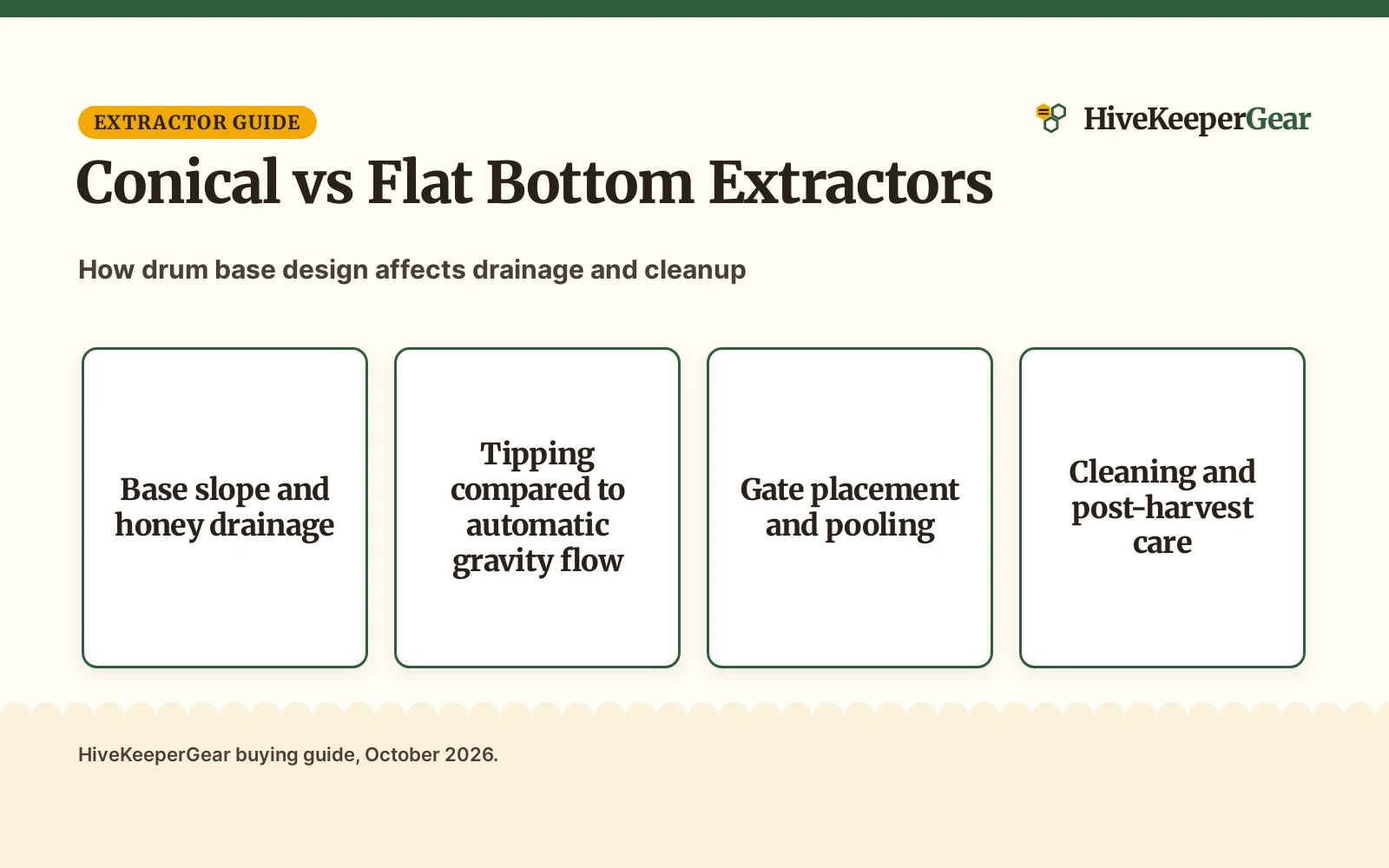
Conical bottom vs flat bottom honey extractor: key differences
The structural difference between these drum designs comes down to the fabrication of the tank base. A flat bottom honey extractor features a level sheet of stainless steel welded perpendicular to the cylindrical drum walls. The honey gate is installed near the bottom of the sidewall, positioned flush with the floor or slightly above the floor seam.
A conical bottom honey extractor features a base that slopes downward like a shallow cone or funnel. The lowest point of the slope meets the drain opening where the honey gate is attached. This geometry ensures that drops of honey running down the drum wall land on an inclined surface leading directly to the exit port.
| Feature | Conical Bottom Extractor | Flat Bottom Extractor |
|---|---|---|
| Floor shape | Cone-shaped slope toward drain | Flat planar base |
| Honey flow mechanism | Continuous gravity-fed drainage | Puddles across floor surface |
| Drum tilting | Unnecessary during operation | Required to clear remaining honey |
| Gate position | At lowest point of the cone | Sidewall base, sometimes slightly raised |
| Cleaning effort | Rinse water drains freely | Water pools and requires manual dumping |
| Stand stability | Drum remains level on all legs | Tilting risks shifting leg balance |
Honey flow and drainage efficiency
During a busy harvest, drainage efficiency directly impacts your workflow. When honey pools on a flat floor, it must accumulate to a substantial depth before the surface level reaches the gate opening. This means pounds of honey remain inside the drum while you are spinning frames. If the pool becomes too deep, the bottom of the spinning basket can drag through the accumulated honey, creating heavy rotational drag, straining gears, and spraying honey into places it should not be.
With a conical base, honey continuously flows toward the lowest point. Beekeepers can leave the gate open throughout the spinning cycle, allowing honey to pass immediately into a settling tank or through sieves into a bucket. Because liquid drains as fast as it slashes against the walls, honey never accumulates high enough to touch the rotating frame basket.
The physical capacity of an extractor listing illustrates the volume of honey moving through the drum. For example, the Kaponbon manual 2-frame extractor listing states an item weight of 20.5 pounds, a honey capacity of about 49.6 pounds, and a 1.77-inch diameter honey flow spout. Handling dozens of pounds of honey requires reliable drainage so the beekeeper does not spend the afternoon fighting backed-up honey at the gate.
Drum stability and physical safety
Centrifugal extraction produces substantial rotational forces. Even when frames are carefully paired by weight, uneven honey distribution inside the comb can create vibration. Extractors mounted on tall tripod legs must stay firmly balanced to prevent walking or wobbling across the honey house floor.
A conical bottom extractor maintains total stability because it never needs to be tilted. The machine sits level on its legs throughout the entire harvest session. You secure the legs to the floor, to a heavy sheet of plywood, or to a weighted base, and the extractor stays in place from the start until the final frame is finished.
A flat bottom extractor introduces awkward handling at the end of every extraction run. Because honey clings to the flat surface, you must physically tilt the drum forward to guide the last layer of honey toward the valve. Tilting a large stainless steel drum coated in sticky honey can shift the balance of the legs, strain mounting bolts, or cause the extractor to slip. Beekeepers sometimes wedge wooden blocks under the rear legs to create a permanent tilt, but doing so tilts the spinning axis, which can cause excessive wobbling when the basket is rotating.
Post-harvest cleaning and maintenance
After all supers are extracted and frames are returned to the apiary for bees to clean up, the equipment must be thoroughly washed. Honey is water-soluble, but cleaning a sticky extractor drum requires patience and warm water.
A conical bottom extractor simplifies washing. You can position a bucket under the open gate, spray the interior walls with warm water, and watch the rinse water wash down the sloped funnel and exit directly through the drain. The conical shape ensures that wastewater does not linger inside the drum, allowing the stainless steel to dry quickly and reducing the chance of moisture accumulating around seams.
Cleaning a flat bottom extractor is more physically demanding. Rinse water puddles across the flat floor just as honey does. To empty the dirty water, you must either wipe the floor repeatedly with sponges or unbolt the drum from its stand, carry it outside, and turn it upside down to dump the water. Lifting a bulky steel drum over a sink or tub increases the risk of denting the metal or damaging the delicate honey gate valve.
How to choose between conical and flat bottom extractors
When selecting equipment for your apiary, consider your harvest volume, physical setup, and long-term plans. If you manage multiple hives and harvest several supers per season, investing in a conical bottom honey extractor saves considerable effort year after year. The automatic gravity drainage allows you to focus on uncapping frames while the machine drains smoothly into your collection pails.
A flat bottom model can still suit beekeepers with a modest setup who want straightforward gear. If you only harvest a small amount of comb and do not mind tipping the drum at the end of the day, a flat base gets the job done. Whichever style you select, pair it with reliable harvesting gear. Learn how to use a honey extractor properly, explore our guide to the best honey extractor models for different apiary sizes, and compare manual vs electric honey extractor options to decide how you want to spin your comb. You can also review radial vs tangential honey extractor designs to match frame orientation with your harvest needs.
FAQs for beekeepers
Does honey drain completely from a flat bottom extractor?
A flat bottom extractor leaves a shallow layer of honey across the floor because gravity does not direct honey toward the valve. You must tilt the drum forward to drain the remaining harvest.
Why is a conical bottom better for honey extraction?
The sloped floor uses gravity to guide honey directly into the drain gate, allowing continuous hands-free drainage. This keeps the drum stable on its legs because you never have to tip it during harvest.
Are conical bottom honey extractors harder to clean?
Conical extractors are easier to clean because rinse water flows naturally down the incline and exits through the gate. With a flat base, dirty rinse water pools and must be manually scooped out or dumped.
Can I tilt a flat bottom extractor while spinning frames?
Never tilt an extractor while the inner basket is rotating. Off-center spinning creates severe vibration that can damage bearings, bend the central shaft, or cause the extractor to topple.
Does a conical bottom extractor require special legs?
Most conical models include sturdy legs that provide clearance beneath the drum for the low honey gate. This elevated position allows you to fit a settling bucket and honey strainer beneath the valve.
More hive guides
See every honey extractors guide and all honey harvesting guides.
More picks: honey extractors, radial vs tangential extractors, uncapping knives, and honey strainers.