What Is a Mason Bee: A Beginner Guide (2026)
A mason bee is a solitary bee that nests in hollow tubes, seals each nest with mud, and pollinates garden blooms without living in a hive or making honey.

On this page
Top picks at a glance
As an Amazon Associate I earn from qualifying purchases.
- 1
 Rivajam 150 Mason Bee Tubes with 75 Cardboard Tubes and 759.6/10View on Amazon
- 2
 Rivajam 125 Mason Bee Cardboard Nest Tubes Refill Pack9.6/10View on Amazon
- 3
 Veezy Natural Reed Mason Bee Tubes with Clay Sealer9.6/10View on Amazon
- 4
 Mason Bee Houses and Supplies : Bamboo Tube Bee Hotel forView on Amazon
- 5
 Mason Bee TubesView on Amazon
- 6
 Mason Bee HouseView on Amazon
- 7
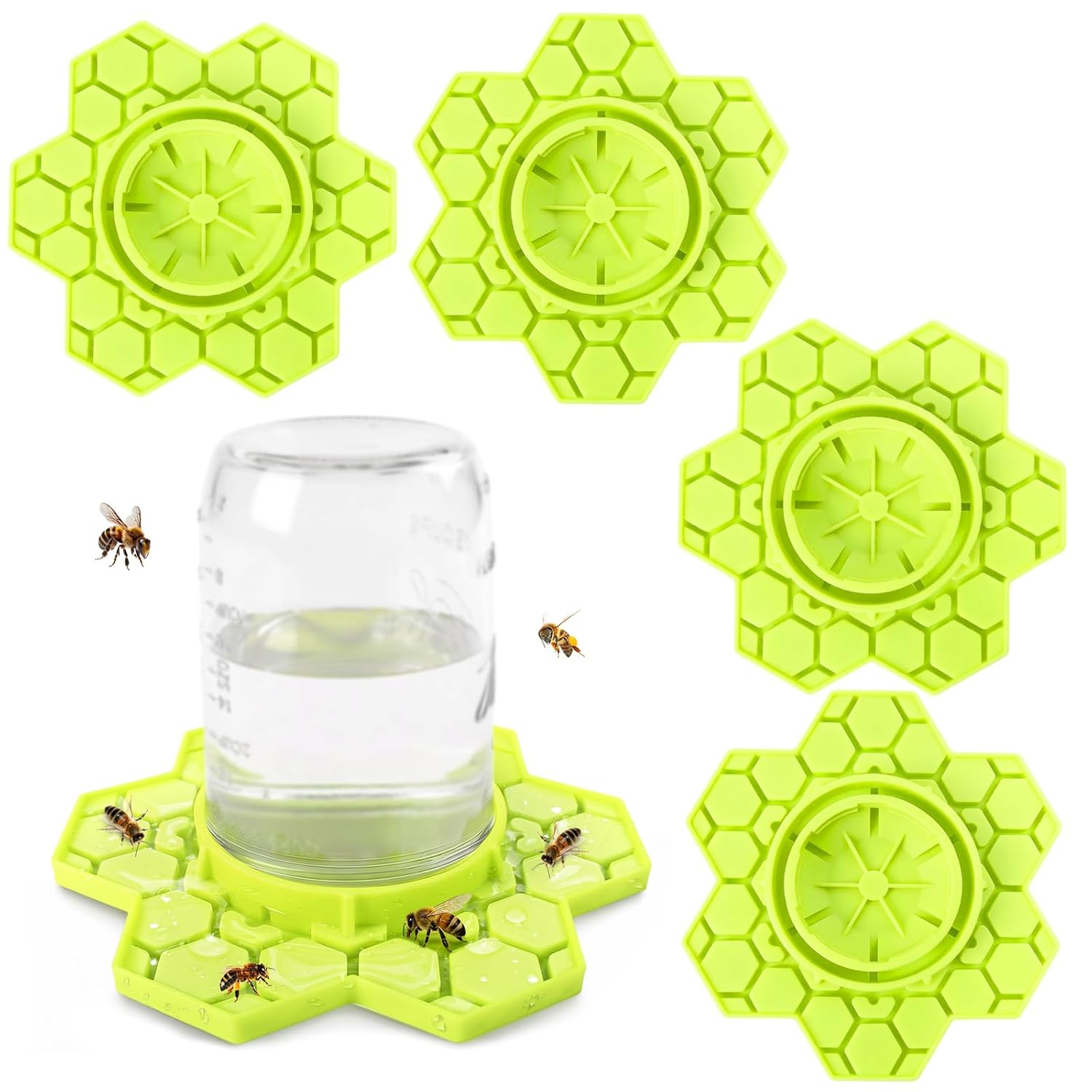 4 Pack Bee Feeder for Mason JarView on Amazon
- 8
 Mason Bee Houses Outdoor Wooden Bee Hotel for Garden and YardView on Amazon
- 9
 Bee Feeder for Mason Jar Made of SiliconeView on Amazon
A quiet bee works the blossom on a fruit tree in spring, slips into a hollow stem, and leaves with pollen on its belly: that bee is likely a mason bee. What is a mason bee? It is a solitary bee that nests in hollow tubes and holes, seals its nest with mud, and pollinates flowers without living in a hive, keeping a queen, or making honey for a colony.
Other hives and gear to compare
 Mason Bee Houses and Supplies : Bamboo Tube Bee Hotel forCheck price on Amazon
 Mason Bee TubesCheck price on Amazon
 Mason Bee HouseCheck price on Amazon
 4 Pack Bee Feeder for Mason JarCheck price on Amazon
 Mason Bee Houses Outdoor Wooden Bee Hotel for Garden and YardCheck price on Amazon
 Bee Feeder for Mason Jar Made of SiliconeCheck price on Amazon
HiveKeeperGear earns a commission when you buy through links on this site, at no extra cost to you. As an Amazon Associate I earn from qualifying purchases. Affiliate disclosure.
Below: how a mason bee lives, how to tell it from a honey bee, where it nests, and how it fits beside a Langstroth hive in the same bee yard.
What is a mason bee
A mason bee lives alone. Each female builds her own nest, gathers her own pollen, and provisions her own young, with no queen giving orders and no workers sharing the work. The nest is a hollow tube or a hole in wood, lined with pollen and sealed with mud, and the name mason comes from that mud work. Inside the tube, the female places pollen and an egg in a cell, seals the cell with a mud wall, and repeats the pattern down the tube until the entrance is plugged with mud.
That solitary life is the point that trips up new keepers. A mason bee has no comb to tend, no honey to store, and no colony to guard, so it behaves very differently from a honey bee in the same garden. It does not swarm, it does not follow a queen, and it does not return to a shared hive at dusk. When the nesting season ends, the female is gone, and the young rest inside their sealed tubes until the next spring.
A female mason bee has a sting, but it has no hive to defend, so it rarely stings and it does not guard its nest. The bee is a pollinator, not a guard, and its work is done on flowers, not at a hive entrance.
Mason bee or honey bee: how to tell them apart
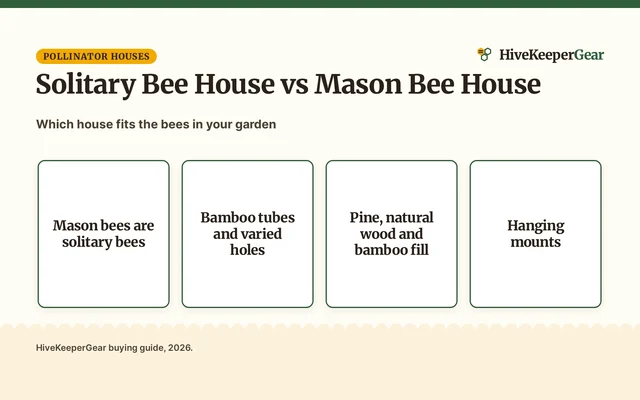
The bees share a garden, but they live in different worlds. A honey bee belongs to a colony with a queen, workers, comb and stored honey, while a mason bee belongs to no colony at all.
| Mason bee | Honey bee | |
|---|---|---|
| Home | Lives alone in a hollow tube | Lives in a colony in a hive |
| Nest | A tube sealed with mud | Comb built inside hive boxes |
| Queen and workers | None: each female nests alone | A queen, workers and drones |
| Honey | Makes none and stores none | Stores honey for the colony |
| Season | Active mainly in spring, around blossom time | Active through the warm season |
| Temperament | Gentle, with no hive to defend | Guards the hive entrance |
The look follows the life. A mason bee is a stocky, hairy bee that carries pollen on the underside of its belly, while a honey bee carries pollen in baskets on its hind legs. That belly load is a handy field mark, and it is also why a mason bee moves pollen from flower to flower with such ease: the pollen brushes off as the bee works the blossom.
Where mason bees nest
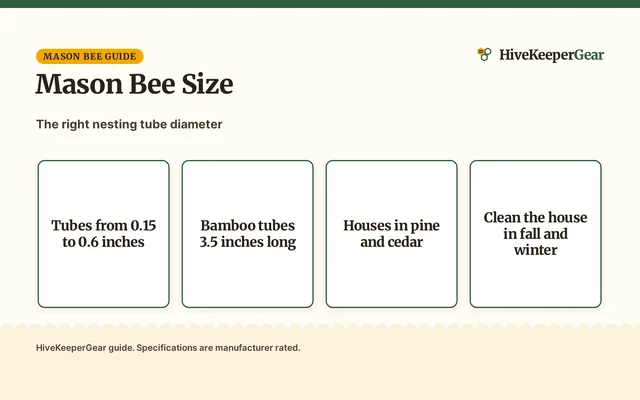
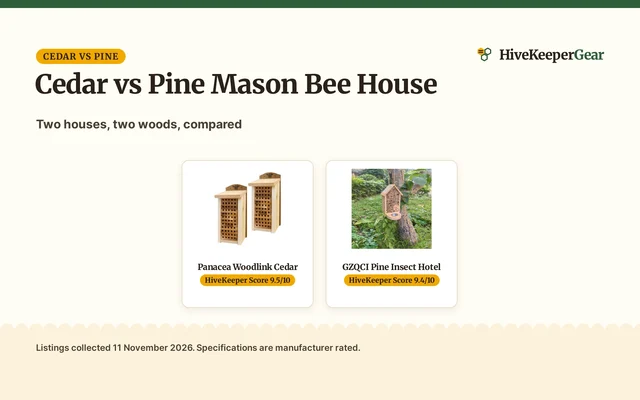
In the wild, a mason bee nests in a hollow stem, a beetle hole in dead wood, or a gap in masonry, anywhere a dry tube is open and close to bloom. In a garden, a mason bee house gives the same thing on purpose: a shelter holding hollow tubes, set where the morning sun warms it and rain stays out of the tube mouths. Our small versus large mason bee house guide compares house sizes, and our wood versus plastic mason bee house guide compares house materials.
Tubes are the heart of the house. Reed versus bamboo mason bee tubes compares tube materials, bee hotel versus mason bee tubes sorts out the kinds of shelter, and mason bee cocoons versus mason bee tubes explains the difference between the cocoon and the tube it rests in.
Place the house near bloom and near damp soil, since the female needs mud to seal each cell. A house hung on a fence or a post, facing the morning sun and sheltered from wind and driving rain, gives the bees a dry tube and a warm start to the day. Keep the tubes dry through the cold months, and leave sealed tubes alone until the bees emerge in spring.
Mason bees and Langstroth hives
A mason bee does not move into a Langstroth hive. The hive is a honey bee home, built from stacked boxes and frames, and a mason bee has no use for frames, comb, or a colony. The bees can share a bee yard, with the Langstroth hive holding honey bees and the mason bee house holding tubes, but they do not share a home. Our 8-frame hive dimensions guide gives the standard box and frame sizing, and our 8-frame beehive picks compare lighter Langstroth kits.
The listings used for reference here show how a Langstroth hive is sized. The Honey Lake 8-frame deep brood box measures 19.88 by 14 by 9.56 in, and the Honey Lake 8-frame medium super box measures 19.9 by 14 by 6.6 in. The boxes are cedar with a dovetail joint design, beeswax-dipped exteriors, and wooden frames with beeswax-coated foundations. The deep box listing gives its size in its bullets, while its spec table lists a different depth, so check the box size before ordering frames for it.
Winter cover for a Langstroth hive is also sized to the hive, not to a mason bee house. The GOCOHHI winter wrap (on Amazon) measures 82 by 23.7 in and fits 8-frame and 10-frame hives, covering 2 deep boxes and 1 medium box. It is a 3-layer wrap of 600D Oxford cloth filled with pearl cotton and PEVA inside, with 3 velcro straps inside, 3 adjustable magic tape straps outside, and an adjustable range of 8 inches. A mason bee house needs no such wrap. Our winter wrap for Langstroth hives picks compare wraps for honey bee hives.
What mason bees need in the garden
A mason bee needs bloom, mud, and a dry tube, and little else. Bloom across spring feeds the females as they provision their cells, so a garden with fruit trees, shrubs, and spring flowers gives them steady work. Pollinator seed mix for apiaries can help fill gaps in bloom, and a patch of damp soil gives the females mud for their seals. Keep the house and the tubes clean between seasons.
FAQs for beekeepers
Do mason bees sting?
A female mason bee has a sting, but it has no hive to defend and rarely stings. It is a gentle bee around its nest, and it leaves a disturbed tube rather than guarding it.
Do mason bees make honey?
No. A mason bee gathers pollen for its own young, stores no honey, and builds no comb. Honey is a honey bee store, not a mason bee store.
Can mason bees live in a Langstroth hive?
No. A mason bee needs a hollow tube, not frames and boxes. A Langstroth hive is a honey bee home, and the bees can share a bee yard without sharing a home.
What is a mason bee house?
A mason bee house is a shelter holding hollow tubes where females nest and seal their cells with mud. Our mason bee house versus bee hotel guide compares it with a bee hotel, and our mason bee house for fruit trees picks suit an orchard setting.
When are mason bees active?
Mainly in spring, around blossom time, when females nest and pollinate. Through summer and the cold months, the young rest inside their sealed tubes until the next spring.
More hive guides
Browse every guide by category: beehives and 8-frame beehives, or see our how to start a bee hive guide for honey bee keepers.