Heated vs Cold Uncapping Knife: Which One Should You Buy?
Compare heated and cold uncapping knives by heating speed, comb preservation, ease of handling, and apiary scale to choose the right uncapping tool for your honey harvest.

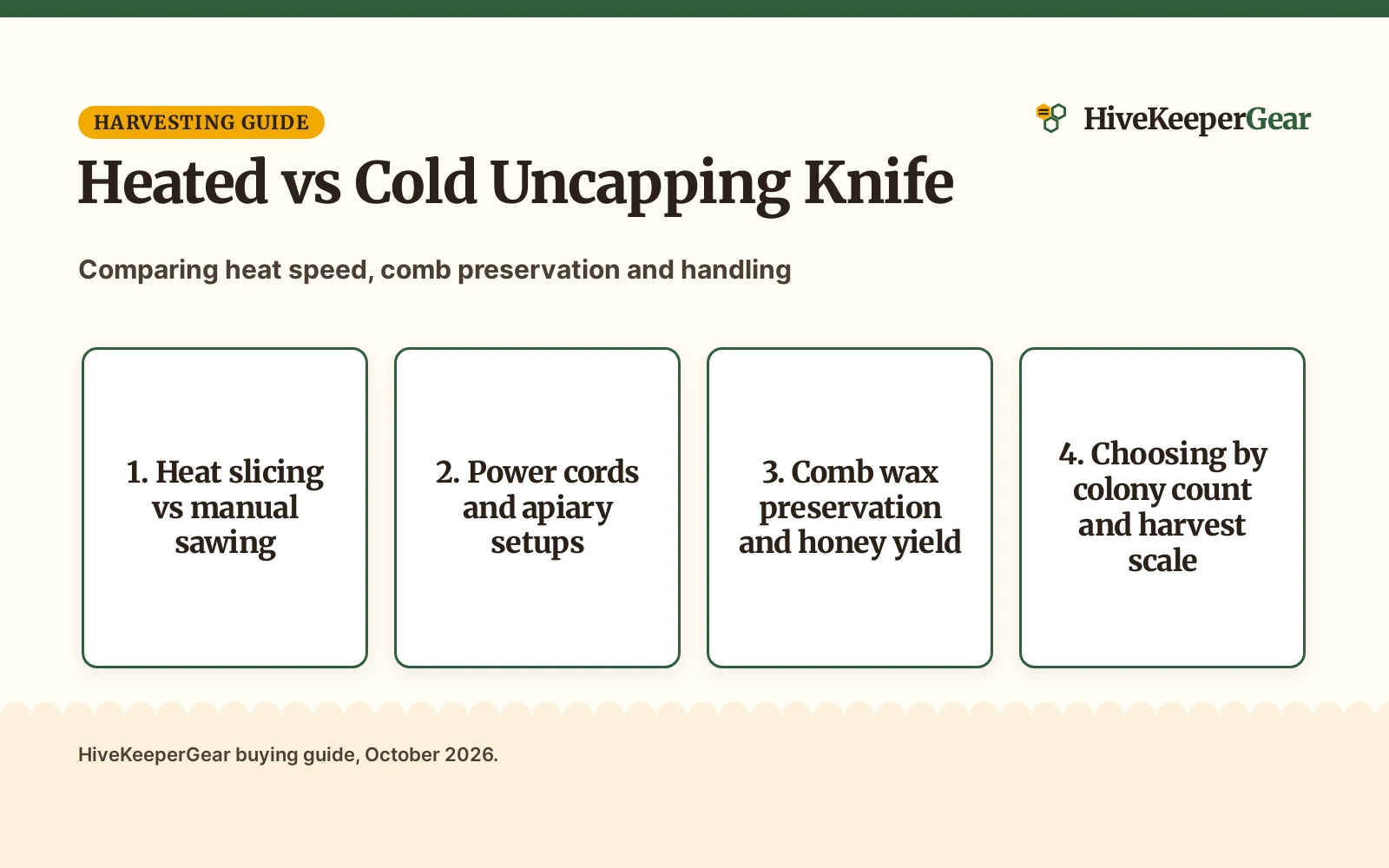
On this page
As the summer nectar flow winds down, deciding between a heated vs cold uncapping knife determines how smoothly your harvest runs. A heated uncapping knife melts through beeswax cappings rapidly, making it the practical choice for beekeepers harvesting multiple supers. In contrast, a cold uncapping knife uses manual serrations to slice wax seals without cords or heat management, providing a reliable option for small apiaries. Evaluating cutting action, workspace needs, and fatigue helps identify the right tool.
HiveKeeperGear earns a commission when you buy through links on this site, at no extra cost to you. As an Amazon Associate I earn from qualifying purchases. Affiliate disclosure.
Before you buy: how comb uncapping works
Before honey frames enter an extractor, every comb face must be uncapped. Honey bees seal ripe honey with beeswax once moisture drops to safe storage levels. Beekeepers remove these cappings while preserving drawn comb for bees to refill during future flows. Our what is an uncapping knife guide explains the mechanics of this step.
Over an uncapping tank, the frame rests upright on an end bar so the wooden top and bottom bars act as rails. The knife spans both bars, shearing cappings into the tank. Dull or dragging blades tear delicate cell walls, making blade style the central decision when setting up.
Heated vs cold uncapping knife: key differences
Comparing these tools centers on heat transfer versus manual cutting. Heated blades melt wax with light forward pressure, while cold blades rely on serrations and manual sawing. The table below outlines key differences.
| Feature | Heated uncapping knife | Cold uncapping knife |
|---|---|---|
| Cutting mechanism | Heated metal blade melts through wax seals | Beveled serrations slice wax mechanically |
| Power source | Corded electrical supply | Manual hand power with no electricity |
| Cutting resistance | Minimal downward pressure across comb | Requires continuous manual sawing stroke |
| Comb preservation | Glides flat across frame bars without snagging | Can tear uneven comb if sawing stalls |
| Setup requirements | Power outlet and heat-safe knife stand | Uncapping tank or resting tub only |
| Cleaning procedure | Wipe hot blade with damp cotton cloth | Wash in warm water and dry thoroughly |
| Tool guide | Uncapping tools | Knife vs plane guide |
1. Cutting action and comb preservation
The primary advantage of heat is speed. An electric knife melts directly through beeswax cappings, gliding across the comb face with minimal downward force. Because you avoid vigorous sawing, the risk of gouging foundation or flattening cell rims drops significantly, preserving drawn comb that saves the colony energy during future flows.
Cold knives require a deliberate sawing technique across the top and bottom frame bars with steady downward progress. A sharp cold blade slices cleanly through warm, soft comb. If frames cool or comb is uneven, cold blades can snag cappings and tear cells. While warming a cold blade in hot water between frames softens wax, the blade must be wiped dry to prevent moisture from entering honey.
2. Temperature, power, and workspace setup
Heated uncapping knives require corded electrical power and steady heat regulation. GoodLand Bee Supply and GLOGLOW both list 110-volt power supplies. GLOGLOW lists an operating range where the highest temperature can be 140-160 degrees, and Yencoly lists an electric knife reaching a 140-160℃ maximum temperature. Pierce Beekeeping Equipment features a preset thermostat on its Speed King knife that heats in 30 seconds, maintaining cutting heat automatically without burning honey sugars.
An 8-foot grounded cord, listed on the Pierce Beekeeping Equipment Speed King, provides reach across an uncapping tank but requires clear routing to avoid snagging sticky frames. Heated knives also require a heat-safe rest between frames. Cold knives eliminate cords, warmup time, and outlets entirely, allowing uncapping anywhere in an outyard shed.
3. Blade dimensions, weight, and handling fatigue
Blade length determines whether you span top and bottom frame bars in a single stroke. Cold knives often offer generous reach. Toresano lists an 11-inch blade with a 16-inch overall length and a weight of 1.6 ounces, featuring a serrated cutting edge on high-carbon stainless steel that minimizes wrist strain.
Internal heating elements add physical weight to electric knives. GoodLand Bee Supply lists an overall length of 18.9 inches with a weight of 1 pound, Yencoly lists 1.05 pounds, and GLOGLOW lists a 17.32-inch length. Pierce Beekeeping Equipment lists a 10-inch blade with a 2-inch width on its Speed King model, paired with a turned wood handle designed to stay cool. That extra weight helps slice downward through wax, though comfortable grip geometry remains essential when uncapping multiple supers.
4. Maintenance, cleaning, and long-term durability
Clean tools protect honey quality and prevent corrosion. Pierce Beekeeping Equipment specifies food-grade 304 stainless steel for its Speed King blade and provides a 2-year warranty. Stainless steel resists honey acids and endures repeated cleaning. While warm, a heated blade cleans easily by wiping with a damp cotton cloth to remove wax and honey; it must never be submerged in water.
Cold knives have no electrical components to fail. They wash thoroughly in warm soapy water, rinse clean, and air dry before storage. Knives made with high-carbon stainless steel, such as the Toresano model, retain sharp cutting edges across seasons without rusting. Oiling wooden handles periodically prevents drying and keeps grips smooth.
5. Matching your knife to apiary scale
Harvest volume is the central factor when choosing uncapping gear. For a beekeeper managing 1 or 2 backyard hives, honey supers yield a modest frame count. A cold knife handles this volume cleanly without electrical cords, warmup delays, or extra expense. Paired with an uncapping fork for low spots, it provides an economical setup that packs neatly into a tool box.
As an apiary grows, uncapping becomes the primary extraction bottleneck. An extractor sits idle if frames are uncapped slowly by hand. An electric heated knife melts through cappings quickly per frame side, allowing an operator to keep a honey extractor running continuously. For multiple supers, heated blades save substantial time and physical effort.
A step-by-step uncapping workflow
Setup: Place your uncapping tank on a sturdy table. Warm an electric knife on a heat-safe stand, or keep a clean cloth and uncapping fork beside a cold knife. Positioning the frame: Rest an end bar on the tank crossbar, holding the opposite end bar firmly. Tilt the frame forward so severed cappings fall directly into the tank. Making the cut: Rest the blade across the top and bottom wooden bars as a depth guide. Slice downward with steady progress. Heated blades melt wax seals smoothly, while cold blades require short, rhythmic sawing strokes. Detailing: Use an uncapping fork to lift wax from recessed comb pockets the blade missed. Loading: Place uncapped frames directly into extractor baskets, following our how to use a honey extractor guide.
Essential accessories for your uncapping station
- An uncapping scratcher fork to clear wax from low pockets and uneven comb.
- An uncapping tub with a strainer screen to separate cappings wax from raw honey.
- A stainless steel honey strainer seated over a food-grade settling bucket.
- A frame rest bar to stabilize frames upright during cutting.
- A heat-resistant resting tray to park a hot knife safely between frames.
Organizing these accessories around your uncapping tank keeps workspace surfaces clean and maintains a steady frame flow toward the extractor.
Common uncapping mistakes to avoid
A frequent mistake is cutting too deeply into comb. Slicing into the foundation base ruins drawn comb, produces jagged wax edges, and clogs settling strainers. Keep the blade riding lightly on the wooden frame rails rather than gouging cell bases.
With heated knives, never leave a hot blade resting on comb or wooden frames during pauses. Stationary heat scorches honey and chars wood, causing dark flecks and off flavors. Always park the knife on a heat-proof stand. With cold knives, forcing a dull blade tears comb; keeping serrations clean and sharp ensures clean shearing without cell damage.
FAQs for beekeepers
Does a heated uncapping knife damage or scorch honey?
A properly operated heated knife does not scorch honey because the blade glides quickly across the comb face. Contact is momentary, melting wax seals cleanly without overheating honey underneath. Scorching only occurs if a hot blade rests stationary on comb.
Can I use a cold uncapping knife without dipping it in hot water?
Yes, sharp serrations slice wax cappings cleanly at room temperature. Beekeepers using knives like Toresano can uncap comb dry. If dipping in warm water to soften wax, always wipe the blade dry first.
How fast does an electric uncapping knife heat up?
Warmup speed depends on heating element design. Pierce Beekeeping Equipment lists a 30-second warmup time on its Speed King knife, allowing beekeepers to begin uncapping almost immediately after plugging the tool in.
How long should an uncapping knife blade be?
An uncapping blade must span the distance between the top and bottom wooden frame bars with clearance for cutting strokes. Examples include the 10-inch blade on the Pierce Beekeeping Equipment Speed King and the 11-inch blade with a 16-inch overall length on the Toresano knife.
Which uncapping knife is better for a beginner with one hive?
A cold uncapping knife is practical for a beginner managing 1 hive because it requires no cords, presents no burn risk, and stores easily. Expanding apiaries can upgrade to an electric heated knife as harvest volume grows.
More hive guides
See every uncapping tools guide and all honey harvesting guides.
More picks: Explore our guides on the electric uncapping knife vs uncapping plane, manual vs electric honey extractor, and honey extractors. New to beekeeping? Start with our beekeeping supplies for beginners checklist.