Electric Uncapping Knife vs Uncapping Plane: Which One Should You Buy?
A comparison of electric uncapping knives and uncapping planes, covering blade heating, cutting mechanics, comb preservation, and how to choose for your apiary.

On this page
Top picks at a glance
As an Amazon Associate I earn from qualifying purchases.
- 1
 Pierce Beekeeping Uncapping Tub Kit with Cover9.7/10View on Amazon
- 2
 GLUK-ELEC Electric Decapping KnifeView on Amazon
- 3
 Electric Honey Uncapping Knife Digital Display Uncapping KnifeView on Amazon
- 4
 ROTORS Electric Honey Uncapping KnifeView on Amazon
- 5
 Stainless Steel Uncapping KnifeView on Amazon
When honey supers come off the hives in late summer and extracting begins, deciding between an electric uncapping knife vs uncapping plane comes down to your harvest volume and cutting motion. For backyard beekeepers managing a few colonies, an electric uncapping knife is practical because its heated blade slices smoothly through wax cappings with minimal setup. An uncapping plane suits larger apiaries processing dozens of supers, using an adjustable heated blade and a downward pulling stroke that reduces wrist strain. We compared heated uncapping tools across heating design, ergonomics, throughput, and comb preservation.
Other hives and gear to compare
 GLUK-ELEC Electric Decapping KnifeCheck price on Amazon
 Electric Honey Uncapping Knife Digital Display Uncapping KnifeCheck price on Amazon
 ROTORS Electric Honey Uncapping KnifeCheck price on Amazon
 Stainless Steel Uncapping KnifeCheck price on Amazon
HiveKeeperGear earns a commission when you buy through links on this site, at no extra cost to you. As an Amazon Associate I earn from qualifying purchases. Affiliate disclosure.
Before you choose: understand your harvest setup
Uncapping is the main bottleneck during extraction. Before frames enter the extractor, thin wax cappings sealing each honey cell must be removed. Cold serrated knives often tear comb and slow progress, leaving ragged cells that bees must rebuild.
Electric uncapping knives and uncapping planes apply continuous heat directly to the wax, melting cappings so cutting edges glide through without snagging. Choosing between them depends on your frame count, preferred cutting stroke, and tank setup. See our guide on what an uncapping knife is for basic tool operation.
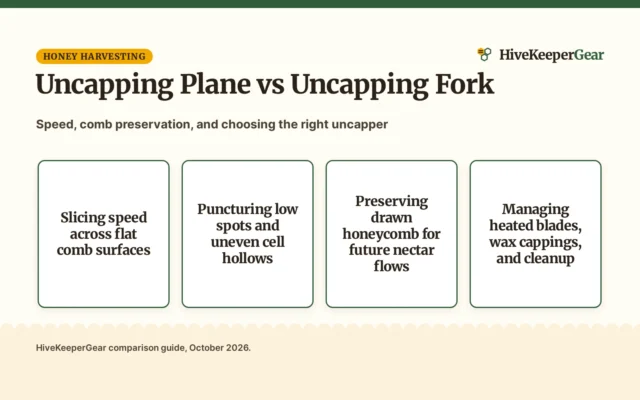
The electric uncapping knife vs uncapping plane comparison
Both tools melt and slice wax cappings, but their mechanics and handling differ across several areas.
| Feature | Electric Uncapping Knife | Uncapping Plane |
|---|---|---|
| Primary cutting motion | Sawing upward or downward across the comb face | Downward pulling stroke along the comb face |
| Heating method | Internal heating element sealed inside a stainless steel blade | Heated copper cutting element or heating shoe |
| Handle orientation | Inline handle held like a carving knife | Right-angle handle held like a woodworking hand plane |
| Depth guidance | Blade bridges across wooden top and bottom frame bars | Adjustable cutting shoe mounted directly on the tool |
| Comb preservation | Rides frame wood on flat comb; requires care to avoid gouging | Adjustable shoe regulates cut thickness to protect comb |
| Apiary scale | Hobbyists harvesting a few hives | Sideliners and apiaries harvesting dozens of supers |
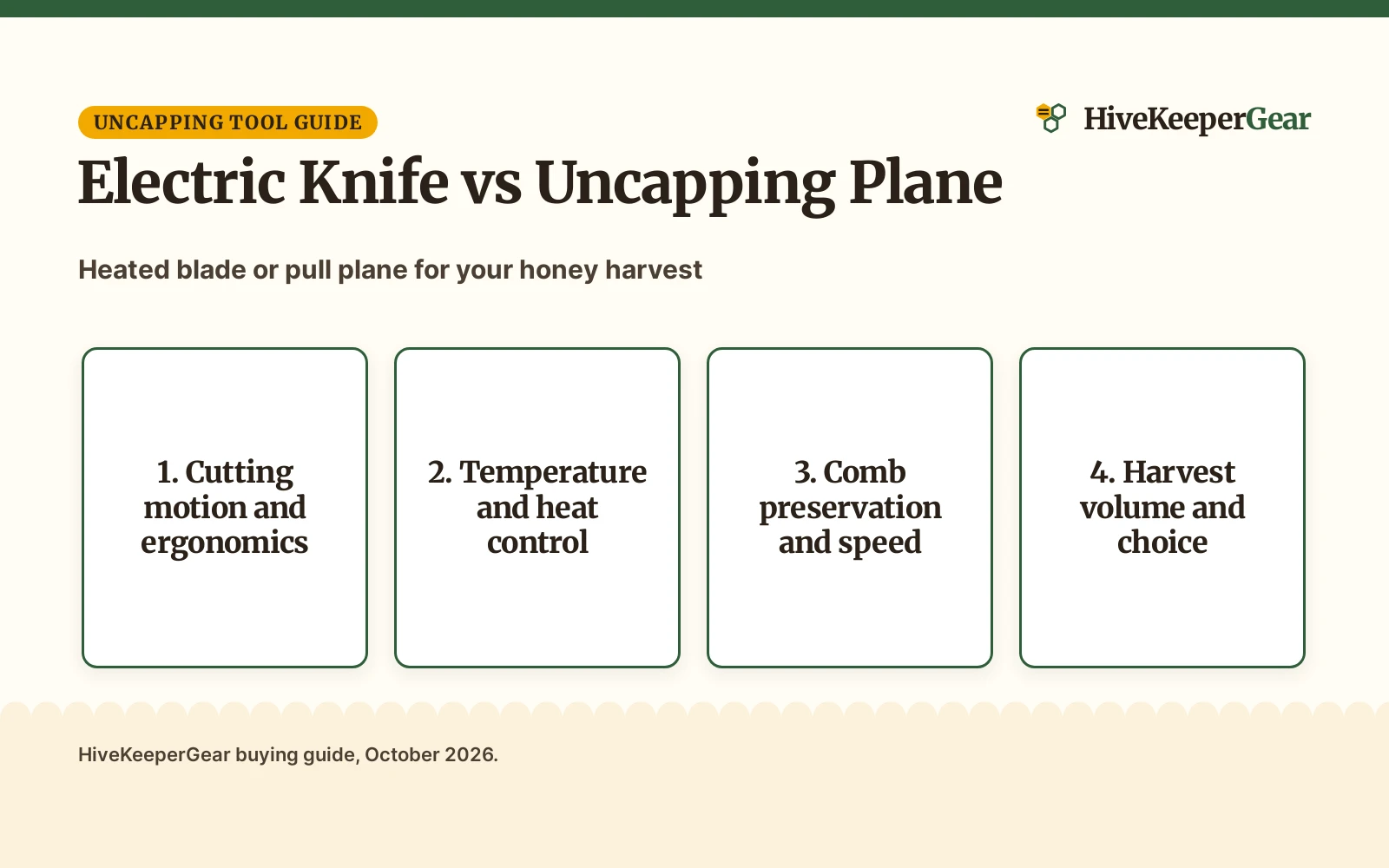
1. Cutting motion and wrist ergonomics
The primary difference between both tools is the physical motion required during uncapping. An electric uncapping knife uses an inline handle. You hold the frame vertically over an uncapping tank and slice across the comb face, drawing upward so severed wax drops away, or slicing downward. Dimensions influence balance: Pierce Beekeeping Equipment lists a 10-inch long and 2-inch wide stainless steel blade with a turned wood handle on its Speed King knife. Little Giant lists an overall length of 18.38 inches and a weight of 10.08 ounces. A Generic uncapping knife listing reports a 5.7-inch wooden handle and a 17.3-inch overall length, while GOODLAND BEE SUPPLY lists a heated decapping knife weighing 1 pound. Holding an extended knife horizontally across frame bars requires steady wrist tension, which can cause fatigue during long sessions.
An uncapping plane positions its handle at a right angle above the cutting shoe. You pull the plane downward along the comb face using your forearm and shoulder while keeping your wrist neutral. This pulling stroke reduces joint fatigue during extended harvesting runs.
2. Heat management and temperature control
Both tools rely on electric heating elements to melt wax cappings, but heat delivery varies. Electric uncapping knives house internal elements sealed inside the blade. Preset models maintain factory heat: Pierce Beekeeping Equipment lists a 100-watt heating element operating at 120 volts that heats in 30 seconds, and Blue Sky Bee Supply notes an 8-foot grounded cord with a preset thermostat and a 2-year warranty. Little Giant states that its heated knife warms up within 1 minute, and GOODLAND BEE SUPPLY lists a 110-volt power supply. Other knives offer adjustable heat: Pierce provides a Speed King model with a manual control box, and Kuuleyn lists a temperature range of 50 to 180℃ running at 220V. Unregulated designs, including a Generic knife citing 140°C–160°C (284°F–320°F), benefit from resting in a clean water bath when idle, as noted by GLOGLOW.
Uncapping planes typically use a heated copper element or shoe with high thermal mass, slicing through cold cappings without stalling. Many connect to an external rheostat or controller to fine-tune heat without scorching honey. Browse our review of uncapping tools for additional options.
3. Comb preservation and cutting depth
Preserving drawn comb is critical because bees consume substantial nectar rebuilding wax. An electric uncapping knife uses the frame top and bottom bars as guide rails. On flat comb bulging past the frame wood, the blade glides smoothly along the rails to leave an even surface. However, if comb has low spots recessed below the wood, the flat blade bridging the bars cannot reach them without tilting, which risks gouging foundation.
An uncapping plane controls depth directly through its adjustable shoe. Setting blade exposure relative to the shoe skims cappings in an even sheet while protecting cell structure. Because the plane rides over the comb face rather than bridging distant frame bars, it maintains consistent depth. Low pockets below the reach of either blade require a manual scratcher.
4. Speed and frame throughput
For speed on individual frames, an electric uncapping knife excels on flat comb. Because the 10-inch blade spans from top bar to bottom bar, a single upward pass on each side strips cappings in seconds. For small harvests from a few hives, a heated knife is fast and nimble with minimal equipment staging.
An uncapping plane excels at sustained throughput across multiple supers. Although each pass covers a narrower swath, the downward pulling stroke causes far less fatigue over hundreds of frames, preventing sloppy cuts late in the day. After uncapping, frames move to extraction; see how to use a honey extractor and our guide comparing manual honey extractors.
5. Maintenance and blade care
Proper care prevents sticky wax and caramelized honey buildup from degrading honey quality. Knife listings from Pierce Beekeeping Equipment and Generic recommend wiping the blade with a damp cloth or rinsing with water between frames.
Heated planes require similar care: keeping the copper shoe clean prevents scorched residue from discoloring honey. Always disconnect power and allow heating elements to cool before storage. Check cords regularly for wear near handle connections. For broader apiary equipment maintenance, read our guide on how to clean beekeeping tools.
Harvest day workflow in the honey house
Organizing your uncapping station improves efficiency and reduces sticky cleanup. Mount an uncapping tank with a crossbar and frame rest pin, allowing wax cappings to fall into a perforated basket where honey drains freely.
Keep a heat-resistant stand beside the tank to park hot tools safely while handling frames. Load uncapped frames directly into your extractor to minimize dripping. Drained honey is then filtered into a settling tank fitted with a honey gate, as described in our guide to honey buckets with gates.
Helpful accessories for uncapping
- An uncapping tank with a drain valve to collect cappings and reclaim honey.
- An uncapping scratcher fork to lift wax from low comb pockets without gouging foundation.
- A heat-resistant stand to prevent scorched surfaces between frame passes.
- Stainless steel double sieves, detailed in our guide on honey strainer mesh sizes.
- A frame rest to steady frames above the tank during slicing.
What neither tool replaces
Neither tool eliminates the need for an uncapping fork. Natural comb contains recessed hollows that flat blades cannot access without damaging comb structure. A quick scratch with a fork opens low cells in moments.
Neither tool should be used on brood comb or frames containing bee bread, as heat damages brood and pollen stores. After extraction, wet frames can be returned to bees for cleanup, or stored following our guide to cleaning bee frames for reuse.
FAQs for beekeepers
Does an electric uncapping knife scorch honey?
An electric uncapping knife will not scorch honey when kept moving steadily across the comb face. Scorching occurs only if a hot blade rests motionless against honey and wax, so unplugging or turning off the tool when stepping away from the uncapping tank is essential.
Can an uncapping plane cut uneven comb?
An uncapping plane glides over comb using its adjustable shoe, following surface contours better than a rigid blade bridging frame bars. However, deeply recessed hollows still require a manual uncapping fork to scratch open sealed wax cells.
How long does an electric uncapping knife take to heat up?
Listing specifications show rapid warm-up times: Pierce Speed King models list heating within 30 seconds, while Little Giant lists ready-to-use heating within 1 minute. Keeping the tool on a dedicated stand preserves working temperature between frames.
Is an electric uncapping knife or uncapping plane easier on the wrist?
An uncapping plane is easier on the wrist because its right-angle handle uses a pulling motion powered by the forearm and shoulder. An electric uncapping knife requires an inline grip and continuous wrist tension that tires hands during long sessions.
What temperature do heated uncapping tools reach?
Operating temperatures depend on design. Unregulated knives like Generic cite 140°C–160°C (284°F–320°F), adjustable models like Kuuleyn list 50 to 180℃, and premium knives use preset thermostats calibrated to melt wax smoothly without burning honey.
More hive guides
See every uncapping tools guide and all honey harvesting guides.
More picks: uncapping knives, honey extractors, honey strainers, and honey buckets. New to beekeeping? Start with our beekeeping supplies for beginners checklist.