How to Use a Bee Escape Board
Learn how to use a bee escape board to clear honey supers quietly before harvest, including board orientation, hive inspection, timing, and robber bee prevention.

On this page
Top picks at a glance
As an Amazon Associate I earn from qualifying purchases.
- 1
 YYGMSS 50 Pack 3 Inch Wooden Honey Dippers with Deep Grooves9.6/10View on Amazon
- 2
 CINBILCORN 4 Pack 3 Inch Wooden Honey Dippers with Deep9.6/10View on Amazon
- 3
 WEFOO 100 Pack 3 Inch Wooden Honey Dipper Sticks9.5/10View on Amazon
- 4
 Little Giant® Bee EscapeView on Amazon
- 5
 2Pcs Beehive Screened Bottom Board 8 Frame Langstroth BeeView on Amazon
- 6
 Beehive Screened Bottom Board Dipped in 100% BeeswaxView on Amazon
- 7
 2Pcs Beehive Screened Bottom Board 10 Frame Langstroth BeeView on Amazon
- 8
 4Pcs Beehive Screened Bottom Board 10 Frame Thickened 100%View on Amazon
- 9
 Foxhound Bee Co Universal Solar Fume Board A BeekeepersView on Amazon
Late summer honey harvest brings full, heavy supers to the bee yard, and knowing how to use a bee escape board allows you to clear those boxes quietly without brushing comb or shaking frames. To use a bee escape board, you slide the framed board directly between your honey supers and the brood nest with the one-way exits facing downward, allowing worker bees to walk down into the hive bodies while preventing them from returning to the honey. Over the next day, the honey supers empty naturally as bees travel down to join the queen and cluster, leaving clear comb ready for collection. In this guide, we explain the clearing process step by step, from timing and hive placement to robbing prevention and clean removal.
Other hives and gear to compare
 Little Giant® Bee EscapeCheck price on Amazon
 2Pcs Beehive Screened Bottom Board 8 Frame Langstroth BeeCheck price on Amazon
 Beehive Screened Bottom Board Dipped in 100% BeeswaxCheck price on Amazon
 2Pcs Beehive Screened Bottom Board 10 Frame Langstroth BeeCheck price on Amazon
 4Pcs Beehive Screened Bottom Board 10 Frame Thickened 100%Check price on Amazon
 Foxhound Bee Co Universal Solar Fume Board A BeekeepersCheck price on Amazon
HiveKeeperGear earns a commission when you buy through links on this site, at no extra cost to you. As an Amazon Associate I earn from qualifying purchases. Affiliate disclosure.
Before you install: check hive readiness
Before installing a bee escape board, inspect the honey supers and confirm that the honey frames are capped and ready for extraction. A bee escape board relies on bees leaving the super voluntarily, so you must confirm that no brood or queen is present above the excluder. If brood is present in a honey super, nurse bees will not abandon the brood frames, and the box will not clear. Also verify that the hive boxes fit tightly without gaps or warped corners, because unattended honey supers are vulnerable to robbing by neighboring colonies or yellow jackets once worker bees leave the box.
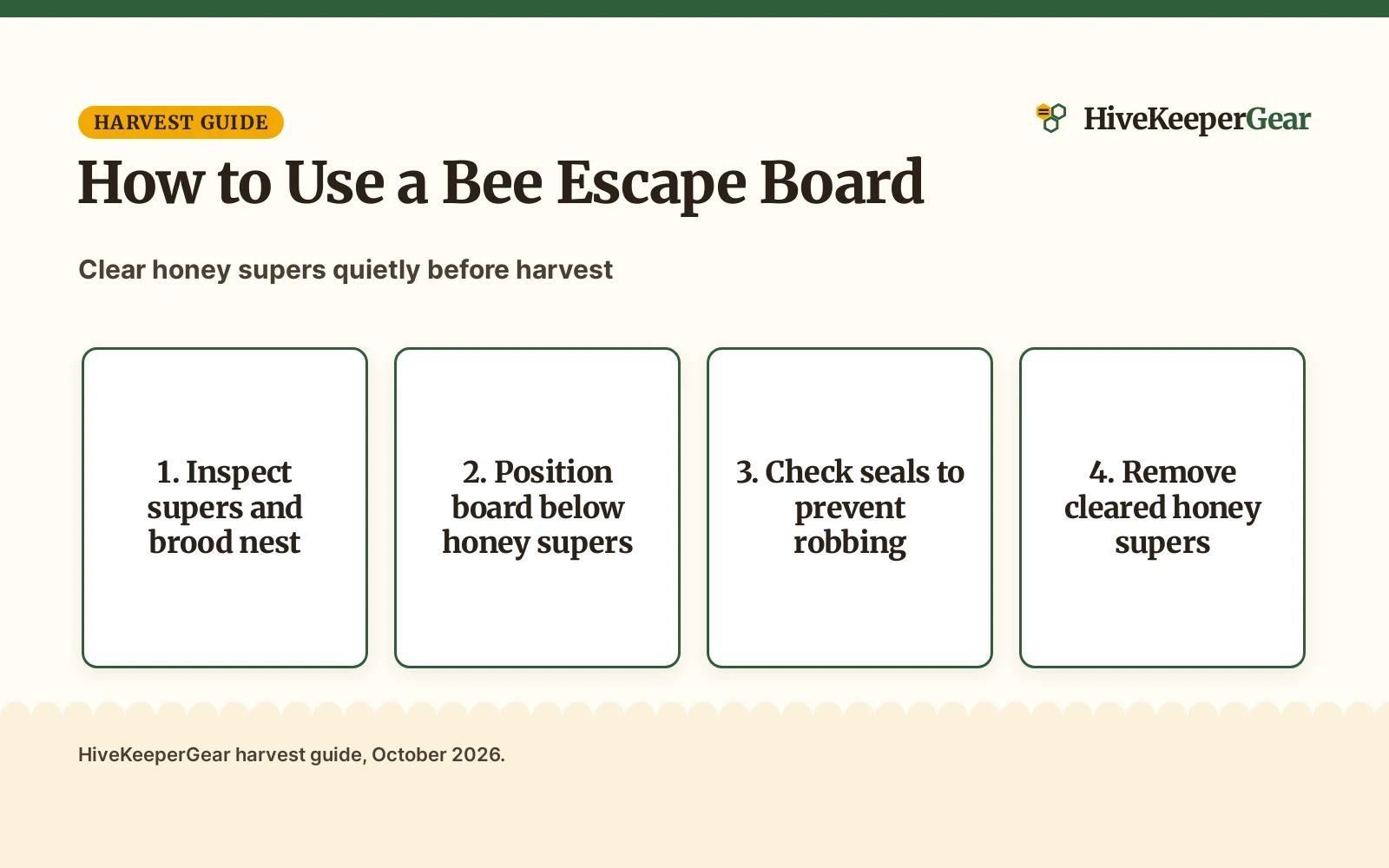
How to use a bee escape board, step by step
| Step | Action | Key detail | Related guide |
|---|---|---|---|
| 1 | Inspect honey supers | Confirm frames are capped and free of brood | Beehive frames |
| 2 | Suit up and smoke lightly | Calm the colony and protect against defensive bees | Bee suits |
| 3 | Loosen and lift honey supers | Pry boxes loose with a hive tool and set aside | Hive tools |
| 4 | Position the escape board | Place flat side up with one-way exits facing downward | 10-frame hive dimensions |
| 5 | Replace honey supers and seal | Stack supers on top and seal all cracks | Hive boxes |
| 6 | Allow clearing time | Boa Cushion lists that bees exit within 24 hours | Honey harvesting |
| 7 | Remove cleared supers | Take honey boxes indoors immediately | Honey extractors |
1. Inspect the honey supers and brood nest
Start by inspecting the honey supers you intend to pull. Honey frames should be mostly capped with beeswax before harvesting, which ensures the moisture content is low enough for storage. Use a hive tool to check individual honey frames across the super. Ensure that the queen has not laid eggs in the honey super; a queen excluder kept beneath the super throughout the season prevents brood comb above. If you discover patches of brood in a honey super, leave that box on the hive until the brood emerges. Worker bees instinctively remain in boxes that contain brood, regardless of how long an escape board remains in place.
2. Protective gear and clearing safety
Even though a bee escape board reduces disturbance compared to shaking or brushing bees off comb, protective clothing remains necessary when lifting heavy supers and cracking propolis seals. Wear a full bee suit or jacket with a secure veil, along with protective gloves. When you pry boxes apart, guard bees will investigate the seam. Calm movements and sealed closures at the wrists and ankles prevent stray bees from crawling into clothing while your hands are occupied lifting boxes.
3. Smoke the colony and lift the supers
Light your smoker with dry smoker fuel and approach the hive from behind or to the side. Puff a few cool puffs of smoke into the hive entrance and under the inner cover to settle the bees. Use your hive tool to break the propolis seal between the lowest honey super and the hive box beneath it. Lift each honey super carefully and place it upright on an inverted hive cover or temporary hive stand nearby. Avoid setting supers directly on grass or dirt where ants and debris can enter the frames.
4. Position the escape board correctly
Place the bee escape board directly on top of the brood nest, where the honey super previously sat. Orientation is essential. The flat side faces upward toward the honey super, while the one-way mesh exits or valves face downward toward the brood chamber, with the rim providing bee space below for exiting bees.
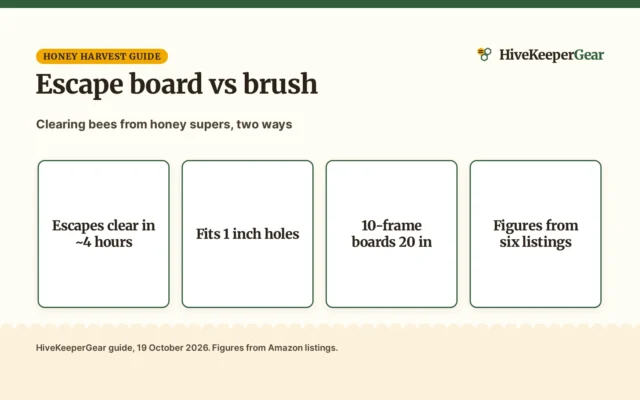
Makers offer boards to fit standard hive dimensions. For example, Little Larue Apiary produces select pine escape boards sized for standard 8-frame hives and 10-frame hives, while ENGAMEGURI offers 10-frame beeswax-coated inner covers measuring 16.25 by 19.92 inches equipped with two bee escape devices. If you use individual Porter-style valves, Little Giant specifies that its plastic escape valve inserts into a 1-inch diameter hole in an inner cover.
Stack your honey supers squarely on top of the escape board. Ensure the edges align perfectly with no gaps between boxes. If your supers have small cracks, cover them with tape or cloth so robber bees cannot enter from the outside. Place the inner cover and outer telescoping lid securely on top of the stack.
5. Remove cleared supers and secure honey
Leave the hive undisturbed while the bees exit the upper boxes. Bees travel downward toward the brood nest and the queen’s scent, passing through the one-way channels. While Boa Cushion notes that bees exit within 24 hours for its board, actual clearing times vary with colony size and weather. Once you verify that the bees have moved down, return to the hive with your protective gear.
Gently lift the outer cover and inner cover to verify that the supers are empty of bees. A few stray bees may remain on comb; you can gently sweep them off with a soft bee brush. Lift the cleared honey supers off the hive and transport them immediately into an enclosed, bee-tight room or vehicle for extraction. Never leave harvested supers sitting open in the apiary, as foraging bees will quickly locate the honey and initiate robbing. Finally, remove the escape board from the hive, replace the normal inner cover, and close the colony.
A harvest clearing timeline
Managing harvest timing ensures smooth super removal without inviting robbers. Day before harvest (late afternoon): Inspect supers, confirm frames are capped, and install the bee escape board beneath the honey boxes. Installing in the late afternoon takes advantage of natural bee movement, as foragers return at dusk and move down toward the brood cluster overnight. Harvest day (within 24 hours): Check the supers. Boa Cushion lists that bees exit within 24 hours for its board; once supers are clear of bees, immediately carry the honey boxes indoors. Processing: Extract honey promptly using your uncapping tools and honey extractor, strain through honey filters into clean pails, and return wet supers to the colonies so bees can clean them before storage.
Helpful gear for honey harvest
- A sturdy hive tool to crack propolis seals between heavy supers without damaging box joints.
- A soft bee brush to gently remove the few remaining bees from cleared honey frames.
- An uncapping fork or uncapping knife to remove wax cappings from comb before extraction.
- A manual or motorized extractor to spin honey from frames without destroying the wax comb foundation.
- A food-grade honey bucket fitted with a gate valve for settling, straining, and clean bottling.
Having all processing gear assembled indoors before pulling boxes keeps the honey harvest clean and prevents outside bees from reaching exposed frames.
What an escape board cannot do
- It cannot clear supers that contain brood. Bees refuse to abandon brood comb, so any honey super containing eggs or larvae will remain populated with nurse bees.
- It does not protect unsealed boxes from robbing. If hive boxes are warped or cracked, robber bees will enter the unattended honey supers from outside.
- It cannot be left on the hive indefinitely. Leaving an escape board in place for several days invites wax moths or allows bees to discover ways back into the supers through loose valve fittings.
- It does not harvest or process honey. Extracting, uncapping, and straining require separate harvesting equipment once boxes are brought indoors.
For health and colony management guidance, consult your local beekeeping association or state extension apiary program.
FAQs for beekeepers
How long should a bee escape board stay on the hive?
A bee escape board should remain on the hive only until the bees clear out. For example, Boa Cushion states its board allows bees to exit within 24 hours, though cooler conditions or larger supers may require additional time. Leaving the board on longer than necessary increases the risk of robber bees finding cracks or pests entering unguarded supers.
Which side of the bee escape board faces up?
The flat side faces upward toward the honey super, while the one-way escape exits or wire valves face downward toward the brood nest so exiting bees move down into the hive bodies below.
Why are bees not clearing out of my honey super?
The most common cause is brood in the honey super, which nurse bees will not leave. Other common reasons include backward board installation, propolis clogging the escape valves, or cool weather keeping bees inactive.
What size bee escape board do I need?
Choose a board that matches your hive box dimensions. Little Larue Apiary offers dedicated boards in standard 8-frame and 10-frame sizes to ensure a flush seal that prevents outside bees from entering.
Can I use an inner cover as a bee escape board?
Yes. Many standard inner covers feature a central hole that accepts a one-way insert, such as the Little Giant Porter-style valve (on Amazon) designed for a 1-inch opening, or inner covers like ENGAMEGURI that include two bee escape devices.
More hive guides
See every honey harvesting guide, explore our honey extractors, uncapping tools, and honey strainers reviews, or browse all beekeeping guides.
More picks: explore our guides to the best honey extractor, best uncapping knife, and best honey strainer. New to beekeeping? Start with our beekeeping equipment list for beginners.