Solar vs Battery Wildlife Camera: Which One Should You Buy?
Solar panels charge while the camera sits in place, while battery cameras run on battery power alone, and the right choice depends on sun, access and how often the camera fires.

On this page
Top picks at a glance
As an Amazon Associate I earn from qualifying purchases.
- 1
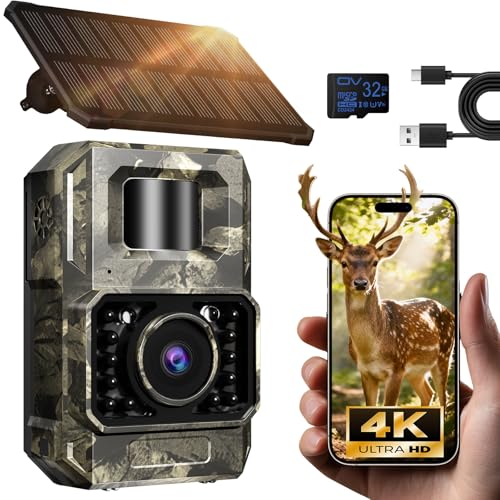 MAXDONE Solar WiFi Trail Camera9.7/10View on Amazon
- 2
 KJK Trail Camera9.6/10View on Amazon
- 3
 CEYOMUR Trail Camera9.5/10View on Amazon
- 4
 WOSPORTS Trail CameraView on Amazon
- 5
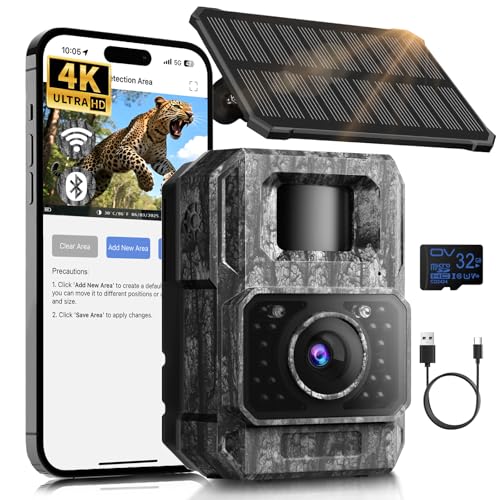 MAXDONE Solar Trail CameraView on Amazon
- 6
 WOSODA 2 Pack Trail Cameras with Night Vision MotionView on Amazon
- 7
 MAXDONE Solar Trail Camera WiFi BluetoothView on Amazon
- 8
 WOSPORTS Mini Trail CameraView on Amazon
- 9
 Trail Camera 4K 60MP Solar WiFi Night Vision Game CamView on Amazon
A wildlife camera only earns its place on a tree or fence post when it keeps watching while you are away, and the power source is a big part of how often you have to visit it. A solar vs battery wildlife camera choice comes down to sun, access and how much motion passes in front of the lens. Solar models can top up their own rechargeable battery when enough sunlight reaches the panel, while battery models run on battery power alone. This guide compares four cameras from the listings: two solar models with rechargeable power, one battery model that also accepts a solar panel, and one two-camera battery pack, ranked by what each listing states about power, trigger speed and night vision.
Other hives and gear to compare
 WOSPORTS Trail CameraCheck price on Amazon
 MAXDONE Solar Trail CameraCheck price on Amazon
 WOSODA 2 Pack Trail Cameras with Night Vision MotionCheck price on Amazon
 MAXDONE Solar Trail Camera WiFi BluetoothCheck price on Amazon
 WOSPORTS Mini Trail CameraCheck price on Amazon
 Trail Camera 4K 60MP Solar WiFi Night Vision Game CamCheck price on Amazon
HiveKeeperGear earns a commission when you buy through links on this site, at no extra cost to you. As an Amazon Associate I earn from qualifying purchases. Affiliate disclosure.
Solar vs battery wildlife camera: the short answer
If the camera sits where sun reaches the panel for part of the day, a solar model with a rechargeable battery needs the fewest battery visits. If the spot is shaded or deep in woods, a battery model is simpler, since there is no panel to aim at the sun. The listings in this guide split the same way: the two MAXDONE cameras carry a 6000mAh rechargeable battery with solar charging, the WOSPORTS camera runs on 8 AA batteries with a solar panel sold separately, and the WOSODA pack holds two battery cameras.
Power is only part of the picture. Trigger speed affects whether a fast-moving animal is caught, and night vision decides whether the night frames show anything useful. The fastest trigger in this set is 0.1-second, listed for the two MAXDONE cameras, while the WOSPORTS camera lists 0.2-second and the WOSODA cameras list 0.3s. Night vision reach runs to 65 ft on the two MAXDONE cameras. The WOSODA cameras list a trigger distance of up to 60ft, which is the range at which motion sets the camera off, not a night vision distance, and the WOSPORTS listing states no night vision distance.
The four cameras at a glance
| Camera | Power | Photos and video | Trigger speed | Night vision |
|---|---|---|---|---|
| MAXDONE PH970S-218 | Solar panel and 6000mAh rechargeable battery | 64MP photos and 4K video | 0.1-second | 65 ft, low-glow infrared |
| MAXDONE PH960W | Solar panel and 6000mAh rechargeable battery | 64MP photos and 4K video | 0.1-second | 65 ft, infrared |
| WOSPORTS G600-4K | 8 AA batteries, or solar panel sold separately | 64MP photos and 4K video | 0.2-second | No-glow IR, 32 IR LEDs |
| WOSODA G200, two-camera pack | Battery power | 48MP photos and 1080P video | 0.3s | Low-glow IR, 850nm |
The table ranks the cameras in the order this guide covers them, from the solar model with the widest detection angle to the two-camera battery pack. The two MAXDONE cameras share the same sensor figures and the same battery size, and they differ mainly in panel design and wireless features.
1. MAXDONE PH970S-218: solar power and a rechargeable battery
The MAXDONE PH970S-218 is the solar camera with the fullest feature list in this set. The listing states 64MP photos and 4K video, a 0.1 s trigger speed, a 130° wide detection angle, a 5-shot burst mode and night vision to 65 ft with low-glow infrared lights. Power comes from a built-in 6000mAh rechargeable battery matched with solar charging panels, and a 32GB micro SD card comes preloaded, with support for cards up to 256GB.
Wireless control runs over WiFi6 and Bluetooth through the camera’s own hotspot, with a connection range within 55 ft and initial pairing within 0.5ft of the camera. The listing is clear that the camera is not compatible with home WiFi and does not support cellular networks. An IP66 waterproof casing covers rain and humid conditions, and the listing adds a time stamp, time-lapse shooting, customizable working hours, audio recording, an adjustable detection zone, loop recording and a password lock. Dimensions are 7.6 inches x 3.9 inches x 2.7 inches, weight is 1.0 pounds, and no warranty term is stated.
2. MAXDONE PH960W: split solar panel and app control
The MAXDONE PH960W shares the 64MP photos, 4K video, 0.1-second trigger speed and 65FT night vision of the camera above, and it pairs the same 6000mAh rechargeable power with a split solar panel design. The panel angle can be adjusted by hand to face the sun, which the listing presents as the way to keep charging steady as the seasons change. Three charging modes are listed: solar charging, Type-C charging and rechargeable power.
The camera creates its own short-range Wi-Fi hotspot for setup and downloading files, with a Wi-Fi range of up to 33-50 ft in open areas, and it pairs with the TrailCamGO app over WiFi and Bluetooth, with a maximum connection range of 55FT and a recommended range within 10FT. The listing states plainly that the camera is not compatible with home WiFi, does not support cellular networks and does not send real-time motion alerts. A 32GB SD card is included and pre-installed, and the camera also lists time-lapse, scheduled shooting, motion detection, a 5-shot burst mode and customizable timestamps, with an IP66 rating for rain and humidity. Dimensions are 3.94 inches x 1.7 inches x 2.64 inches, and no warranty term is stated.
3. WOSPORTS G600-4K: battery power with a solar option
The WOSPORTS G600-4K is the battery-first camera in this set, and it keeps its power options open. The listing states 64MP photos with adjustable resolutions, 4K video, a 0.2S trigger speed, a 120° wide-angle detection range and a 1-3 burst shooting mode. Night vision uses 32 no-glow IR LEDs, and a 2-inch color LCD screen lets you preview photos and videos on the camera without removing the card. Power comes from 8 AA batteries, with a rechargeable lithium battery and a compatible solar panel both sold separately.
One note in the listing is unclear: it mentions a 16GB card and also says the card is not included, so plan on buying a card, with support for cards up to 256GB. The listing also notes a password lock and a time stamp function, and it describes the camera as waterproof. Dimensions are 7.6 inches x 5.0 inches x 3.2 inches. This is the camera to pick when the mounting spot gets little sun and you would rather carry spare cells than rely on a panel.
4. WOSODA G200: two battery cameras in one box
The WOSODA G200 is sold as a 2 pack, so one box covers two mounting spots. Each camera lists 48MP photos and 1080P video, a 0.3s trigger speed and a trigger distance of up to 60ft. Night vision uses 850nm low-glow IR, and the listing includes mounting straps and a stand mount. Two 16GB memory cards are included, with support for cards up to 256GB.
Photo capture runs at 1P or 3P per trigger, and the listing notes that the camera suits monitoring reptiles, cold-blooded animals or amphibians while cutting shots set off by leaves or grass. One detail in the spec table does not match the rest of the listing: the part number is given as Headphones-70, which belongs to a different product type, so trust the title and bullets over that line. The cameras are described as waterproof, with a mimetic appearance that blends into cover. This is the pack to pick when two simple battery cameras cost less attention than one camera with a panel to aim.
How to choose between solar and battery power
Start with the mounting spot. A solar panel needs direct sun on the panel for part of the day, so a camera on a sunny fence post suits a solar model, while a camera deep in shaded woods suits a battery model. The MAXDONE PH960W helps here, since its split panel can be angled to face the sun even when the camera body sits in cover.
Then weigh how often you want to visit the camera. A solar model with a 6000mAh rechargeable battery can top up between visits when its panel gets enough sun, while a battery model such as the WOSPORTS runs on cells you swap when they run down. If the camera sits close to the house, either power source is easy to tend; if it sits far out, solar saves the walk. Check the card too: the two MAXDONE cameras include a 32GB card, the WOSODA pack includes two 16GB cards, and the WOSPORTS camera leaves the card to you.
Finally, match the trigger and night vision figures to the animals you hope to see. A 0.1-second trigger, listed for the two MAXDONE cameras, leaves a fast-moving animal less time to leave the frame, while the 0.3s trigger listed for the WOSODA cameras is the slowest in this set. Night vision to 65 ft, listed for the two MAXDONE cameras, covers a wide clearing, while the trigger distance of up to 60ft listed for the WOSODA cameras is the range at which motion sets the camera off.
FAQs for beekeepers
Do solar wildlife cameras work in shade?
A shaded panel gathers less light than one in open sun, so a solar camera belongs where the panel sees sky for part of the day. The MAXDONE PH960W listing describes a split panel whose angle can be adjusted to face the sun, which helps when the camera body sits in cover.
Can a battery wildlife camera use a solar panel?
The WOSPORTS G600-4K lists a compatible solar panel as a separate purchase, alongside 8 AA batteries and a rechargeable lithium battery sold separately. The two MAXDONE cameras already pair solar charging with a 6000mAh rechargeable battery.
How far away can a wildlife camera see at night?
The two MAXDONE cameras in this guide list night vision up to 65 ft. The WOSODA listing does not state a night vision distance; the 60ft figure it lists is a trigger distance, the range at which motion sets the camera off. The WOSPORTS listing does not state a night vision distance.
Do I need Wi-Fi at the camera site?
No home Wi-Fi is needed. The two MAXDONE cameras create their own short-range hotspot, with a Wi-Fi range of up to 33-50 ft on the PH960W and an app connection range within 55 ft on the two models, while the WOSPORTS and WOSODA cameras have no Wi-Fi at all.
What memory card does a wildlife camera need?
The two MAXDONE cameras include a 32GB card and support cards up to 256GB. The WOSODA pack includes two 16GB cards and also supports cards up to 256GB, while the WOSPORTS camera supports cards up to 256GB but its note on an included card is unclear.
More hive guides
Browse the Wildlife Cameras guides in the Backyard Wildlife category for more camera comparisons, and read our affiliate disclosure for how buying through links on this site works. Also see our cellular vs wifi trail camera. Also see our choose the best trail camera. Also see our best camera for photographing wildlife. Also see our best non-cellular trail camera. Also see our ant farm vs insect observation habitat.
More related guides (70)
- best backyard wildlife camera
- 8×42 vs 10×50 binoculars
- best trail camera for backyard
- tree mount vs ground stake trail camera
- photo vs video trail camera
- bluetooth vs wifi trail camera
- single vs multi chamber bat house
- best outdoor wildlife camera
- best 12v battery for trail camera
- best trap camera with night vision
- best thermal camera for wildlife
- vortex crossfire vs vortex viper binoculars
- spin vs gravity deer feeder
- best bird cam
- 10×42 vs 20×50 binoculars
- 8×28 vs 10×28 binoculars
- best bridge camera for wildlife
- thermal vs night vision monocular
- digital vs analog outdoor thermometer
- rain gauge vs weather station
- waterfall kit vs fountain kit
- best outdoor bird camera
- pond pump vs pond aerator
- corn feeder vs deer feeder
- best compact camera for wildlife
- bird feeder camera vs trail camera
- best cellular trail camera under 150
- 8×30 vs 8×42 binoculars
- bat house vs owl box
- security camera vs wildlife camera
- green backyard bird camera
- bat house vs birdhouse
- motion sensor wildlife camera
- butterfly feeder vs hummingbird feeder
- game camera vs trail camera
- wildlife camera mini
- best wildlife remote cameras
- best binoculars for butterfly watching
- best camera for live streaming wildlife
- best non-cellular trail camera under 100
- best monocular for bird watching
- best cellular trail camera with solar panel
- best monocular with smartphone adapter
- best trail camera for backyard wildlife
- best camera for beginner bird photography
- best camera for bird and wildlife photography
- best trail camera for low signal areas
- best monocular for travel
- best cellular trail camera for security
- best monocular with night vision
- trail camera with viewing screen
- best trail camera for night video
- best trail camera for verizon
- angled vs straight spotting scope
- best monocular for moon
- trail camera for garden
- best trail camera that sends pictures to your phone
- bird camera vs binoculars
- no glow vs white flash trail camera
- cellular vs non cellular trail camera
- thermal camera vs trail camera
- 8×21 vs 10×42 binoculars
- tripod vs monopod for spotting scope
- best 12v battery for trail camera under 40
- butterfly house vs butterfly cage
- bushnell powerview vs nikon monarch
- wild yard owl box
- best trail camera aa batteries
- 10×28 vs 10×32 binoculars
- vortex diamondback hd 10×32 vs 12×50