Where to Buy Mason Bees: Cocoons and Houses
A calm guide to where to buy mason bees as cocoons, and the houses, tubes and sprays that help them settle in your garden.

On this page
Top picks at a glance
As an Amazon Associate I earn from qualifying purchases.
- 1
 Rivajam 150 Mason Bee Tubes with 75 Cardboard Tubes and 759.6/10View on Amazon
- 2
 AukBeeFun 120 Pack Cardboard Mason Bee Nesting Tubes9.6/10View on Amazon
- 3
 POLLIBEE Mason Bee Tubes 120 Pack9.5/10View on Amazon
Late winter is the quiet stretch in the bee yard, when hives sit closed and the work is mostly planning for the season ahead. For gardeners who want gentle pollinators without keeping honey bees, that planning often leads to the question of where to buy mason bees. The short answer is that cocoons come from specialist bee suppliers and garden centres, while houses, tubes and attractant sprays come from garden shops and online listings. Cocoons and housing are bought separately, then put together at home.
HiveKeeperGear earns a commission when you buy through links on this site, at no extra cost to you. As an Amazon Associate I earn from qualifying purchases. Affiliate disclosure.
Before you buy: know what you are buying
Mason bees are solitary bees, which means each female makes her own nest in a hollow tube, with no hive, no queen and no honey crop to manage. What you buy comes in separate parts: the bees themselves, sold as cocoons, and the housing they nest in, sold as a bee house with tubes inside. The cocoons are dormant bees in papery cases, ready to wake when warmth and blossom arrive.
Before ordering, check what the listing actually includes. Some houses arrive with tubes fitted, some arrive empty and need tubes bought separately, and some cocoons arrive loose while others arrive already inside tubes.
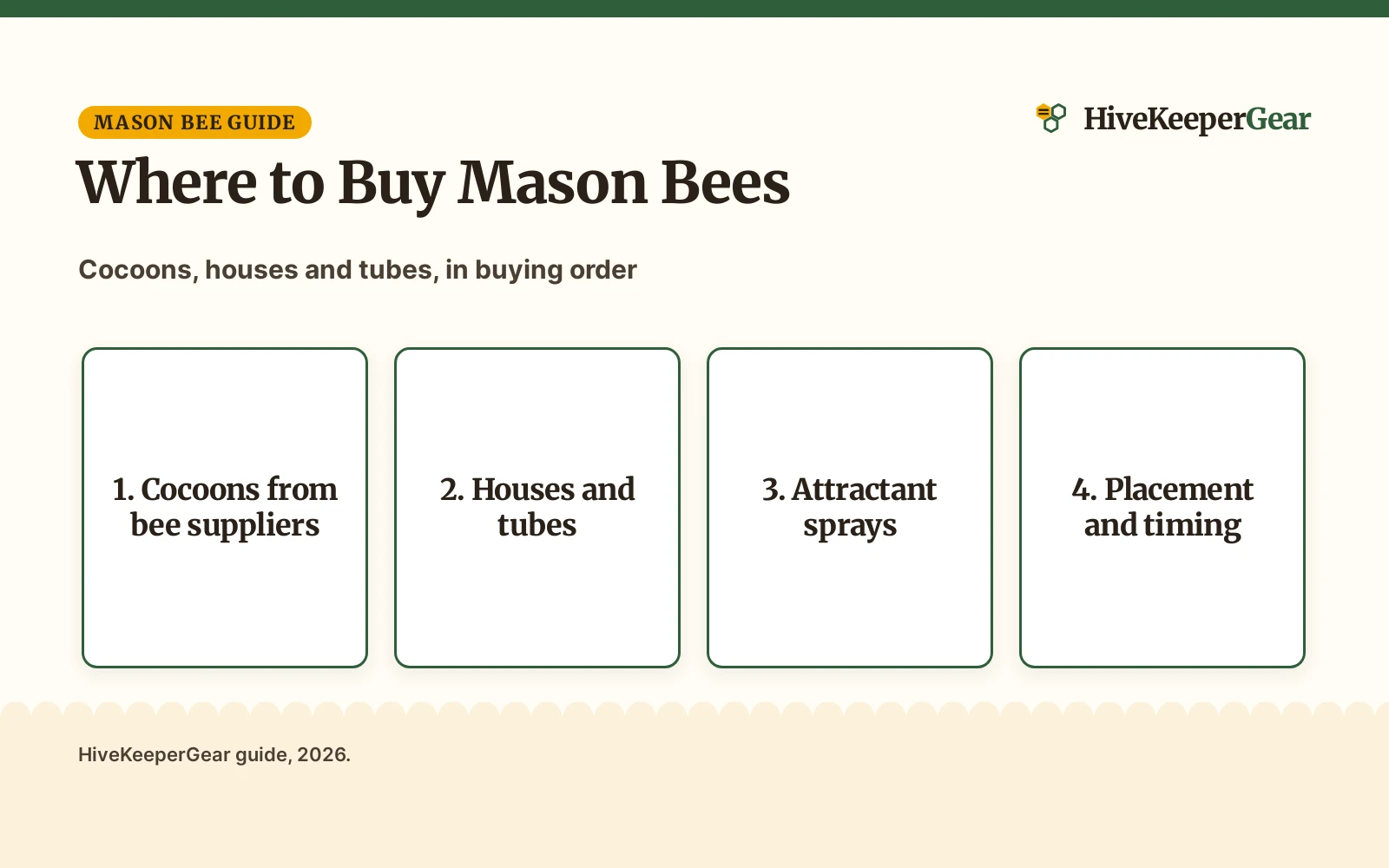
Where to buy mason bees, in buying order
Buy in this order and the parts arrive ready to fit together, with nothing left waiting for a missing piece.
| Step | What to buy | Where to look | Guide |
|---|---|---|---|
| 1 | Cocoons | Specialist bee suppliers and garden centres | Cocoons or tubes |
| 2 | Bee house | Garden shops and online listings | Cedar or pine houses |
| 3 | Tubes and refills | Garden shops and online listings | Tube sizes |
| 4 | Attractant spray | Garden shops and online listings | Mason bee basics |
1. Cocoons
Cocoons are the usual way to buy mason bees, and the usual sellers are specialist bee suppliers, garden centres and nurseries that stock pollinator supplies. Many gardeners order cocoons in the cold months so the bees arrive before the blossom opens. Loose cocoons are the common form: a small bag or box of papery cases that you tip into the house when the season turns.
Ask the seller how the cocoons are packed and whether they are loose or tubed. A loose cocoon order needs a house with clean tubes ready, and a tubed order needs a house the tubes fit.
2. Houses
House listings usually state the size and what is inside. The DoubleFill listing offers a pack with 2 houses, each about 8.27 x 4.92 x 4.13 inches and made of bamboo and wood, with tubes included. The NASIDE house (on Amazon) lists bamboo tubes 3.5 inches long in a house 6 by 6 inches, with a metal wall buckle and a rope for hanging. The Burbell listing offers 2 wooden houses with 294 paper tubes, the tubes 6 inches long with an inner diameter of 8mm, and the houses 18 x 14 x 14 cm with hanging holes on the back.
The choice is often between cedar and pine, or between wood and plastic. The guides compare wood and plastic houses and small and large houses side by side.
3. Tubes and refills
Tubes are the part that wears out, so refills are worth buying with the house. The DOITOOL listing offers a 500-pack of reed tubes, each 5.90 x 1.57 x 0.31 inches, as refills for a house. The Rivajam listing offers a 125-piece pack of paper inserts, 8.27 x 5.9 x 2.56 inches, made to fit inside guard tubes and open for inspection.
Match the refill to the house: a tube that is too long will not sit flush, and a tube that is too short leaves dead space at the back. The guides on reed and bamboo tubes and bee hotels and tubes explain the trade-offs.
4. Attractant sprays and placement
Attractant sprays are sold to lure mason bees toward a new house, and they are the extra that beginners often buy with the cocoons. The Donaldson Farms spray (on Amazon) is a 2oz bottle with lemongrass oil for use near the house. The CAMAS spray comes in a bottle 1.25 x 1.25 x 5.25 inches, with a scent meant to imitate solitary bees near mud, pollen and nesting hives.
Placement matters as much as the spray. The Burbell listing recommends a south or southeast-facing spot, sheltered and well ventilated. Keep a mud source within easy reach of the house. Hang the house firmly so it does not swing. The guide to solitary bee houses and mason bee houses helps with the choice of house shape.
A first-season timeline
Winter: order cocoons and a house, and put the house together indoors where it stays dry. Early spring: hang the house in its chosen spot and set the cocoons inside. Late spring and summer: watch the tubes fill from the back, keep a mud patch damp, and leave the house alone after the bees are working. Fall: take the tubes down, store the cocoons somewhere cool and dry, and clean the house. Winter again: order fresh tubes, repair the house, and plan the next season.
Nice to have later
- Spare tubes, so a damaged insert can be swapped without waiting for an order.
- An extra house, for a garden that grows or a spot that fills fast.
- A notebook to record each visit: what bloomed, what filled, and what to change next season.
- A small dish of mud kept damp near the house, for bees sealing their tubes.
What is not on this list
Honey bee gear is not on this list: mason bees need no hive boxes, no frames, no smoker and no honey extractor, and this guide does not cover honey bee colonies. Packages and nucleus colonies are honey bee stock, not mason bee stock. This guide covers solitary bees only.
FAQs for beekeepers
Where are mason bee cocoons sold?
By specialist bee suppliers, garden centres and nurseries that stock pollinator supplies, in shops and in online listings. Buy the house separately, and check whether the cocoons arrive loose or already inside tubes.
Do mason bees need a house as well as cocoons?
Yes. Cocoons need a shelter with clean tubes to nest in, and a house hung in a sheltered spot gives them that. Tube lengths in the listings here run from 3.5 inches to 6 inches, so match the tube to the house.
When should cocoons be put outside?
In early spring, when blossom is open and the days are warm enough for bees to fly. Cocoons ordered in the cold months can wait in cool storage until then.
Do attractant sprays help mason bees find a new house?
Sprays are sold for that purpose, and the Donaldson Farms listing offers a 2oz spray with lemongrass oil for use near the house. A spray is a helper, not a promise: placement, mud and blossom matter more.
Should tubes be replaced each season?
Fresh tubes each season keep the nest clean and give each female a clean start. The DOITOOL listing describes its 500-pack as a refill supply for seasonal replacement, and the Rivajam 125-piece (on Amazon) pack is sold as refills for that purpose.
More hive guides
Browse the mason bee guides: mason bee houses and bee hotels, wood and bamboo bee hotels, bee houses for leafcutter bees and bee hotel bamboo tubes.