Complete Beehive Kit vs Unassembled Hive: Which One Should You Buy?
Compare complete beehive kits and unassembled hives to decide whether an all-inclusive wooden starter setup or modular flat-pack boxes fit your beekeeping plans.

On this page
Top picks at a glance
As an Amazon Associate I earn from qualifying purchases.
- 1
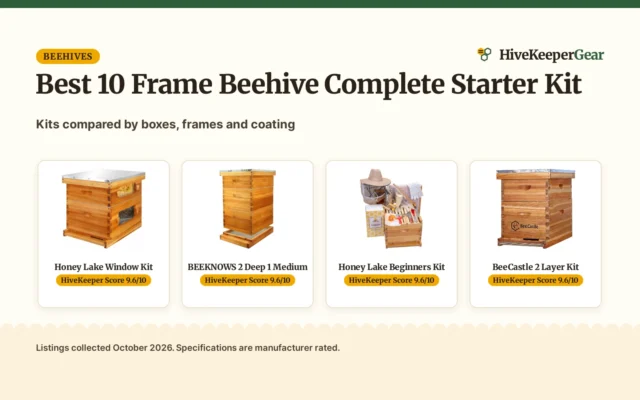
 BeeCastle 10-Frames Complete Beehive Kit9.6/10View on Amazon
- 2
 BeeCastle Unassembled 10-Frame Deep Brood Box with Frames and9.4/10View on Amazon
- 3
 10-Frame Bee Hive Complete Beehive Kit Beeswax Coated BeehiveView on Amazon
- 4
 10 Frame Bee Hive Box KitView on Amazon
- 5
 5 Frame Nuc Complete Bee Hive Kit Langstroth Beehive BoxView on Amazon
- 6
 10-Frame Langstroth Bee Hive Complete Bee Hive Kit BeeswaxView on Amazon
- 7
 POLLIBEE 8 Frame Beehive kitView on Amazon
When deciding between a complete beehive kit vs unassembled hive, choose a complete beehive kit if you are establishing a new apiary and need every matched component, from bottom boards and covers to frames and foundation, in a single order before bees arrive. Choose an unassembled hive box or standalone components if you already own spare hive parts, want to spread purchases across the season, or prefer selecting box depths individually.
Other hives and gear to compare
 10-Frame Bee Hive Complete Beehive Kit Beeswax Coated BeehiveCheck price on Amazon
 10 Frame Bee Hive Box KitCheck price on Amazon
 5 Frame Nuc Complete Bee Hive Kit Langstroth Beehive BoxCheck price on Amazon
 10-Frame Langstroth Bee Hive Complete Bee Hive Kit BeeswaxCheck price on Amazon
 POLLIBEE 8 Frame Beehive kitCheck price on Amazon
 BeeCastle 10-Frames Complete Beehive KitCheck price on Amazon
HiveKeeperGear earns a commission when you buy through links on this site, at no extra cost to you. As an Amazon Associate I earn from qualifying purchases. Affiliate disclosure.
Complete beehive kit vs unassembled hive: core differences
Many beginners assume a complete kit arrives assembled, while an unassembled hive requires carpentry. In practice, almost all wooden hives sold online arrive as flat-pack lumber regardless of tier, because shipping assembled boxes creates bulky parcels prone to joint damage. Both options require assembly with glue and fasteners.
The real difference lies in package completeness. A complete kit provides the full stack needed to establish a colony, whereas an unassembled hive usually refers to purchasing individual boxes, supers, or frame packs as needed. Our guide to assembled vs unassembled bee hives explains the difference between factory-built and flat-pack woodwork.
| Comparison Factor | Complete Beehive Kit | Unassembled Hive Boxes |
|---|---|---|
| Included Parts | Full stack with bottom board, boxes, frames, foundation, and covers | Individual boxes, supers, or frame packs bought separately |
| Assembly Required | Flat-pack boxes and frames assembled in one session | Flat-pack panels and frames assembled as needed |
| Fasteners Included | Full set of screws, nails, or pre-drilled joint holes | Fasteners included per box pack or supplied by keeper |
| Dimensional Match | Uniform factory width and standard cuts across all tiers | Verify width and dimensions across makers before stacking |
| Upfront Planning | All primary equipment arrives in one shipment | Boxes added as brood expands and honey storage grows |
| Recommended For | Beginners setting up their first colony | Keepers replacing aging boxes or making splits |
What comes inside a complete beehive kit
A complete beehive kit provides every wooden and protective element needed to house a colony from spring buildup through honey storage, ensuring each tier interlocks cleanly.
A standard complete kit typically includes:
- Telescoping outer cover: A roof cap with galvanized metal shielding the hive from weather. See our guide to telescoping covers.
- Inner cover: A wooden board under the outer lid aiding airflow and preventing propolis sealing.
- Honey supers: Medium wooden boxes for honey storage. Compare depths in our guide to deep vs medium hive boxes.
- Queen excluder: A barrier keeping the queen in brood boxes while letting workers into supers. Compare styles in our guide to metal vs plastic queen excluders.
- Deep brood boxes: Wooden bodies housing the colony nursery and food stores.
- Frames and foundation: Wooden frames with waxed inserts for comb building. Compare options in our guide to wax-coated vs bare plastic foundation.
- Bottom board: The hive base supporting the stack. Compare designs in our guide to screened vs solid bottom boards.
- Entrance reducer: A wooden bar adjusting the front entrance opening.
Manufacturer listings show how complete packages are configured. POLLIBEE lists a 10-frame 4-layer kit that includes 2 deep brood boxes measuring 19-7/8 by 16 by 9-5/8 inches and 2 medium super boxes measuring 19-7/8 by 16 by 6-5/8 inches, along with 20 deep frames, 20 medium frames, 1 bottom board, 1 inner cover, 1 metal top cover, 1 entrance reducer, and 1 queen excluder. BEEINN lists a 10-frame complete kit with 2 deep brood boxes measuring 16-1/4 by 19-7/8 by 9-5/8 inches and 2 medium super boxes measuring 16-1/4 by 19-7/8 by 6-5/8 inches, with cedar wood hive boxes, pine wood frames, 1 metal top cover, 1 inner cover, 1 solid bottom board, 1 entrance reducer, and 1 queen excluder. ThxBees lists a 10-frame complete kit with 1 deep brood box and 1 medium super box, containing 10 deep frames, 10 medium frames, 1 solid bottom board, 1 entrance reducer, 1 inner cover, 1 top cover, and 1 queen excluder, weighing 44 pounds. Hoover Hives lists a 10-frame kit with 1 deep brood box and 1 medium super box weighing 45 pounds, coated in 100% natural beeswax. Explore our roundup of 10-frame beehive kits for complete setups.
What an unassembled hive component package includes
When purchasing an unassembled hive rather than a complete kit, beekeepers typically buy standalone hive bodies, supers, or frame packs. This modular approach allows keepers to replace worn equipment, expand apiaries, or build gear on a flexible schedule.
An unassembled box package generally contains only exterior wall panels, matching internal frames, plastic foundation sheets, and fasteners. It excludes bottom boards, inner covers, metal-capped outer covers, and entrance reducers, meaning you must already own those parts or buy them separately.
Listings illustrate these modular packages. MayBee lists an unassembled 10-frame deep brood box constructed with cedar exterior parts cut to industry standard dimensions, supplied with 10 pine deep frames and 10 food grade plastic foundation sheets dipped in beeswax. For honey super expansion, BeeCastle lists an unassembled 8-frame medium super box that includes 3 wooden panels, 1 acrylic observation window, 2 bolts, and 8 frames with beeswaxed foundations. For replacement woodwork, browse our guide to beehive frames.
Assembly process, wood joints, and hardware
Because complete kits and standalone unassembled hives arrive as flat-pack lumber, proper assembly ensures durable gear. Beehives endure sun, rain, humidity, and winter winds, so square assembly prevents drafts that stress colonies.
Quality wooden hive components use precision-cut dovetail joints at each corner. Dovetail fingers interlock tightly, distributing load and resisting weather warping. Makers like ThxBees and BEEINN feature pre-cut dovetails and pre-drilled holes with included screws, while MayBee provides pre-cut dovetails with nails for assembly.
Apply exterior waterproof wood glue to dovetail fingers before joining. While screws or nails provide clamping pressure, glue seals against moisture. Use a rubber mallet to seat fingers without denting wood, and check that boxes are square by measuring diagonal corners. Once boxes are fastened, assemble wooden frames with glue and drive small nails through frame joints to support comb weight.
Wood choice also affects longevity. Cedar provides natural rot resistance, while pine offers rigid framing lumber. Learn more in our guide comparing cedar vs pine beehives, and read about coatings in our guide to wax dipped vs painted beehives.
Sizing standards: 10-frame vs 8-frame Langstroth hives
Selecting hive width is a fundamental choice because 10-frame and 8-frame components cannot be interchanged on the same stack.
A 10-frame hive is the North American standard, providing wider boxes that hold 10 frames for generous brood space and honey storage. However, full 10-frame boxes become heavy to lift during inspections. For keepers wanting lighter equipment, 8-frame boxes offer a narrower footprint holding 8 frames per box.
Listings reflect these dimensions. POLLIBEE and BEEINN list 10-frame deep brood boxes measuring 16 inches or 16-1/4 inches wide by 19-7/8 inches long by 9-5/8 inches deep. In contrast, MayBee lists an 8-frame complete kit with 2 deep boxes measuring 14 by 19-7/8 by 9-5/8 inches and 2 medium supers measuring 14 by 19-7/8 by 6-5/8 inches, with 16 frames per size and an item weight of 49 pounds. Because 8-frame equipment is narrower (such as MayBee listing 8-frame boxes at 14 inches wide versus POLLIBEE at 16 inches and BEEINN at 16-1/4 inches), boxes, covers, and bottom boards from the two widths cannot be mixed. Review our guides to 10-frame beehive dimensions, 8-frame hive dimensions, and 8-frame beehive kits before ordering.
Cost considerations and seasonal timeline
Choosing between complete kits and unassembled components balances upfront investment against seasonal timing.
A complete kit requires a larger single payment upfront, but bundles all required components into matched packaging. This eliminates last-minute orders for missing covers or reducers before bees arrive and saves on freight compared to shipping individual cartons. Beginners wanting an all-in-one package can also look into beekeeping starter kits combining hives with tools and smokers.
In contrast, buying unassembled components spreads expenses across the calendar. A new package colony only needs one deep brood box and frames during early comb development. Keepers can buy one deep box in winter, assemble it, and buy a second deep box or medium super later in the season as the brood nest expands. However, order expanding supers well ahead of the nectar flow to avoid crowding or swarming.
FAQs for beekeepers
Do complete beehive kits arrive already assembled?
Almost all complete beehive kits sold online arrive flat-packed to reduce shipping bulk and prevent damage. Keepers must assemble boxes, fasten joints, and insert foundation into frames before bees arrive.
How long before bees arrive should I assemble my hive?
Assemble equipment several weeks before bees arrive. Early assembly gives waterproof glue time to dry, lets painted surfaces air out, and ensures everything is organized for installation.
Can I add unassembled boxes from different brands to my complete kit?
Yes, provided frame widths match. Most Langstroth boxes share standard lengths, though minor exterior widths vary slightly (like 16 versus 16-1/4 inches on 10-frame boxes), so verify exterior dimensions before stacking.
Is it more economical to buy a complete kit or individual unassembled boxes?
A complete kit is usually more economical for beginners because bundled shipping and package pricing cost less than buying parts separately. Individual boxes suit keepers who already own spare covers and bottoms.
Should a beginner choose a 10-frame or 8-frame hive kit?
Choose 8-frame kits for lighter boxes that ease lifting during inspections. Choose 10-frame kits for maximum brood capacity and the widest accessory compatibility.
More hive guides
Browse every guide by category: beehives, protective gear, hive tools and honey harvesting.
More guides: assembled vs unassembled bee hives, 10-frame beehive kits, 8-frame beehive kits, and cedar vs pine beehives. New to beekeeping? Start with our beekeeping supplies for beginners checklist.