Fir vs Spruce Beehive: Which One Should You Buy?
This guide answers the fir vs spruce beehive question from what listings state: fir on one hive, wax-dipped cedar on two others, and no spruce anywhere in the set.

On this page
The fir vs spruce beehive question usually comes up when a keeper is choosing wooden boxes for a new colony or replacing weathered ones. A fair answer starts with what hive listings actually state, since wood species, coatings and box counts are all written down in the listing. In this set, no listing states spruce, so the choice the listings support is fir against cedar, with pine in the frames and plastic in the stand set. This guide walks through those listings as written, so the decision rests on stated facts rather than assumptions.
HiveKeeperGear earns a commission when you buy through links on this site, at no extra cost to you. As an Amazon Associate I earn from qualifying purchases. Affiliate disclosure.
The fir vs spruce beehive question, answered from the listings
The set holds a hive whose spec table states Fir Wood, hives whose listings state cedar wood dipped in beeswax, and a stand set made of plastic. Spruce appears in none of the titles, bullets or spec tables. That absence is itself the answer to the focus question: among these listings there is no spruce side to compare, so a keeper shopping this set chooses between a stated fir hive and stated cedar hives. The table below puts the stated facts side by side.
Side by side: what each listing states
| Hive | Wood stated | Finish | Boxes and frames | Dimensions stated | Warranty stated |
|---|---|---|---|---|---|
| Honey Keeper Beehive 20 Frame Complete Box Kit | Fir Wood | non-waxed | 1 deep box, 1 medium box; 20 frames (10 deep, 10 medium) with plastic foundations | 18.25 x 18.25 x 19.75 inches; 19.5 pounds | 90 Day Limited Manufacturer Warranty |
| BEEKNOWS Screened Bottom Board Beehive Kit | cedar | beeswax coated | 2 deep boxes, 1 medium box; 10 deep and 10 medium frames with beeswax coated plastic foundation | medium 19-7/8″ x 16-1/4″ x 6-5/8″; deep 19-7/8″ x 16-1/4″ x 9-5/8″ | Not stated |
| BEEKNOWS Unassembled Langstroth Beehive Kit | cedarwood | heavy beeswax coating | 1 deep box, 1 medium box; 20 frames (10 deep, 10 medium) with beeswax coated plastic foundation | package 22 x 17.98 x 9 inches; 46 pounds | Not stated |
| DECOHS Beehive Stands | plastic | moisture resistant | stand set, not boxes; no frames included | 4.4 x 4.4 x 3.4 inches; 1.28 pounds | Not stated |
The BEEKNOWS screened bottom board kit carries a contradiction worth noting: its bullets list 10 medium frames and 10 deep frames, while its spec table lists Frame Quantity as 16 Pcs. This site’s rules trust the title and bullets over the spec table, so the table above uses the bullets’ frame count. Keepers reading that listing should ask the maker which count is right before ordering.
Fir, as stated by the Honey Keeper listing
The Honey Keeper Beehive 20 Frame Complete Box Kit is the fir entry in this set. Its spec table gives the color as Fir Wood and the style as non-waxed, with premium solid wood construction stated in the bullets. The kit holds 20 frames with plastic foundations: 10 deep brood frames and 10 medium super frames, matching one deep box and one medium box. The listing states a telescoping cover of heavy-duty galvanized metal, a bottom board, a notched wooden entrance reducer that is removable, and a flat plastic queen excluder. Stated dimensions are 18.25 x 18.25 x 19.75 inches at 19.5 pounds. It is also the only listing in the set that states a warranty term: 90 Day Limited Manufacturer Warranty. Keepers comparing fir options can also read the pine vs fir beehive guide and the cedar vs fir beehive guide for the wood-by-wood contrast.
Cedar and beeswax, as stated by the BEEKNOWS listings
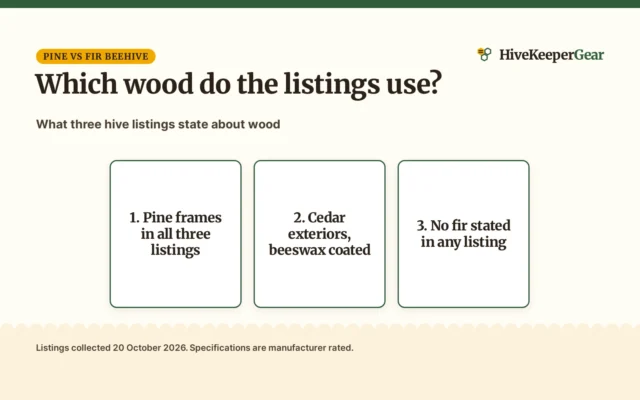
Both BEEKNOWS kits state cedar wood exteriors coated with beeswax, with the unassembled kit describing a heavy beeswax coating for durability. The plastic foundation sheets are beeswax coated in both kits, and the frames are stated as pine wood in the screened bottom board kit’s spec table. Both kits state dovetail joints and pre-drilled holes for assembly. The box dimensions match across both kits: the medium super is 19-7/8″ x 16-1/4″ x 6-5/8″ and the deep brood box is 19-7/8″ x 16-1/4″ x 9-5/8″. The differences sit in the parts list: the screened bottom board kit holds 2 deep boxes and 1 medium box with a screened bottom board, metal top cover and inner cover, while the unassembled kit holds 1 deep box and 1 medium box with a solid bottom board, ships unassembled, and states an item weight of 46 pounds with package dimensions of 22 x 17.98 x 9 inches. Neither listing states a warranty term. For the coating question, see wax dipped vs painted beehive; for the floor choice, see screened vs solid bottom board.
Where the DECOHS stands fit
The DECOHS listing is not a hive at all: it is a stand set of plastic feet, 3 sets of 4 pieces for a total of 12 pieces. The listing states moisture resistance, dimensions of 4.4 x 4.4 x 3.4 inches and a weight of 1.28 pounds. Its bullets describe a cover that closes to keep bees from falling into water and a water tray that blocks ants and other insects from reaching the hive. As support gear it belongs under any wooden hive in this set, since a stand lifts the bottom board off damp ground and distributes the hive’s weight evenly.
Reading wood specs before you buy
A few habits keep the choice honest. First, read the stated material line: fir, cedar, pine or plastic should be written in the title, bullets or spec table, and anything else is an assumption. Second, note the finish: non-waxed fir leaves the protection decision to the keeper, while the beeswax coating on the cedar kits is stated as part of the listing. Third, match the frame count to the boxes: 10 deep and 10 medium frames fill 1 deep and 1 medium box, so note that the screened bottom board kit states 2 deep boxes but only 10 deep frames, which stocks one deep box. Fourth, note whether the kit ships assembled or unassembled and whether the warranty line is concrete. The set’s Langstroth kits are worth comparing with the best Langstroth hive roundup and the complete beehive kit vs unassembled hive guide.
FAQs for beekeepers
Does any listing here state a spruce beehive?
No. The woods stated in this set are fir (Honey Keeper), cedar (both BEEKNOWS kits) and pine (frames in the screened bottom board kit); the DECOHS listing is plastic stand gear. If a spruce hive matters to you, look for a listing that writes the word spruce in its material line.
Which listing states fir wood?
The Honey Keeper Beehive 20 Frame Complete Box Kit. Its spec table lists the color as Fir Wood and the style as non-waxed, and it is the only listing in the set that states a warranty term: 90 Day Limited Manufacturer Warranty.
What is the beeswax coating on the cedar hives?
Both BEEKNOWS listings state cedar wood exteriors coated with beeswax, with the unassembled kit calling it a heavy beeswax coating, and both state beeswax coated plastic foundation sheets.
Do any of these listings state a warranty?
Only the Honey Keeper listing states a warranty term, 90 Day Limited Manufacturer Warranty. The BEEKNOWS kits and the DECOHS stands state no warranty term, so treat the warranty as not stated for those.
Which kit includes a screened bottom board?
The BEEKNOWS kit titled with Screened Bottom Board Dipped in Heavy Beeswax includes 1 screened bottom board along with 2 deep boxes and 1 medium box. The other BEEKNOWS kit includes a solid bottom board.
More hive guides
See all beehive guides, the Langstroth hive guides, the hive frame guides and the beekeeping guide archive. Also see our wooden vs metal queen excluder. Also see our hive tool vs uncapping knife. Also see our beeswax block vs beeswax sheets. Also see our glass vs plastic spray bottle for beekeeping. Also see our mason bee house diy.